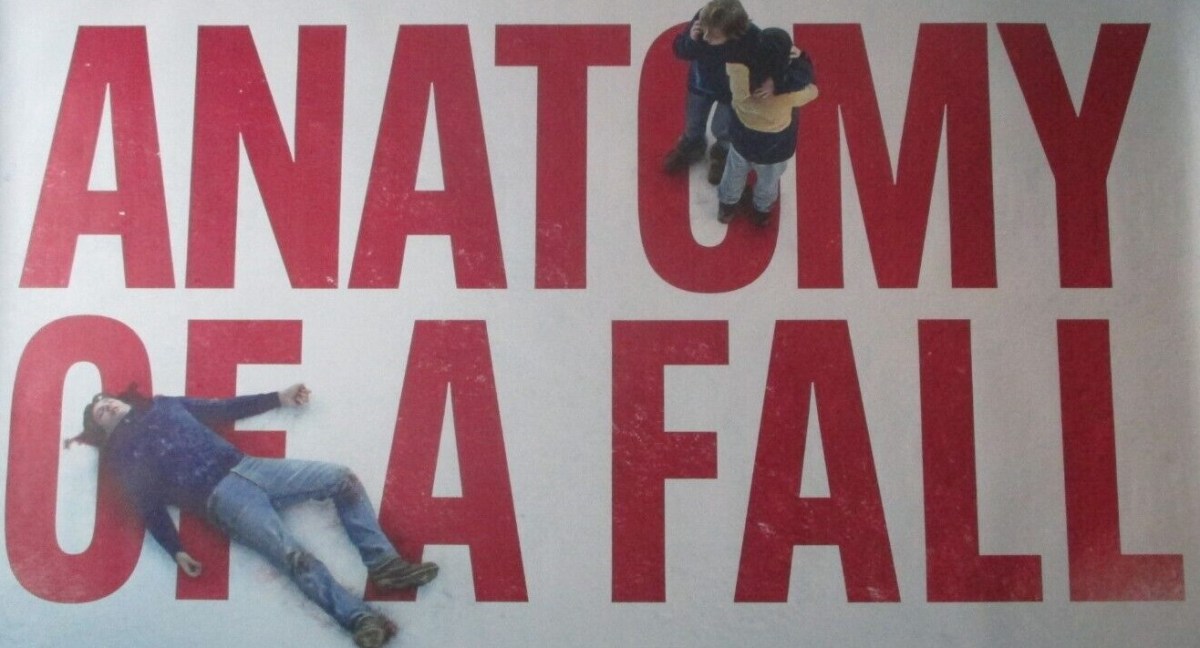
I hate it when a mystery movie so blatantly cheats. Sure, we expect some sleight of hand, some vital piece of evidence retained, for the purposes of maintaining high tension, till the very end. Or a twist, a la Jagged Edge (1985), when a murderer, having got off scot-free, is revealed as the killer after all.
And while the central performances of accused, bisexual respected author and mother Sandra (Sandra Hueller), and accuser, smug unnamed prosecutor (Antoine Reinartz), are excellent and the exposition of the psychology of a marriage is well done, still the omission of the kind of critical forensic evidence that a modern audience would require works against the end result. Because otherwise, it plays like a 1940s courtroom drama, where the emphasis is solely on character rather than the weight of evidence.
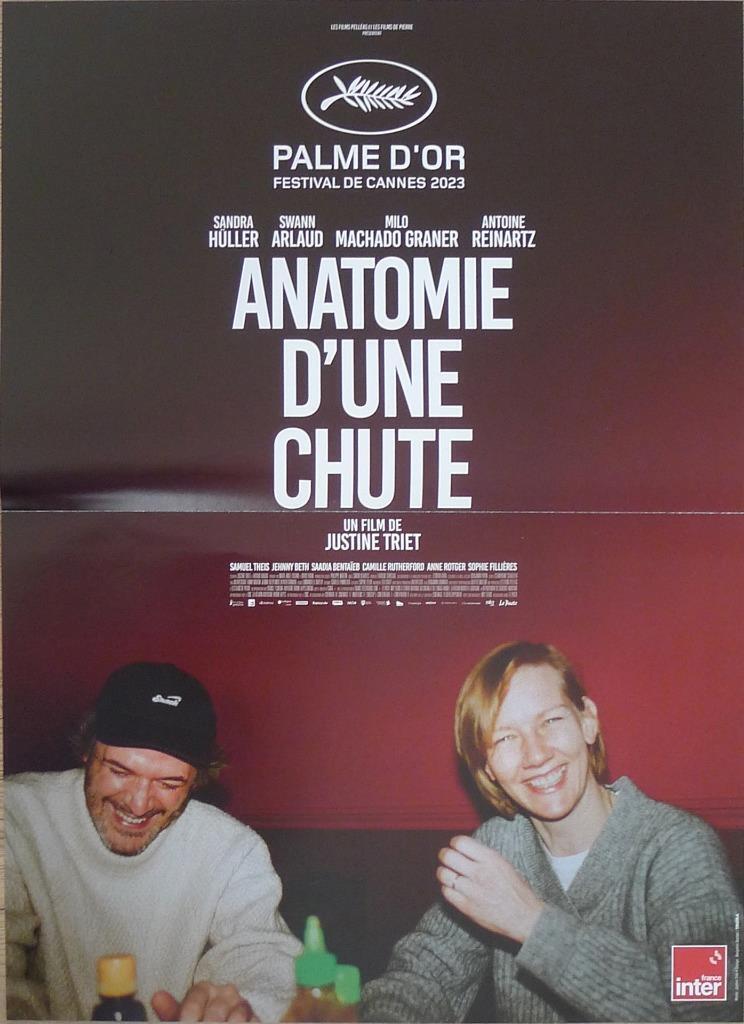
So, here’s my complaint. The dead man has fallen from a window. Did he jump or was he pushed? Using forensics, the prosecution maintains he was hit by a heavy blow and some of the blood spatters down below were consistent with him losing blood when he was falling rather than when he hit the ground.
So we spend a great deal of time on examining how the body might fall and accounting for the blood, all of which appears to go against the accused, who is revealed as a not-so-nice person, possibly a sexual predator, possibly controlling, certainly a cheat – taking lovers while married and a heinous spot of plagiarism from her unpublished wannabe writer husband.
Only at the very end, when the half-blind child enters the loft space from which the father fell, do we realize that it would be impossible for this to be murder unless there was more evidence pointing to that eventuality. If the movie – prosecution and defence equally guilty of overlooking the obvious – had spent a couple of minutes on the loft space both would have come to the conclusion not so much that murder could be counted out but that there would be clear evidence of it.
The window is pretty small and an odd shape. But there was no evidence of a struggle, no scratches on the wood or glass, no tiny shred of material, and for the questionable spatters to end up where they did, the victim had to fall out backwards. So that means he needs to be pushed from the front and make no effort to save himself. The more obvious means of disposing of him – being thumped on the head from the back – was not consistent with the way he fell. And in any case, the space available for the wife to hit him with some heavy object would have meant leaving some evidence of that.
So, while it was certainly overlong, and could do with losing a good 15-30 minutes, I was happy to go along with the tale, held together as it was by the superlative performances and the usual courtoom duelling, though taking the last-minute evidence presented by the young boy as conclusive proof the father committed suicide seemed a step too far.
As a dissection of a marriage, of expectations of roles, and especially of the propensity for a failure to blame everyone else for their failings, it gets top marks. But it wears out its arthouse credentials by ignoring the forensic obvious.
I can’t also be the only one really annoyed that this Oscar-nominated performance basically skipped cinematic release. As far as I can work out, it was shown for one week in an arthouse in my neck of the woods way back last year and despite the Oscar nomination didn’t resurface except for a money-grab one-day showing two days (i.e. last night) before the Oscar ceremony. Like Maestro, it’s taken the streaming dollar and run, rather than allowed cinematic word-of-mouth to do what cinematic word-of-mouth is meant to do and build a groundswell of positive opinion prior to the awards.
So, yes, watch it for the psychology and the Oscar-worthy performance but don’t expect a contemporary approach to the mystery.


I liked this more than you, but then I didn’t take quite as phorensic approach to the crime-scene; I was just wowed by how the lawyers in French courts seems to dress like superheroes.
LikeLiked by 2 people
And they clearly didn’t watch British or Hollywood movies – no objection sustained. No bills for wigs either.
LikeLiked by 1 person
You seem to have been unlucky with your local cinemas. This title appears to have been distributed in the UK through a link-up between Picturehouses Entertainment and Lionsgate. In my part of the UK (i.e. West Yorkshire), the film was available in various cinemas over a period of around three months (admittedly often just for one or two showings in some cinemas). It showed in both multiplexes and specialised cinemas. It wasn’t, as far as I am aware, available to stream before that cinema run was nearly completed.
LikeLiked by 3 people
I did notice when I was googling it that there were regular ongoing showings in London but I didn’t realize Yorkshire was being better served than Glasgow.
LikeLiked by 2 people
Hello Brian,
Our opinions agree on this film, in my opinion very overrated, a very questionable Palme d’Or. I do admit some undeniable formal qualities (the editing in particular which was rewarded in France and which could well also be at the Oscars) but I am less enthusiastic about the script and the direction. The trial is well conducted but the body of evidence is indeed very weak. I like the idea of the blind child who comes to shed light on the truth. And the dog does a great job. Other than that, … it’s too long, exactly.
LikeLiked by 3 people
I was surprised in retrospect it did so well at Cannes. The acting yes, the film no.
LikeLiked by 2 people
I’ll chuck my hat into the ring. I get that this isn’t a flawless murder mystery, but it’s meant to be a drama, and the last forty minutes barely goes near a courtroom. The mystery element is less important than the human story; I get why critics, including myself, sell this movie for the procedural elements, but they are secondary.
LikeLiked by 2 people
I liked the drama but just fellt cheated when at the end they showed the loft. And I did wonder if the boy got the mother off so he wouldn’t effectively be orphaned.
LikeLiked by 1 person
Yes, and there are ambiguities like that which are not pinned down as a murder mystery would…
LikeLiked by 2 people
I quite liked the ambiguity and the family secrets emerging the way they do in a mystery.
LikeLike
I largely preferred another zone of interest 😉
LikeLiked by 2 people
This is true, but the film also shows how justice invades the house, with the chaperone played by Jehnny Beth always near the boy. What deeply bothered me was the very personality of the couple, locked in their little world, centered around their little intellectual ego.
LikeLiked by 1 person
They wer enot an attractive couple, dtermined to be insular even when isolation clearly didn’t work for them. You felt for the little boy,
LikeLiked by 1 person
I was looking forward to this. I’ll temper my expectations.
LikeLiked by 1 person
Well, it’s now got an Oscar accolade, so maybe i’m wrong.
LikeLike
An excellent review. It seems as though I enjoyed this film far more than you did. I thought this was a mesmerizing murder mystery with immense emotion. Having witnessed relatives endure divorce, it was easy for me to connect with the film’s message. Sandra Huller was an incredible presence in the lead role. I didn’t have any issues reading subtitles either. I think this was fully deserving of its accolade. Here is why I loved it:
LikeLike