You might be surprised to learn that by Hollywood standards the recent self-elective dualing of Barbie and Oppenheimer was a perfect double bill. Not because it resuscitated an old distribution ploy but that the two films would have been viewed in the 1960s as an ideal pairing. A program comprising two completely different pictures was seen as the best way to attract an audience.
You might also be under the misapprehension that until the dominance of the single-film program from the 1980s onwards an outing to the movies always involved seeing two movies. But that wasn’t the case at all and studios fought a hard battle against a trend, beginning in the United States in 1930s especially in cities like Chicago, of demanding a program comprising two films rather than one.

were often made with that purpose in mind.
But by the 1960s, except in their initial publicity-driven outings in the giant seating arenas in the likes of London, Paris, New York, Rome, Chicago etc, films that went out on subsequent release were often accompanied by a supporting feature well above the caliber of the B-pictures that had saturated the previous decades. In the 1940s and 1950s, for example, most double bills, while complying with the three-hour dictat for a reasonable night out, were rarely value-for-money, usually composed of a main feature and a much inferior cheaper B-movie, often a series western or crime movie.
It was only in the 1960s, when B-film production all but vanished, that cinemas began to offer what you might call a decent value-for-money package. Though, if you looked beneath the lines, you might discover that one of the offerings was being offloaded after flopping in initial opening.
Not surprisingly, at the start of the 1960s, with movie production in terminal decline, the last thing studios wanted to do was to use up their scant supplies too soon. Double bills could also limit box office. Shown on its own, a single feature could generate four or five showings a day. Teamed with another movie, exposure was reduced to two, maybe three, complete programmes a day depending on venue and location. The supporting feature generally played for a fixed rental rather than a percentage, so income was further reduced.
U.S. chains tended to be regional rather than national so it’s hard to get an idea from them of the importance double bills played in the national consciousness. On the other hand, Britain boasted two national circuits, ABC and Odeon, and examination the programmes put out there give a better idea of the role double bills had in cinemas.

Considerable thought went into allocating partners, studios, rather than cinemas, responsible for the arriving at the ideal mix. Except for a horror pairing, appealing to a specific adult market, the perfect double bill was deliberately wide in its aim, attempting to scoop up business from different sectors of the population, perhaps on a sexist basis. For example, a drama targeting women might be paired with a western attracting men. This kind of thinking accounted for some of what you might consider oddities of programming.
On the UK’s ABC circuit, for example heist picture They Came To Rob Las Vegas (1969) went out as the main attraction with Sandy Dennis romantic drama Sweet November (1969); Angie Dickinson romance Lovers Must Learn (aka Rome Adventure, 1962) with violent Sam Peckinpah western The Deadly Companions (1961); Faye Dunaway-Rossano Brazzi tragic romance A Place for Lovers (1969) with Glenn Ford western Heaven with a Gun (1969); and the sixth iteration of The Man from U.N.C.L.E. series The Karate Killers (1967) with Alexander Mackendrick’s Californian beach comedy Don’t Make Waves (1967) starring Tony Curtis and Claudia Cardinale.
Other times, there was clearly an element of making the best of a bad job, how to otherwise explain thriller David McCallum in non-U.N.C.L.E. thriller The Heroin Gang (aka Sol Madrid, 1968) – the main attraction – being matched with David Niven-Deborah Kerr occult oddity Eye of the Devil, which had been sitting on the shelf for two years; Ann-Margret showcase The Swinger (1966) with Rock Hudson sci fi Seconds (1966) directed by John Frankenheimer; and French sex romp Benjamin (aka Diary of an Innocent Boy, 1968) with the violent prison-set Riot (1969) starring Jim Brown and Gene Hackman.

The only genre, outside of horror, that accommodated the double bill was comedy as seen through the teaming of Who’s Minding the Store (1963) starring Jerry Lewis and Jill St John and Who’s Been Sleeping in My Bed (1963) with Dean Martin; Jerry Lewis again in The Patsy (1964) with Robinson Crusoe on Mars (1964); and Tony Curtis starrer Drop Dead Darling (aka Arrivederci, Baby, 1966) with Warren Beatty and Leslie Caron in Promise Her Anything (1966).
Some Elvis Presley musicals were considered too lightweight to be released without a support – It Happened at the World’s Fair (1963) was bracketed with swashbuckler Swordsman of Siena (1962) starring Stewart Granger; Kissin’ Cousins (1964) with Pat Boone comedy Never Put It in Writing (1964); Tickle Me (1965) with Soldier in the Rain (1963) – only given a full release two years after completion due to star Steve McQueen’s increasing popularity; California Holiday (aka Spinout, 1966) with sword-and-sandal epic Hercules, Samson and Ulysses (1963); and Double Trouble (1967) with western Hondo and the Apaches (1967), a feature stitched together from two episodes of TV series Hondo. Others Elvis pictures were deemed quite capable of looking after themselves at the box office – Girls! Girls! Girls! (1962), Roustabout (1964), and Easy Come, Easy Go (1967), for example, released as single bills.

Some programs seemed terrific value for money, films that individually might struggle to find an audience, but together seemed a worthwhile visit. I would have been quite happy to line up for any of the following: John Ford western Sergeant Rutledge (1960) plus A Tall Story with Anthony Perkins and Jane Fonda; Never Take Sweets (Candy) from a Stranger (1960) and Brigitte Bardot crime drama Come Dance With Me (1959); France Nuyen in John Sturges’ A Girl Named Tamiko (1962) and Debbie Reynolds in My Six Loves (1963); and Rod Taylor and Jane Fonda in romance Sunday in New York (1963) plus Glenn Ford and Stella Stevens in comedy western Company of Cowards (aka Advance to the Rear, 1964).
For that matter I’d be easily tempted into a program comprising Rod Taylor as Young Cassidy (1965) and Glenn Ford-Henry Fonda modern western The Rounders (1965); Sidney Poitier in A Patch of Blue (1965) and Ann-Margret romantic comedy Made in Paris (1966); Robert Stack and Elke Sommer thriller The Peking Medallion (aka The Corrupt Ones, 1967) and Jane Fonda in comedy Bachelor Girl Apartment (aka Any Wednesday, 1966); and Rod Taylor as Chuka (1967) in the Gordon Douglas western and David Janssen in thriller The Warning Shot (1967).
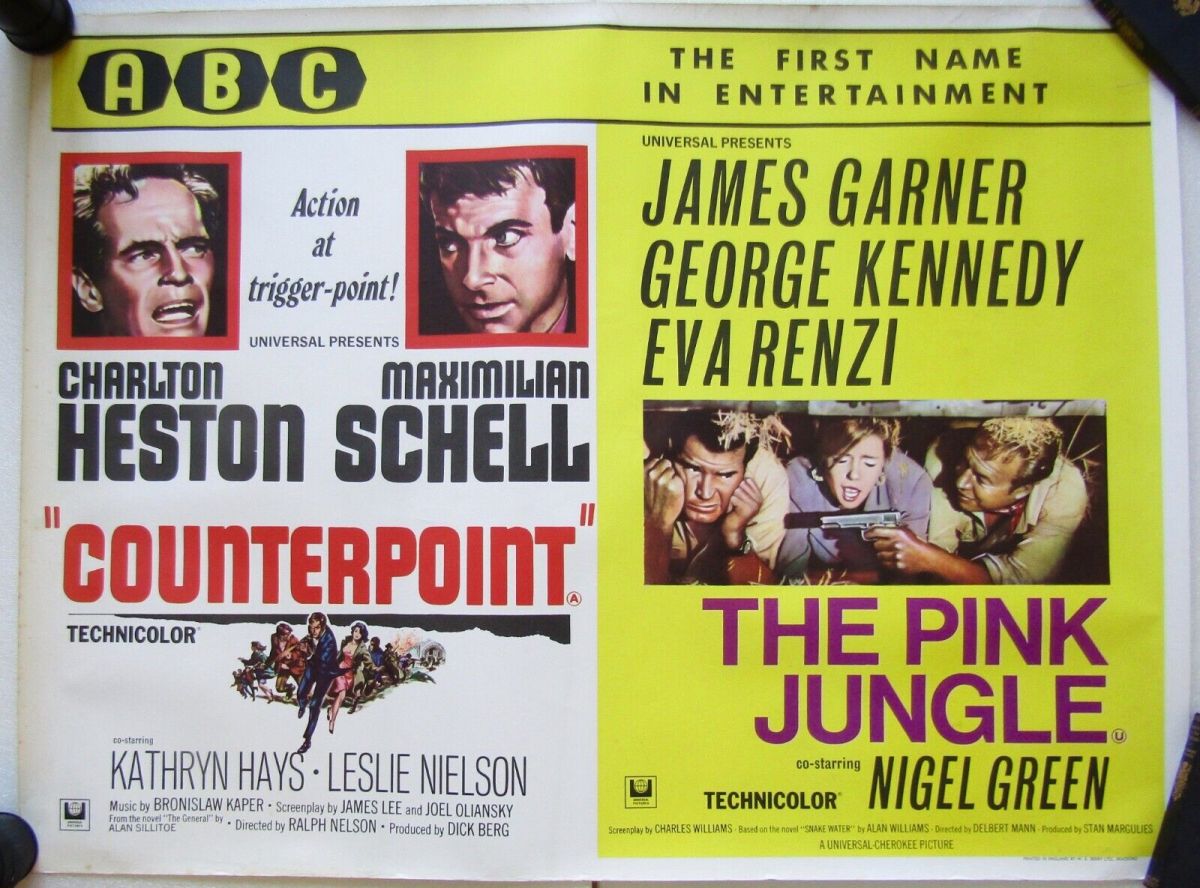
Count me in for the following combos: Charlton Heston in WW2 drama Counterpoint (1967) coupled with James Garner adventure The Pink Jungle (1968); George Segal hunting serial killer Rod Steiger in No Way to Treat a Lady (1968) and Sidney Poitier in The Slender Thread (1965) – receiving a full release somewhat late in the day on the back of the star’s recent box office; British home invasion thriller The Penthouse (1967) and heist masterclass Grand Slam (1967); and Burt Lancaster-Deborah Kerr drama The Gypsy Moths (1969) and James Garner as Raymond Chandler’s Marlowe (1969).
Imagining either The Wonders of Aladdin (1961) or Tarzan Goes to India (1962) as single bill fodder would be a stretch, a double bill the best solution. In any case, since Disney pushed all its product through the rival Odeon chain, ABC was short of family-friendly programs for the school holiday periods. Hence the coupling of Son of Spartacus (aka The Slave, 1962) starring Steve Reeves with Flipper (1964) or Tarzan’s Three Challenges (1963) with Flipper and the Pirates (aka Flipper’s New Adventure, 1964).
Equally, you might wonder what had gone so wrong with Kirk Douglas Korean War drama The Hook (1963) that it ended up on the lower end of a double bill with airline stewardess comedy Come Fly with Me (1963). And you might be surprised to discover which films weren’t rated strong enough box office to go out on their own. James Garner and Julie Andrews in cynical WW2 drama The Americanization of Emily (1964) required support from the first The Man from U.N.C.L.E. adventure To Trap a Spy (1964) (Equally odd given the series’ later fame that the latter was merely a support.)
Richard Burton and Elizabeth Taylor in The Sandpiper (1965) were given a helping hand by Miss Marple mystery Murder Ahoy! (1964). Sophia Loren as Lady L (1965) plus an all-star cast including Paul Newman required release assistance from Glenn Ford-Rita Hayward film noir The Money Trap (1965). Sizzling London box office and critical adoration didn’t save Antonioni’s Blow-Up (1966) from being paired with Sandra Dee comedy Doctor, You’ve Got To Be Kidding (1967). Charlton Heston western Will Penny (1968) was bundled up with Tarzan and the Great River (1967).
Nothing pointed to Doris Day’s fading box office prowess more than Where Were You When the Lights Went Out? (1968) being hooked up to Raquel Welch bikini caper The Biggest Bundle of Them All (1968). An Oscar nomination for Joanne Woodward in drama Rachel (aka Rachel, Rachel, 1968) wasn’t enough to see it home without the accompaniment of Tony Curtis period comedy The Chastity Belt (aka On the Way to the Crusades, 1967). Goodbye, Columbus might have been a huge hit in the USA and turned Ali McGraw into a star but as an unknown her debut feature went out with Peter Bogdanovich’s Targets (1968).
On the other hand, if a feature was considered too weak to play on its own, it might be withdrawn from the British ABC circuit before the week was over, a fate that befell Maureen O’Hara starrer Battle of the Villa Florita (1965), Jeffrey Hunter thriller Brainstorm (1965) and, unusually given its source, a bestseller by Arthur Hailey, Hotel (1966) starring Rod Taylor.
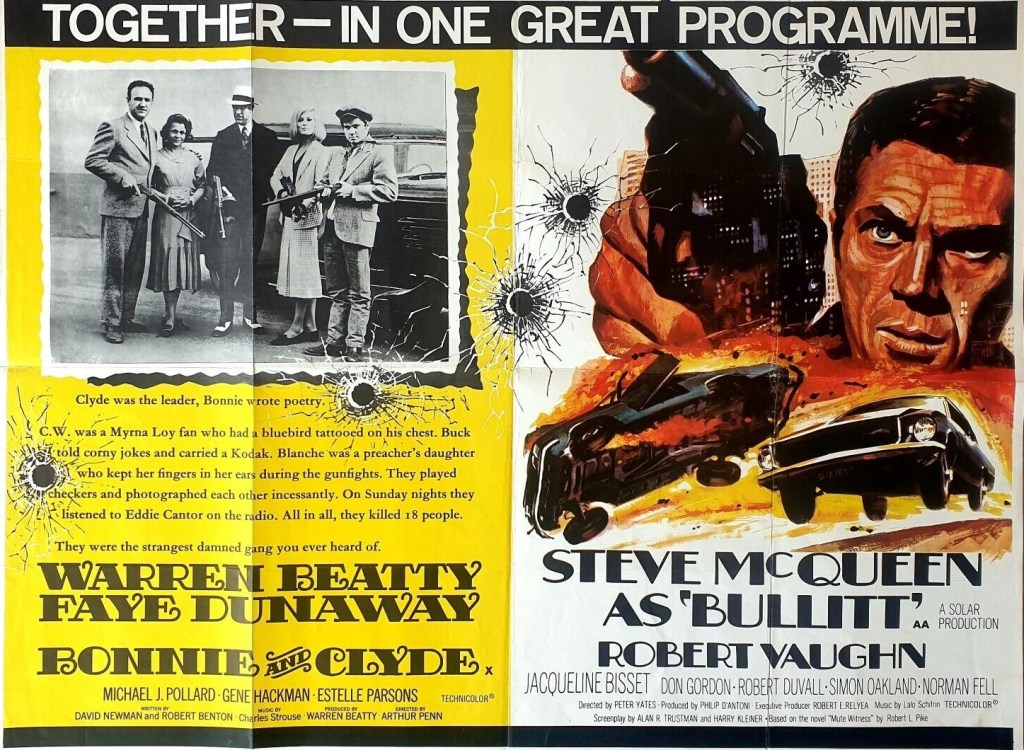
The advent of the reissue double bill made studios reassess what constituted a successful combo. James Bond, Clint Eastwood, Pink Panther and cheesecake duos (One Million Years B.C., 1966, starring Raquel Welch paired with She, 1965, headlining Ursula Andress), and speedy revivals of recent hits, such as Bonnie and Clyde (1967)/Bullitt (1968). showed that such programs could do just as well, if not better, by targeting a specific audiences as attempting to spread appeal.
The single-bill was in decline throughout the 1960s. On the ABC circuit in the U.K., for example, the number of single bills shown in an individual year peaked at 37 in 1963 before sharply falling to an average of 28 for the next six years. In other words, while ABC worked its way through a total of 67 movies in 1963, for the rest of the decade it was screening an average of 76 a year.
The following decade it was a different story as the circuit release system crumpled under the weight of long-runners like The Godfather (1972) and Jaws (1975) that sucked up so much juice in first run there was little left at the box office when they hit the suburban/small town circuit. The single bill was back on top by the end of 1970s – only eight double bills shown in 1979.
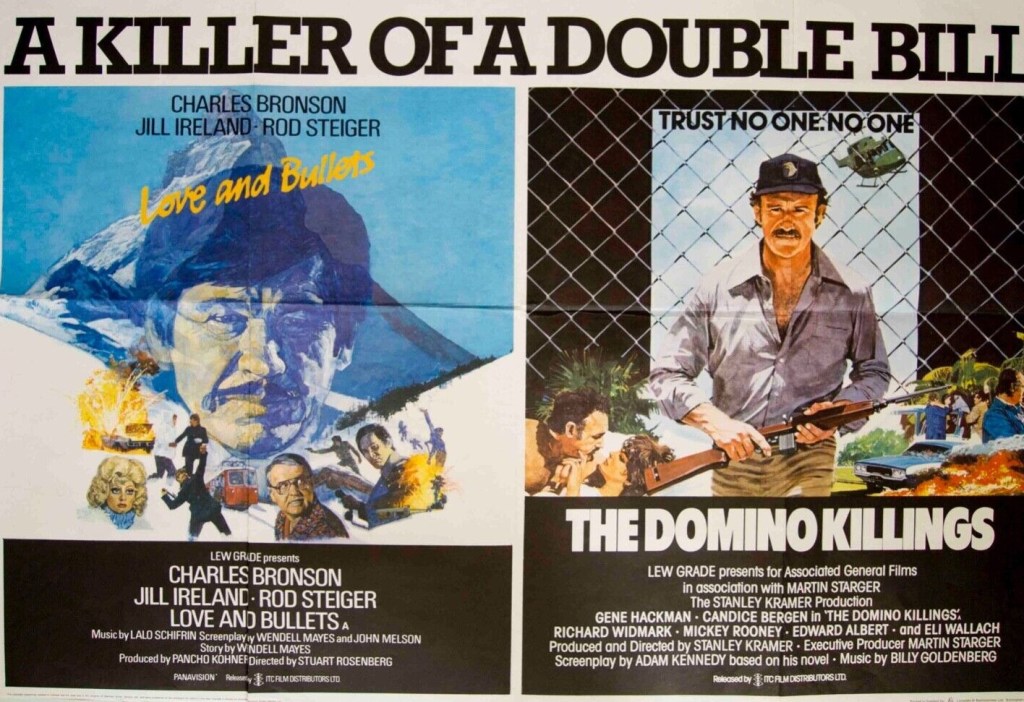
(Of course, I’m ignoring here those independent cinemas – the Scala in London’s King’s Cross or the Prince Charles in Leicester Square – that became famous for making up their own double bills, many of which examples went into legend.)
Gradually, except for very occasional reissues, the double bill was consigned to history until the public this year, of its own accord (though perhaps driven by a clever social media campaign) changed its tune. I’m a perennial supporter of the do-it-yourself double bill. On my weekly jaunt to the cinema I see back-to-back two films of my own choosing. But I’m guessing that cinema buffs regularly make up their own double bills from their own collections or digging out what’s on offer from mainstream networks and the streamers. So I’m not as surprised as some that what appears a one-off phenomenon caught on so fast.
Note: I’d be interested to know if the double bills I’ve mentioned above were shown in the USA or the rest of the world for that matter.
SOURCE: Allen Eyles, ABC, The First Name in Entertainment (Cinema Theatre Association, 1993) p122-127.


A double bill that I enjoyed enormously was Universal’s ‘Beau Geste’ (1966) and Madame X (1966), which I saw in the spring of 1967.
LikeLiked by 2 people
I reviewed the Beau Geste part not so long ago and I’ve got Madame X in my sights. most of these remakes worked out pretty well.
LikeLiked by 1 person
In general, horror flicks, Elvis and trite beach blanket films, and comedies were often double billed in 60s in states where I lived, PA, MD, GA, AZ, CA, FL, Maine… interesting historic film dive and info!
LikeLiked by 2 people
Do you mean two Elvis films on the one program or two beach pix?
LikeLiked by 2 people
2 Elvis films… one was tolerable, two was often too much!
LikeLiked by 1 person
Surprised they had to double them up to get an audience although I guess this might be a reissue double bill.
LikeLike
And yet I remember double bills running well into the 1980s, Mel Brooks films, stuff like that…
LikeLiked by 1 person
Yeah, they kept going. I ran out of easily-found listings because the two Allen Eyles books I referenced only carried this information up to the end of the 1970s.
LikeLiked by 1 person
I’m thinking old Evening Times Friday editions would have cinema listings for CAC cinemas. Must be on a microfishe somewhere.
LikeLike
H from ireland. 64 year old here. Double Bills I remember are various James Bond movies with one of the Dollar films. As a guess. Goldfinger+The Good, The Bad and The Ugly.
Some others. The Sicilian Clan+Butch Cassidy and The Sundance Kid.
The Wicker Man+Don’t Look Now.
Coffin From Hong Kong+The Guns of Navarone.
Dracula+The Mummy (The Cushing+Lee ones)
Wish I could remember more.
LikeLiked by 1 person
Sicilian Clan and Butch would be interesting. Both were Twentieth Century Fox so I’m guessing the western was to give the French film more support. Wicker Man/Don’t Look Now a classic of course. Navarone was an interesting coupling. Older movies lasted long as revival machines for newer pictures because they took a lot longer to end up on television than in the US.
LikeLike
Also would have seen Eurospy movies, Giallos, Peplums, Spaghetti westerns etc. Of course no idea that the first were three menioned were called that.
I have this idea that Frederick Stafford would have been in a lot of the eurospy ones.
I have a vague recollection (perhaps false) of when I was a small child of going with one or both of my parents to a double bill of Maniac+Tarantula.
Oh. and then there was the time A lodger in our house+my brother and me went to a double bill of The Man who Haunted himself+Day of Anger. Then there was the time my brother went with me to a double of Klute+Dirty Harry.
So there must have been a time when cinemas as a general rule decided to only show the latest movies, only one movie, and no stills outside, just posters. I used to love looking at the stills. Sure posters can be great too.
If I think of any more doubles, i will let you know.
LikeLiked by 1 person
I loved looking at the stills, too. There was a cinema, the Rialto, round the corner from our primary school in Dumbarton and I’d sneak round to see what was on and then peer inside to see what was coming next. I’m not sure when stills died out but certainly the idea of one movie rather than two started to develop in the 1970s. Klute/Dirty Harry was a great double bill. Independent cinemas could have cobbled together their own double bills so there would have been some interesting programmes. I saw Spartacus once at the Parade in Dennistoun in Glasgow with a support feature – over four and half hours of cinema, started at 5.50pm, ending at 10.30pm.
LikeLike
Notable double bills I remember and enjoyed off the top of my head:
Following your mention of The Patsy / Robinson Crusoe on Mars, shortly after Paramount combined The Disorderly Orderly with a superior effects-driven Crack in the World (which in these days you could stay behind and watch twice).
633 Squadron / The Great Escape gave excellent value for money doing the rounds around 1969 (no doubt either due to the 25th Anniversary of D-Day or the fact that both would be picked up shortly for BBC transmission). In any case the programme was so long one had to leave early to catch the last bus
while you mention the New Parade in Dennistoun, I recall a double bill there which I recall seeing advertised in Glasgow’s Evening Times – Von Ryan’s Express and Airport around 197/71. . Strange bedfellows indeed !
LikeLiked by 1 person
Interesting about the Parade. I think it struggled to get business. Though I did note that in 1971 for a repeat of a Robin Hood picture they promised that Robin Hood and Maid Marian would put in an appearance.
I saw 633/Great Escape and the first time I saw The Magnificent Seven was in a double bill with the sequel.
LikeLike