The Defector (1966) ***

How often does a government hoodwink a morally upright citizen into deceitful action for the cause of the greater good? In this case physicist Professor James Bower (Montgomery Clift) doesn’t need a great deal of urging because what’s at stake are Russian space race secrets and the man selling them is a Russian scientist he knows from translating his books. It’s apparent from the outset that in setting out to make contact in East Germany, he is walking into a trap. It’s moody, and drab in the vein of The Quiller Memorandum (1966), shot in soulless German streets, and of course it is the final performance, after a four-year screen absence, of a frail-looking Clift, an iconic Hollywood star for nearly two decades.

But genres can be confusing. Although tagged as a spy picture it’s not really a spy film. It’s a character study. In fact, two character studies, the other being a far-from-typical communist. And when you get to the end and realize the sacrifice made in order not to compromise principle, it turns into quite a different movie, one with considerably more depth than you might have imagined.

Bower is a rather adept amateur spy, neatly dodging being followed, and capable of nipping between two moving trams to evade pursuit. His instructions lead him to asking for a particular prescription and being sent in apparent haphazard fashion to an intended meeting with Dr Salter (Hans Messemer), his contact. Instead he is led to Counselor Peter Heinzmann (Hardy Kruger). His hotel room is not merely bugged but fitted with electronic instruments to prevent sleep and distort his mind. Meanwhile Heinzmann is engaged in a hawk-vs.-dove battle with  Orlovsky (David Opatoshu) to determine whose methods, the latter preferring torture and brainwashing, would prove the more successful in forcing Bower to betray the whereabouts of the would-be defector. And there is also a doctor’s receptionist Frieda (Macha Meril), with whom romance so obviously beckons your natural moviegoer instinct is to regard her as lure rather than friend.

It’s a chess game, Bower a pawn, with the net growing tighter, imprisoned in more ways than one, being groomed for defection himself. Although there is double cross, triple cross, murder and an excellent Hitchcockian escape/chase, and a final unexpected, very human, twist, it’s far from your typical spy thriller, in general subtle in tone except for the nightmarish hotel scenes. Heinzmann is also a pawn, fighting a system that sees degradation as its most potent weapon and even while a danger to Bower displays humanity.

Clift’s physical state, skin drawn tight over his face, works to the movie’s advantage, turning him into more of a Glenn Ford-type actor, the staunch man-next-door with steely resolve, but not the kind of character you would imagine Elizabeth Taylor or Marilyn Monroe giving a second glance. In fact, since the story calls for him to be suffering from a mysterious malady – hence the need to seek out a pharmacy and doctor in a foreign country – his features endorse this plot point far better than if he had been fit and well.

Quite what the set was like is anybody’s guess given that not only was Clift dead by the time of the film’s release but that Belgian director Raoul Levy (Hail, Mafia, 1965) – better known as the producer of many Brigitte Bardot films and now helming only his second film – had committed suicide.  

If ever there was proof of star power, this is it. Even when the film is meandering and the plot at times impenetrable, Clift exerts an almost hypnotic hold on the viewer. Despite his clear infirmity, the intensity that enraptured audiences from films as disparate as Red River (1948), From Here to Eternity (1953) and The Misfits (1961) has not vanished. Since many scenes are just meetings that scarcely progress the story, it is quite a feat to keep audiences interested. Far from his greatest performance, he still displays screen presence.

He is helped along by Hardy Kruger (Flight of the Phoenix, 1965) in one of his more measured performances, both men sharing the knowledge that in doing good for their country they are betraying themselves. David Opatashu (Guns of Darkness, 1962) is excellent as his  quietly ruthless superior and there should be mention of  Karl Lieffen as the constantly complaining Major. Even as a dowdy East German, Macha Meril (Une Femme Mariee, 1964) still captivates.  Serge Gainsbourg contributed the music.

Jungle Cruise (2021) **** – Seen At The Cinema

Can’t believe this romp is getting such sniffy reviews. But the reason is simple enough. Critics don’t watch it with an audience (except possibly of other critics) – on Rotten Tomatoes critics scored this at 63% while audiences rated it 93%. I saw it as part of my Monday Night Cinema Double Bill – along with Suicide Squad which critics adored. But while I thought Suicide Squad was a blast and very original, I laughed more at Jungle Cruise and I was much more involved. The difference – Suicide Squad is slick and cynical with hardly a single empathetic character, which is an easier target these days, but Jungle Cruise goes for something more difficult to achieve, a genuine warm-hearted movie that doesn’t disappear into romantic slush.

Sure, Jungle Cruise recycles not just Raiders of the Lost Ark (1981) – which itself recycled just about everything – but Ghost (1990), Highlander (1986), The African Queen (1951), Romancing the Stone (1984) and Pirates of the Caribbean (2003), but I don’t think that took away from its originality. The story made sense and the clues involved in the treasure hunt aspect of the picture were well worked out, delivering quite a few surprises. But mostly, there was terrific charisma between Dwayne Johnson and Emily Blunt.

Roguish Frank Wolff (Dwayne Johnson), with a line in lame jokes (which, by the way, had the audience roaring), operates an Amazon river cruise before the First World War where most of what the passengers see is manufactured. Explorer and accomplished burglar Lily Houghton (Emily Blunt) mistakes him for riverboat magnate Nilo (Paul Giametti) but after Frank saves her from a tiger (his tame beast, it turns out) she hires him to find a fabled treasure. Also in the hunt are ruthless German Prince Joachim (Jesse Plemons) and Spaniard Aguirre (Edgar Ramirez).

Both Wolff and Houghton are given great opening scenes, he proving what a con man he is, she more than capable in a man’s world, where such is the antipathy to female archaeologists that her brother MacGregor (Jack Whitehall) has to deliver her lecture for her. There’s action by the bucketload, quite a few Indiana Jones-type escapes, shooting the rapids, encounters with dangerous animals – snakes, piranha fish etc – and natives. Prince Joachim has one hell of a river vessel and quite a few tricks up his sleeve. It’s not just that the pace never lets up, but it is generally delivered with verve.  

Interestingly, there is a nod towards diversity in that MacGregor is gay, a fact accepted by Wolff. Equally interesting, MacGregor has a pivotal transitional moment as his character starts out in one mode and ends in another.  And Lily gives the finger to the male-dominated academic world.

Paul Giamatti (TV’s Billions, 2016-2021) only has a small part but it’s a delight to see him make any big screen appearance at all and Jesse Plemons (Judas and the Black Messiah, 2021) takes on the rather unusual role of the German bad guy. Even though Edgar Ramirez (Yes Day, 2021) spends most of the movie in disguise one way or another, his intensity still shines through.

Jaume Collet-Sera made his name directing Liam Neeson thrillers like Unknown (2011) – one of my favorite pictures – and Non-Stop (2014), Run All Night (2015) and The Commuter (2018) but this is a big step up not just in terms of budget and the occasionally complex story line but also in the romance and comedy elements and in my eyes he more than delivers. Michael Green (Blade Runner 2049, 2017), Glen Ficarra (Focus, 2013) and John Requa (The Bad News Bears, 2005) all had a hand in the screenplay and James Newton Howard (News of the World, 2020) has written a great score.  

I’ve no idea whether Jungle Cruise has anything in common with the ride at the Disney theme park and I didn’t care. This is not just great family viewing but for audiences of all ages who just want to be – wait for it – entertained. But Disney may well have shot itself in the foot by streaming this at the same time as opening it in cinemas for I bet you this will get terrific word-of-mouth and they should have let it sit in cinemas for months to gather the benefits. An ideal summer movie of the old-fashioned kind.

What Raquel Welch Wore in “A House Is Not A Home” (1964)

A few years before Raquel Welch became the poster girl for bikinis, she could not have been in better hands, costume-wise, for her movie debut in this picture. Costumier extraordinaire and multiple Oscar-winner Edith Head, was in chare of the outfits, in particular the lingerie, which, given the subject matter, was often all that was required.

Here, Head was recycling famous movie costumes of old. Whether Ms. Welch’s figure was perhaps too bountiful for the kind of outfits worn by stars in the 1920s and 1930s where bosom size was less of a priority is unknown. You can probably spot her second from the right in the photo above.

The movie paraded famous fashions of the period in more ways than one. Head’s idea was to have the girls sporting lingerie that had been seen in movies from the 1920s to the 1950s when worn by famous female stars. Whether the clothes were the actual pieces worn in previous films, and adjusted to suit, or the designs were based on the previous movies is unclear. An article in Variety asserted that Head had not actually designed costumes for the film but that the producer had simply raided the Paramount costume department, where Head had worked since 1924, for outfits she had designed.

The “nightgown museum” was drawn from films made between 1925 and 1953. The earliest nightgown, worn by Gloria Swanson in The Duchess and the Waiter (1925), was assigned to Gigi Galligan. Meri Wells worn an item previously made famous by Clara Bow in It (1927), Leona Gage used a number from famed clothes-horse Kay Francis in Behind the Make Up (1930), Amede Charbot was adorned with the eye-popping flimsy piece that Carole Lombard paraded in Bolero (1933). Patricia Thomas was given Nancy Carroll’s trousseau from Abie’s Irish Rose (1928) and Lisa Seagram was the second wearer of Grace Kelly’s powder blue chiffon in To Catch a Thief (1955).

However, there were more costumes worn than merely those which had acquired a classic status, all the male outfits for a start plus clothes reflecting the period worn by Shelley Winters and the other stars so it is likely that Head adapted her own previous outfits and augmented those with new costumes for the other players. Head had, of course, been working for Paramount during the 1920s and 1930s so she had firsthand experience of the types of clothes that would be worn.

Edith Head won eight Oscars from a total of 35 nominations. She won each year in 1950, 1951 (twice), 1952, 1954 and 1955 and again in 1961 and 1978 (for The Sting). Even where a film was not a commercial or critical success, there was every chance Edith Head would snag a nomination. Such was the case during the 1960s, up to A House Is Not A Home. In that half-decade she was nominated eleven times. In those days designers were nominated in two categories, films made in color and those made in black-and-white, thus accounting for the double award in 1951.

She won for Bob Hope-Lucille Ball comedy The Facts of Life (1960) and was nominated for John Ford western The Man Who Shot Liberty Valance (1962). In the same year as A House Is Not A Home, she was also nominated for the star-studded What A Way To Go! and the previous year three of her films were up for Oscar honors – A New Kind of Love starring Paul Newman and Joanne Woodward, Wives and Lovers with Janet Leigh and Natalie Wood-Steve McQueen drama Love with the Proper Stranger.  

SOURCES: Pressbook for A House Is Not A Home, p3; “Shelley Winters on Polly Adler: Bad & Ends Sad,” Variety, April 8, 1964, p5.

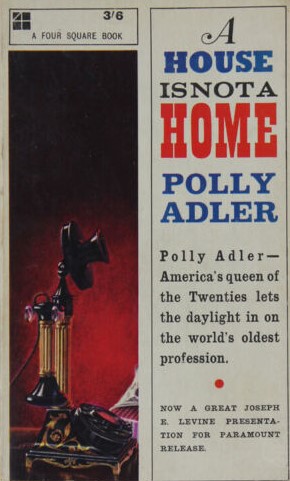
Book into Film – “A House Is Not A Home” (1964)

Hollywood biopics tended to follow one of two routes – overcoming circumstances or falling victim to circumstances. Polly Adler’s autobiography A House Is Not A Home fitted into neither category. It was more of a survivor’s guide and if there was any element of triumph it was within an unsavory profession and one that sailed too close to the nether worlds of the Prohibition gangster.

The film stuck to a shorter time frame than the book, kaleidoscoping certain events and characters, highlighting an inevitably impossible romance and adding a gangster subplot, while acting as an expose of civic corruption, cops especially rubbing their noses in the financial trough.

Dramatic license is taken throughout the film, for example Adler (Shelley Winters in the film) was not rescued in the book by future lover Casey Booth (Ralph Taeger), who was in any case a pseudonym, but first met him when he drank himself unconscious in her brothel. Lucky Luciano (Cesar Romero) makes only a brief appearance in the book. Both film and book skip present Adler as businesswoman first and victim second.

Adler’s unflinching attitude to the business is core to both book and film but inevitably a movie made in Hollywood in the mid-1960s enjoyed less freedom in matters relating to sex than a book published a decade before. In some respects it’s a shame that the film was shot  in such prohibitive times. Had it been made today either as a movie or mini-series it would have had a more decent chance of telling a better story and bypassing the pressing issues of morality, as was the case with Molly’s Game (2017), another true story, about a woman heading up a multi-million-dollar illegal gambling racket.

The book tells a fascinating story and casts a light on troubled times. Adler came to the U.S. as an immigrant at the age of 13, was raped by her workplace supervisor, thrown out of her home and went into the pimping business by accident before setting up her own brothel. But she did quit and operated instead as a lingerie retailer before being duped out of her savings. Thereafter, back in the sex worker business, she made a point of hiring only the most beautiful girls and her career path  demonstrated a fascinating understanding of business, especially her grasp of marketing, as she moved from the gangster world into high society.

There were busts along the way and she went out of business for over a year when implicated in the Seabury vice investigations of 1930-1931 and for a time afterwards was bankrolled by gangster Dutch Schultz. And although Adler worked her way up to notable personality and enjoyed the attention of artists and members of high society who used her premises almost as a salon, she did not run shy of spelling out the worst aspects of the life.

Loneliness was a key factor. It was impossible to retain a relationship except a destructive one with a pimp or gangster. Poverty, lack of education, poor home environment, lack of love and early exploitation were the reasons women became sex workers. Suicide – loss of hope – was common as was drug use. A high-class brothel was a long way from the type of operation where women were expected to service 25 men a day – a record of their activity kept by a “lace curtain” of holes punched into a sheet – but yet, inevitably, that was the final destination for the high-class girls once age or drugs or alcohol took its toll.

 “To outsiders it seems hypocritical and hair-splitting for a madam to make a distinction between herself and a pimp,” said Adler who maintained she did not fall into the latter category because her girls kept more of the money they earned and she did not take on inexperienced girls whereas a pimp seduced girls into the life and kept them there often by hooking them on drugs. 

Much like Don Corleone in The Godfather, morality did not enter the equation. “If I was to make a living as a madam, I could not be concerned either with the rightness or wrongness of prostitution considered either from a moral or criminological standpoint.”

Unlike the bulk of women employed as sex workers, the Adler story had a happy ending. After being busted in 1943 and undergoing a public humiliation on vacation, she retired from the business, went to university and wrote her biography which turned into a bestseller. She died in 1962, two years before the film appeared.

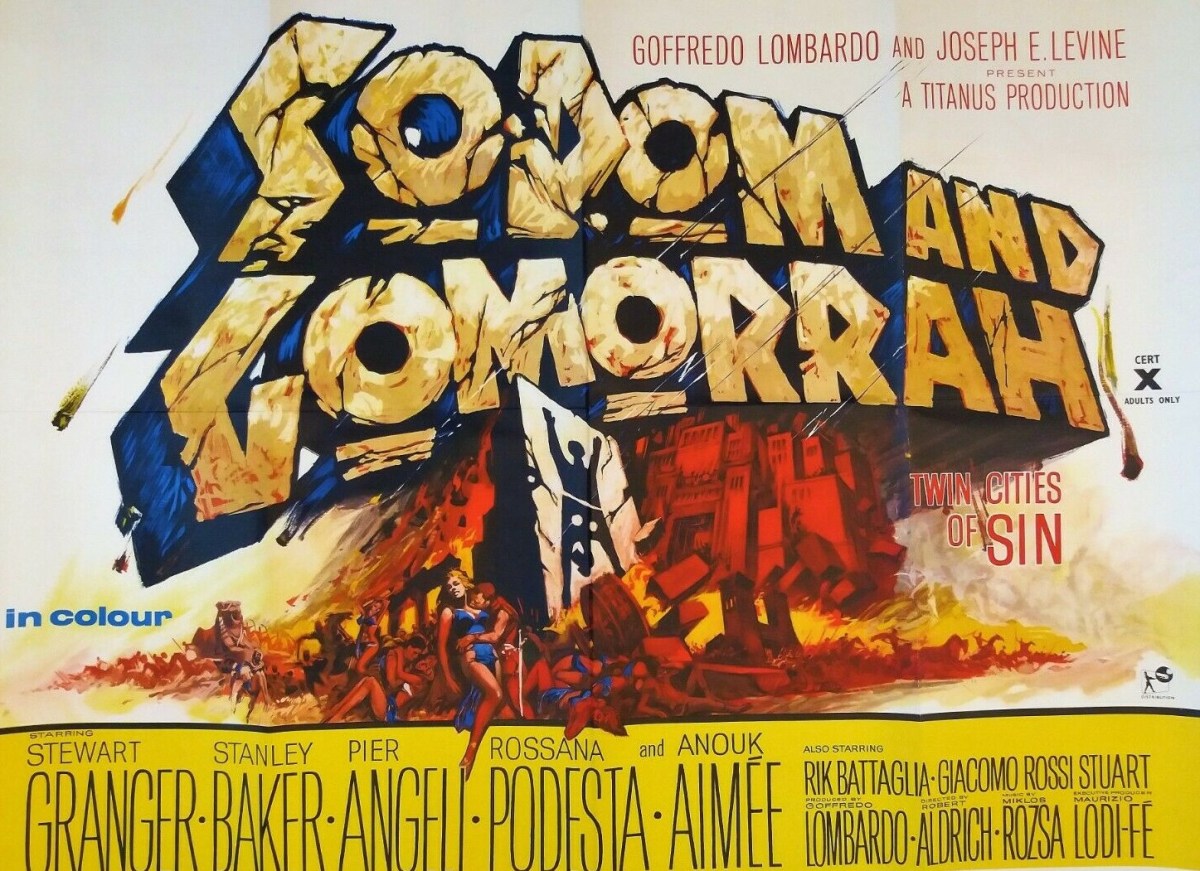
Sodom and Gomorrah (1962) ****

Setting aside the Biblical angle and the need to inject as much sin as the censor at that time would permit, this works very well as a historical drama filled with political intrigue, pivoting on the morality/sin axis, and with a terrific battle scene. The set up is superb. Bera (Anouk Aimee), Queen of the titular twin cities, allows Hebrew leader Lot (Stewart Granger) to settle his wandering tribe along the River Jordan in order to provide a buffer between her kingdom and the marauding Elamite tribe. Meanwhile, her treacherous brother Astaroth (Stanley Baker) intends using the Elamites to dethrone his sister.

Stunning image from the Pressbook.

The Sodom-Hebrew arrangement is ugly from the start. Sodom owes its wealth to salt. And it relies for its salt mining and processing to thousands of slaves, literally worked to death, corpses piled high on wagons and dumped in the desert. The Hebrews abhor slavery. But having been homeless for so many years, Lot is in no position to argue and assumes that his people can live peacefully enough alongside the heathens, even accommodating Sodom to the point of returning fleeing slaves.

Another superb illustration from the Pressbook.

In fact, in agreeing to live in such close proximity to Sodom, Lot is already in the throes of seduction. In what appears a gesture to seal the deal, Bera presents Lot with her chief female slave Ildith (Pier Angeli). In reality this is a cunning move designed to undermine Hebrew culture. Naturally, Lot grants Ildith her freedom but her presence creates disharmony, Melchior (Rik Battaglia) leading the dissenters. Astaroth seduces both of Lot’s daughters Shuah (Rosanna Podesta) and Maleb (Claudia Mori).

Eventually, of course, the Hebrews succumb to many of the pleasures of Sodom, especially after discovering their own salt deposits which instantly make them wealthy, while Astaroth continues to stir up trouble. Lot the politician is more to the forefront than Lot the good and faithful servant, ignoring the slavery for the sake of peace. However, politics remain a sticky maneuver and, in the end, of course, it is God who intervenes, smiting the wicked.

There are surprising depths to the story. Ildrith initially rejects Lot’s overtures of marriage on the grounds that it will diminish his goodness. In trying to improve living conditions for the Hebrews, Lot does the opposite, jeopardizing their beliefs, his actions rendering virtually invisible the distinctions between the opposing cultures, especially when he is up close to the dancing female slaves and men being burned alive on a wheel. Queen Bera is a political genius, skilled at keeping her enemies closer, not just taking advantage of Lot’s weakness but ensuring that Astaroth never catches her cold.

It’s a very absorbing mix of power, politics, human weakness, the dangers of collaboration, sex and action. Although Lot takes center stage, it is only to watch his decline from man of principle to weak-willed politician, through the astute workings of Queen Bera, a far better manipulator of human emotions than her opposing number.

Images showing the capture of slave Tamar (Scilla Gabel)

Stewart Granger (The Secret Partner, 1961) is surprisingly good as the Hebrew leader. He might lack the physical presence of the likes of Charlton Heston but he proves himself no mean adversary in the various action scenes, two fights with Astaroth for example, the battle itself and in quickly dealing with dissent in the ranks. It would never have occurred to me that a shepherd’s crook was much of a weapon, but in Granger’s hands it proves very effective. He knows he is being seduced, first by Ildith, and then by Sodom, but, as a human being rather than figure of spirituality, is powerless to stop it.  Stanley Baker (The Guns of Navarone, 1961) as the queen’s treacherous brother, on the other hand, just looks shifty and mean throughout.

Anouk Aimee (La Dolce Vita, 1960) is excellent as the politically astute monarch, and save for God’s intervention, would have got the better of everyone around her.  Pier Angeli (The Angry Silence, 1960) is touching, initially angry at being cast out of Sodom, gradually warming to Lot, but only too aware that in succumbing to her charms he might spoil his own innate goodness, like a femme fatale only too wary of her own powers.  Rosanna Podesta (Seven Golden Men, 1965) is good in a supporting role as is Rik Battaglia (Esther and the King, 1960) while Scilla Gabel (Colossus of the Arena, 1962) has a smaller part as the slave Tamar who meets a horrible death. Look out, too, for Gabrielle Tinti (Esther and the King, 1960), later best known for his marriage to Laura Gemser of the Black Emmanuelle series, and future spaghetti western anti-hero Anthony Steffen (Django the Bastard, 1969).

Novelisation of the screenplay with a cover placing the focus strictly on sin.

Robert Aldrich (4 for Texas, 1963) creates an excellent addition to the genre, the pace of the drama, with various storylines, never slacking. As a historical picture this aims higher than mere pulp where sexiness and torture are the audience hooks. His battle sequence is outstanding, unusual in that the balance of power shifts throughout, in part through treachery, between the participants. Although Aldrich often disparaged this picture, he has done a really good job of working up the ingredients into a heady brew, notwithstanding the “deus ex machina” ending that met audience expectation. Ken Adam (Dr No, 1962) headed up the production design and Wally Veevers (The Guns of Navarone, 1961) among the half dozen experts contributing to the special effects. Mention also to Maurice Binder for the credit sequence and Miklos Rosza (Ben-Hur, 1959) for a nuanced score.

Catch-Up: Reviewed previously in the Blog are Robert Aldrich’s 4 for Texas (1963) and The Flight of the Phoenix (1965), Stewart Granger in The Secret Partner (1961) and The Secret Invasion (1964), and Stanley Baker in The Guns of Navarone (1961) and The Girl with a Pistol (1968).

Discover WordPress

A daily selection of the best content published on WordPress, collected for you by humans who love to read.

The Atavist Magazine

by Brian Hannan

WordPress.com News

The latest news on WordPress.com and the WordPress community.