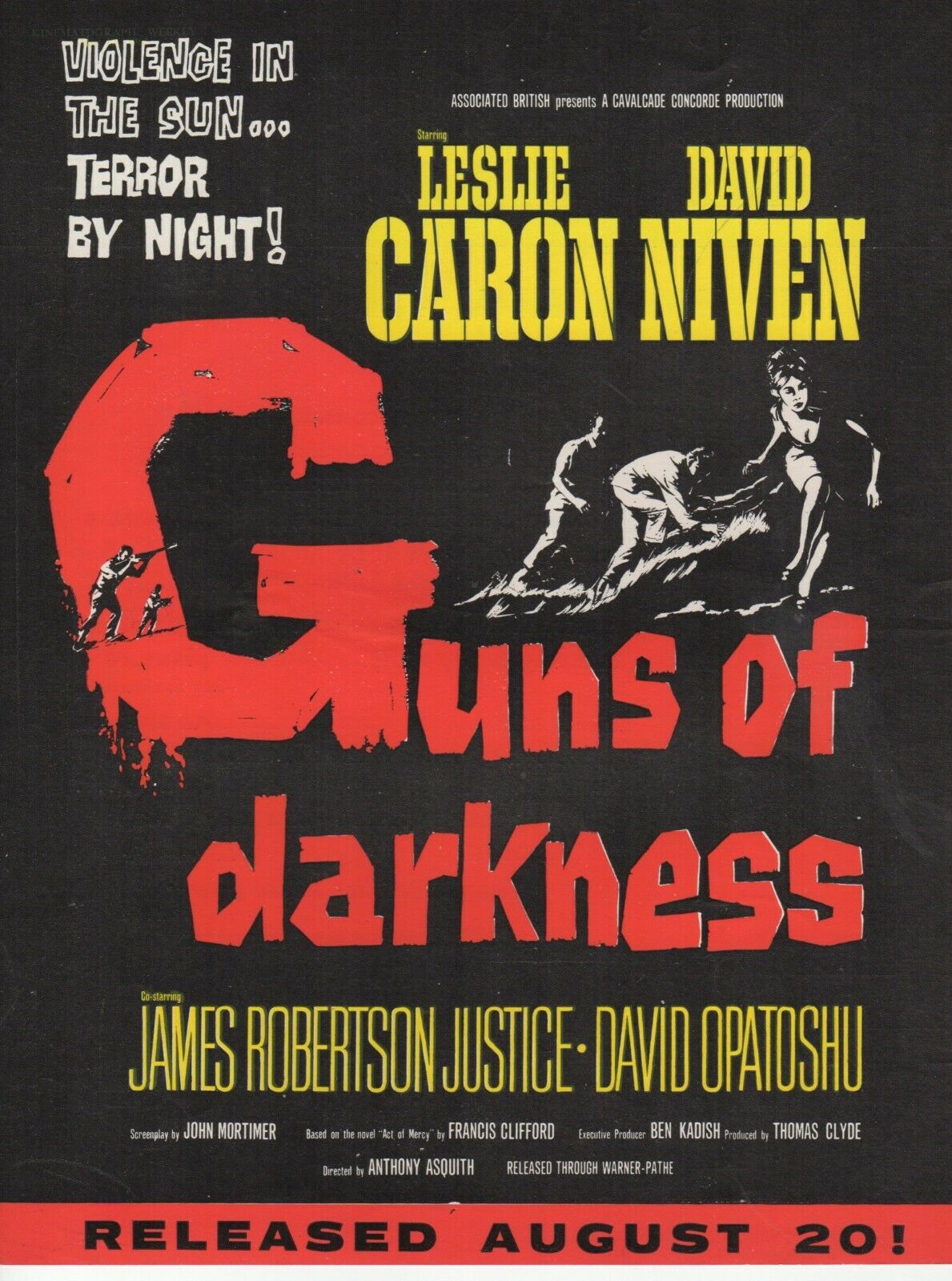
You might think David Lean in Lawrence of Arabia (1962) had cornered the market in startling transitions involving light (from Peter O’Toole’s match to the rising sun) and gut-wrenching scenes involving quicksand but nearly six months prior Anthony Asquith (The Millionairess, 1960) in the less-heralded Guns of Darkness had adopted similar techniques. He cuts from a nightclub singer blowing out a candle to a man lighting a candle in a church and since his film is in black-and-white it cannot hope to match Lean’s fabulous color transition. However, the quicksand scene in the Asquith, I would argue, lacking color or not, is far superior to that of the desert epic.
Thanks to Pygmalion (1938) and The Winslow Boy (1948) Asquith was one of a handful of British directors – Lean, Powell/Pressburger and Carol Reed the others – with an international reputation. Stars David Niven and Leslie Caron had topsy-turvy careers. Niven’s box office cachet had almost disappeared in the mid-1950s before an unexpected Oscar for Separate Tables (1958) and a starring role in The Guns of Navarone (1961). Although Caron had An American in Paris (1951), Lili (1953) and Gigi (1958) on her dance-card she was not an automatic big-name star. It reflects their respective positions that Caron has star billing.
Niven and Caron are an unhappily married couple caught up in a revolution in a fictional South American country. His boyish charm has long worn thin, his employment record is spotty and he is inclined, when drunk, to insult bumptious boss (James Robertson Justice). On New Year’s Eve while an enclave of pampered Brits is counting down to the bells, rebels are preparing to storm the presidential palace and seize power. Niven seems the last person to give shelter to a fugitive from the revolution, especially when the runaway turns out to be the ex-president Rivero (David Opatoshu, Exodus, 1960). Caron, who has been planning to leave Niven the next day, finds herself involved in the escape.
The couple are both quickly disabused of notions of the saintliness of presidents and peasants, Rivera nearly strangling a child who discovers his hiding place, Caron stoned by villagers, pacifist Niven forced into a horrific act of violence.
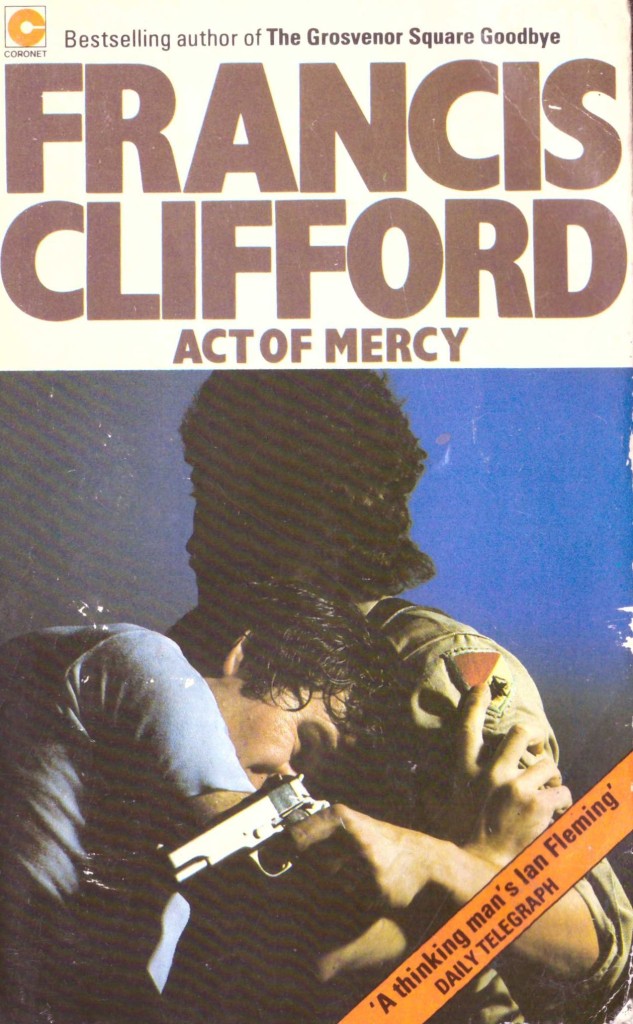
If you ever wondered what screenwriters do to earn their money, this film is a good place to start. It was based on a book “Act of Mercy” by British thriller writer Francis Clifford, who also wrote “The Naked Runner,” also later filmed. The screenwriters changed the David Niven character from the happily married committed businessman of the book to the dissatisfied dilettante of the film. As a happy couple, there are none of the marital tensions in the film. The revolution in the book has already started but in the film it is moved to New Year’s Eve and about to begin. The quicksand scene is a screenwriter’s invention as is the incident with the boy and the massacre in the village.
The pace is brisk from the outset, Asquith cross-cutting between revolutionaries and the Brits and as the manhunt steps up a gear the three escapees face a succession of perilous incidents. Not least is a river that has turned to quicksand. This six-minute scene is a standout, the mud closing in on their heads, Niven having to crawl back to rescue Rivera. As you would expect with this kind of picture there is a fair bit of philosophizing, moralizing and sheer brutality. As the couple flounder towards reconciliation, the script spends some time trying to ascertain Niven’s motives. Had the film stuck to the source book’s title, Act of Mercy, that would not have been necessary.
A taut film with, once the revolution has begun, the British put in their place rather than acting as imperialist overlords. There are a couple of unexpected twists at the end and Asquith finished with a technical flourish of his own, the camera tracking back from people walking forward. Both Niven and Caron are excellent, James Robertson Justice at once cuddly and ruthless, and the picture comes out as a tidy character-driven thriller.
Many of the films from the 1960s are to be found free of charge on TCM and Sony Movies and the British Talking Pictures as well as mainstream television channels. But if this film is not available through these routes, then here is the link to the DVD and/or streaming service.
While Hollywood was capable of dealing with mental illness head-on in pictures like Frank Perry’s David and Lisa (1962), Sam Fuller’s Shock Corridor (1963) and Robert Rossen’s Lilith (1964), the British were more inclined to take an alternative approach. The titular characters of Billy Liar (1963) and this film dealt with awkward reality by creating a fantasy world.
Morgan, played by David Warner in his first starring role, is a failed artist and virulent Communist who cannot come to terms with being divorced by rich Vanessa Redgrave who is planning to marry businessman Robert Stephens. Warner forces his way back into his wife’s house and attempts to win her back with nothing stronger than whimsicality and when that fails resorts to kidnap. And it is clear that she shares his fancy for furry animals, responding to his chest-pounding gorilla impression with tiny pats of her own chest. For a slim guy, Warner makes a believable stab at a gorilla, shoulders hunched up under his jacket, chest stuck out. And he has an animal’s sense of smell – detecting his rival’s hair oil.
But Vanessa Redgrave, in her second film and her first starring role, steals the picture, winning her first Oscar nomination (in the same year as sister Lynn for Georgy Girl). She is made of gossamer. Still attracted to a man she knows will only bring her pain, she is far from your normal leading lady. There is a touch of the Audrey Hepburn in her ethereality but she portrays a completely genuine soul, not a manufactured screen personality.
The tone of the film is surreal. Had David Attenborough been a big name then you could have cited him as one of director Karel Reisz’s influences, such was his predilection for inserting wildlife into the proceedings, not just primates but giraffes, a hippo, a peacock and a variety of other creatures. Some are comments on Morgan’s state of mind but after a while it becomes monotonous. The film is clearly intentionally all over the place, the class struggle also taking central stage, but it’s hard work for the viewer.
Having said that, towards the end of the picture there is an extraordinary image – possibly stolen from the opening of La Dolce Vita – of Warner in a straitjacket hanging from a crane. Had that been the film’s starting point, it might have dealt more demonstrably with the subject matter. The whimsy is all very well and Redgrave is delightful and while Warner is clearly on a mental descent the focus on external animals does little to illuminate his internal struggle. Also, having said that, Warner is imminently watchable. He has an intensity that is hard to ignore and usually is cast with that in mind but here his vulnerability, his inability to grasp that he is living in a different reality, is very touching. Even when his imagination is at its most vivid – such as when Redgrave appears at the end supposedly bearing his child – you are partly convinced that this may actually be true. I would have preferred less of the animal imagery and more of Warner’s true reaction to the world around him. It’s a case of performances spoiled by over-direction.
Setting aside the director’s indulgence, the film is remarkable in one other way. It was almost revolutionary to find a British picture that, despite Warner’s working-class agitation, is effectively about joie de vivre as opposed to the more traditional British stiff upper lip, that inbred stoicism afflicting the entire nation regardless of class status. While Lawrence of Arabia (1962) represented an exhibition of flamboyance, again not a British trait, and the truculent Albert Finney in Saturday Night and Sunday Morning (1960) was determined to enjoy life to excess, Warner’s character epitomizes a desire to be free of normal cares in order to live life to the full.
Given the Warner would later be more famous buttoned-down roles – and that, in contrast, Redgrave would later portray another famous flamboyant in Isadora (1968) – it is surprising that this fun aspect of Warner’s screen persona was not called upon more often.
Many of the films from the 1960s are to be found free of charge on TCM and Sony Movies and the British Talking Pictures as well as mainstream television channels. But if this film is not available through these routes, then here is the link to the DVD and/or streaming service.
Director Sidney Lumet (Fail Safe, 1964) could have made an excellent film just about the customers of a pawn shop, the haunted individuals haggling for more bucks than they will ever be paid, the sad sacks, junkies, lost souls and general losers whose stories are told in the items they pawn or redeem – candlesticks, lamps, radios, musical instruments, occasionally themselves. You don’t need to be a pawnbroker to know that three hoodlums turning up with a pricey lawnmower are dealing in stolen property. And it comes as something of a surprise to learn that the pawnbroker is involved in some kind of money-laundering scam for a local gangster. Clearly shot on location on a bustling low-rent area, north of 116th St in East Harlem, New York, there’s enough going on in the streets – the markets, the tenements, poolrooms, the bustle, the eternal noise – to keep you hooked.
But you might think twice about positing as your hero an “absolute bastard” as Lumet himself described shop owner Sol Nazerman (Rod Steiger). He is more haunted than any of his clientele, a Holocaust survivor, plagued by flashbacks to the concentration camp where he witnessed his son die and his wife raped. He is devoid of life, completely shutdown to any emotion, rejecting overtures of friendship, and his life is played out in tiny elliptical shreds. He does not even derive any enjoyment out of his affair with a widow and although he claims to worship money – according to him the only “absolute” outside of the speed of light – that brings no fulfillment either. It is surprising he has lasted so long without imploding. After his war experience, you would have to wonder at a man who spends his life behind the bars of the grille in his shop and just in case he considers escaping from his predicament designer Richard Sylbert (Chinatown, 1973) incorporates other visual aspects of imprisonment into the production.
This startling image taken from the Pressbook encapsulates one of the striking moment of the film. As seen on the advert at the top of the blog, although not technically a roadshow in the normal sense (i.e. in the grandeur of 70mm) it played separate performances. This was a technique to drive up demand by limiting access. Originally, to take advantage of a British tax break known as the Eady Levy, the film was due to be made in London. Lumet pulled out when MGM insisted on a London shoot and only returned after that idea was abandoned and second-choice director Arthur Hiller bowed out.
Steiger gives a very restrained performance, especially for an actor known for his volubility and over-acting. He seems to sink into the role. He is accused of being among “the walking dead.” Around him are a set of very lively characters, his ambitious assistant (Jaime Sanchez, The Wild Bunch, 1969) trying to go straight and his girlfriend (Thelma Oliver), a very smooth and wealthy and gay gangster (Brock Peters), and a trio of small-time hoods with whom the assistant is friendly. But also the deranged and the lonely. A widowed social worker (Geraldine Fitzgerald) who suffers from the “malady of loneliness” offers him friendship but is rejected.
There is little plot to speak but it is just enough to teeter him on the brink of self-destruction. So it is primarily a character study. Unusually, Lumet observes without any sentimentality those around Steiger. “Sol has buried himself in this area,” Lumet wrote (“Keep them on the hook,” Films and Filming, October 1964, p17-20) “because he needs to be with people that he can despise….This is a man who is in such agony that he must feel nothing or he will go to pieces.” There is no redemption and he lacks the courage to commit suicide. It’s a stunning, bold picture, as raw as you can get without turning into a bloodsucker.
Fans of “The Godfather” might recognise this image – of a puppet on the strings -used to symbolise the power of the Mafia don. Eight years before Coppola’s gangster saga, this rarely seen but similar image in the Pressbook for “The Pawnbroker” evoked the opposite – a broken man.
The film had a few firsts. It was the only mainstream American picture to deal with the Holocaust from the perspective of a survivor (although films like Judgement at Nuremberg, 1961, has shown camp victims). It broke mainstream conventions on nudity, bare breasts being seen for the first time. Lumet experimented with incredibly short cuts – just one-frame and two-frames in places (a technique he had first used in television)- when the standard assumption was that audiences required three frames to register an image. Brock Peters played not just the first openly gay person in a mainstream picture, but the first gay African-American (although The Long Ships the same year had a bit of comedy about a eunuch chasing Vikings).
Quincy Jones made his debut as a movie composer. If you listen closely you might detect a piece of music later made famous by the Austin Powers pictures and if you look closely you might spot a debut sighting of Morgan Freeman. And if want another anomaly, try and work out why Rod Steiger lost out to that year in the Best Actor Oscar stakes to Lee Marvin in Cat Ballou (1965).
Many of the films from the 1960s are to be found free of charge on TCM and Sony Movies and the British Talking Pictures as well as mainstream television channels. But if this film is not available through these routes, then here is the link to the DVD and/or streaming service.
The new documentary on Audrey Hepburn – the Queen of Chic – and my reference to the making of the Valley of the Dolls in “My Books of the Year” blog made me wonder just how important fashion had become to movie marketing in the 1960s. So I did some digging. And found that the this particular decade had indeed been a golden age for Hollywood fashion.
Although actresses had set fashion trends before – Lana Turner’s turtleneck sweater as evening wear, for example, Marlene Dietrich in pants, Carole Lombard’s shirts and Greta Garbo’s pillbox hat while Warner Brother’s star Kay Francis was often in reviews referred to as a clothes-horse – fashion had not previously been given the hard sell. Throughout the 1960s, that was remedied.
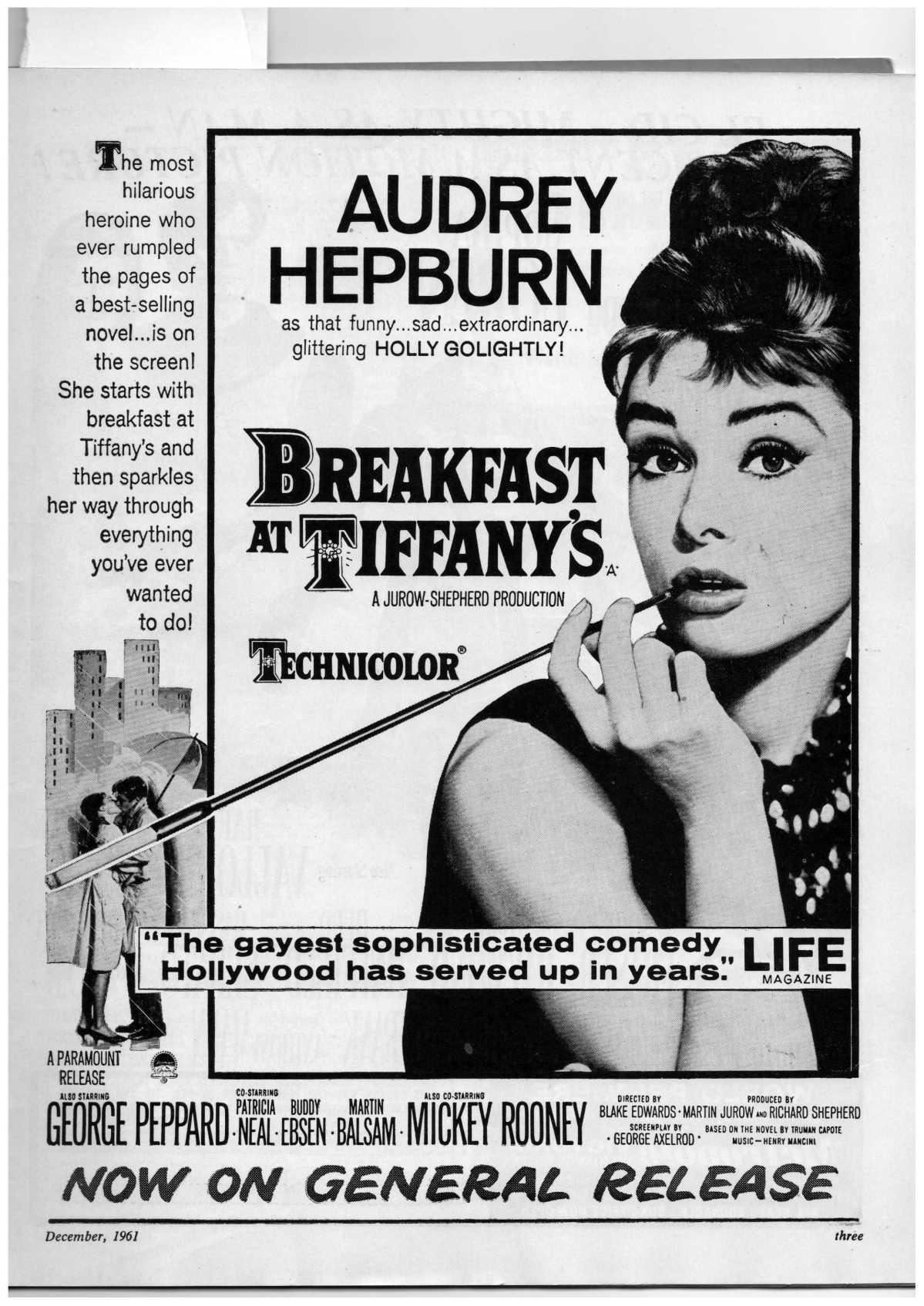
The new attitude to fashion as a marketing tool was instigated after a piece of market research. In 1960 United States market research company Sindlinger carried out consumer investigation on behalf of Universal that came to the conclusion that women made up 58 per cent of the audience going to see seven of the top ten pictures. In consequence, the studio decided to target the female audience with a marketing approach that would specifically appeal to that gender, namely fashion. First picture to benefit from this change of direction was Doris Day vehicle Midnight Lace (1960). Universal was a step ahead of the rest but Paramount was soon leading the field thanks to the impact on female fashion made by Audrey Hepburn in Breakfast at Tiffany’s (1961).
Jean Seberg was a designer’s delight. Yves St Laurent designed the clothes for Moment to Moment (1966).
In 1962 Paramount celebrated the fact that Edith Head was the industry’s only full-time contracted designer by hosting a fashion show on the penthouse set of the studio’s Come Blow Your Horn (1963) starring Frank Sinatra. The event was called “Edith Head’s Penthouse Party.” Being showcased were costumes from eleven of the designer’s current or forthcoming movies. The cheapest outfit on show cost just $2.89 (worn by Patricia Neal in Hud – known at the time as Hud Bannon) while the most expensive (for Jill St John in Come Blow Your Horn) set the studio back $3,700. In total the studio spent $420,000 on costumes for the movies.
As well as the two films mentioned above, other pictures in the Edith Head portfolio given a marketing push because of her fashion input included Elvis Presley vehicle Girls! Girls! Girls! (1962) co-starring Stella Stevens, comedy Papa’s Delicate Condition (1963) with Jackie Gleason and Glynis Johns, comedy Who’s Got the Action (1962) headlining Dean Martin and Lana Turner, and France Nuyen as A Girl Called Tamiko (1962). Also involved were Jerry Lewis numbers It’s Only Money (1962) and The Nutty Professor (1963), John Wayne adventure Donovan’s Reef (1963), Paul Newman-Joanne Woodward romantic comedy Samantha (later renamed A New Kind of Love, 1963) and Debbie Reynolds in My Six Loves (1963).
The outfits were modelled by some of the film’s stars including St John, Stevens, Nuyen, Barbara Rush and Phyllis Maguire (also from Come Blow Your Horn), Myoshi Umieti and Martha Hyer (also from A Girl Called Tamiko) and Elizabeth Allen (Donovan’s Reef). Also on hand were four Japanese models and a quartet of actresses making the transition from modelling – Patricia Olsen who had a small part in Samantha, Pat Jones, Mary Morlas and Olavee Parsons. John Wayne, David Janssen (My Six Loves) and Cesar Romero (Donovan’s Reef) also put in an appearance but drew the line at modeling.
However, the big commercial push for Hollywood fashions came from My Fair Lady (1964). The impact of the Hepburn look in Breakfast at Tiffany’s was accidental, rather than deliberate. But from the outset the bulk of the promotional activity for the Lerner and Loewe musical was based around the costumes designed by Cecil Beaton. Whether or not the public could afford such flamboyant outfits was not uppermost in the minds of fashion editors – what Hepburn wore was just so stunning and converted into fabulous editorial spreads, especially for the magazines and newspaper supplements which by this time were mainlining on color, that it created a tsunami of marketing material.
In 1967 costumes hit a commercial peak with a record $12 million budget in total allocated to wardrobes. A total of $8 million was spent on just 15 movies. Easily topping the list was musical Camelot (1967) at $2.25 million while Doctor Dolittle (1967) racked up $1 million, Star! (1968) $750,000 and Funny Girl (1968) $500,000. Three hundred fashion editors attended a fashion show at the Plaza Hotel in New York for a first glimpse of the clothes worn in Funny Girl.
One year earlier Universal had pushed the boat out marketing-wise for the outfits designed by Yves St Laurent for Jean Seberg in Moment to Moment (1966). That same year Warner Bros had focused on fashion for its promotion of the fashion-conscious Kaleidoscope (1966). Stars Warren Beatty and Susannah York might as well have been fashion models given the range of outfits they wore and the movie’s Pressbook claimed the clothes specially created for the picture were on the biggest selling-points for a movie in years especially as most “in” stores “know about the kicky, eye-arresting swingy ‘mod’ fashion clothes which are all the rage.”
Candice Bergen, a former model, caused a sensation in Paris – where she was shooting Vivre pour Vivre (1967) with Yves Montand – when she participated in the Dior show. Her unexpected appearance as well as the clothes she wore received huge publicity. Also in 1967, MGM took out a full-page advertisement in Variety to, among other things, proclaim the impact of Doctor Zhivago on female fashion – “the world is wearing the Zhivago look.”
Expenditure was not an issue. A red velvet cloak worn by Kim Novak in The Legend of Lylah Clare (1968) cost an eye-popping $35,000 while Samantha Eggar’s fourteen costumes in Doctor Dolittle each cost between $7,000 and $14,000. The price of Vanessa Redgrave’s wedding dress in Camelot was $12,000. Five gowns at a total of $17,000 made for Judy Garland for Valley of the Dolls (1967) were discarded when the actress was sacked and they did not fit replacement Susan Hayward.
Bonnie and Clyde had initially flopped in the U.S. so there was no great demand for Theodora van Runkle’s outfits. The film’s fashion craze started in London where it proved an unexpected hit. There, fashion house Matita launched a Bonnie outfit which caught on. But Stateside when the Bonnie look was widely adopted it was primarily because it was cheap to copy – a mid-calf skirt, thick-seamed stockings and the white beret not hard to replicate.
But it wasn’t just female fashions that benefitted from movie spinoffs. Male fashions seen in Bonnie and Clyde (1967) were adapted for commercial retail use by Geoffrey Beane and Donald Brooks, who were so convinced (mistakenly) that the movie would be a hit straight off the bat that the clothes appeared on racks long before the movie was released and the pair had to wait until the next year before demand for the movie turned into interest in its fashion.
In fact, men had always been a part of fashion marketing for the movies. Even a film as male-oriented and action-filled as The Guns of Navarone (1961) was given a fashion slant as a means of attracting a female audience – as I discovered when writing a book on the making of the film. “Navarone Blue” – was officially adapted by the British Colour Council while “Navarone Gold” was developed for the Colour Association of the United States. Both dyes were marketed to the manufacturers of automobiles, interior design and fabrics such as bedspreads. Grecian fashion was sold in 50 department stores including Macy’s. And it was written into the contracts of all the female stars that they wear clothes of either colour at premieres.
Lee Marvin had become an unlikely fashion icon and to take advantage of this new status MGM set up “coast-to-coast” promotions for Point Blank (1967). Highlander Clothes developed a fashion line as a marketing tie-up with over 60 stores from all over the country participating. Alcatraz – where part of the movie was filmed – was the location for a fashion shoot that went out in a three-page layout to the 20 million readers of Life magazine under the heading “Well-Dressed Moll Styles in Alcatraz.”
At the end of the decade another male-oriented picture, Downhill Racer (1969), was sold via a fashion marketing campaign. Steve McQueen, the epitome of cool, became a hook for fashion marketing, especially after The Thomas Crown Affair (1968) while Eli Wallach was an unlikely male model in upmarket male magazines. Earlier, for another male-dominated story, Seven Days in May (1964), director John Frankenheimer had been pictured wearing a Cardinal custom-made suit in an ad in Gentleman’s Quarterly. More in keeping with old-fashioned publicity gimmickry, for that film Paramount had also hired designer Mollie Parnis to create a suit for women that could be worn seven different ways on seven different days.
SOURCES: “Women Biggest Picture-Goers, So U Laces Midnight Campaign with Fashions,” Variety, Sep 7, 1960, 16 ; “Fashion Omnibus On 11 Features, By Edith Head,” Variety, Oct 31, 1962, 18; “H’wood Fashions Boom Year,” Oct 4, 1967, 5 ; “Paris Fashions – 1967,” Variety, Feb 15, 1967, 2; advertisement, Doctor Zhivago, Variety, Jan 4, 1967, 37.; Pressbook, Kaleidoscope; Pressbook, Point Blank; Pressbook, Seven Days in May; Brian Hannan, The Making of the Guns of Navarone (Baroliant, 2013) p153-154; Brian Hannan, Coming Back to a Theater near You (McFarland 2016) p186.




 The Magnificent 60s