If “I see dead people” isn’t one of the greatest lines ever written, I don’t know what is. Apart from anything else it highlights the screenwriting element of director M. Night Shyamalan’s talent. Had the little boy, in whatever haunted manner, simply said, “I see ghosts,” it wouldn’t at all have had the same impact. And reinventing this genre took a lot more than knitting together a few scary moments.
The horror genre had morphed into scaring the pants off women, their screams the soundtrack of the decade, and, of course, it was often the last sound they made as slicing-and-dicing became the norm and body counts multiplied. Nobody dies here. And the dead aren’t zombies either. Little Cole (Haley Joel Osment) almost acts as a psychiatrist, putting ghosts back together, listening to their woes, letting them come to terms with death. I won’t spoil the ending for you in case you haven’t seen it because when it first came out every audience member was urged not to reveal the ending.
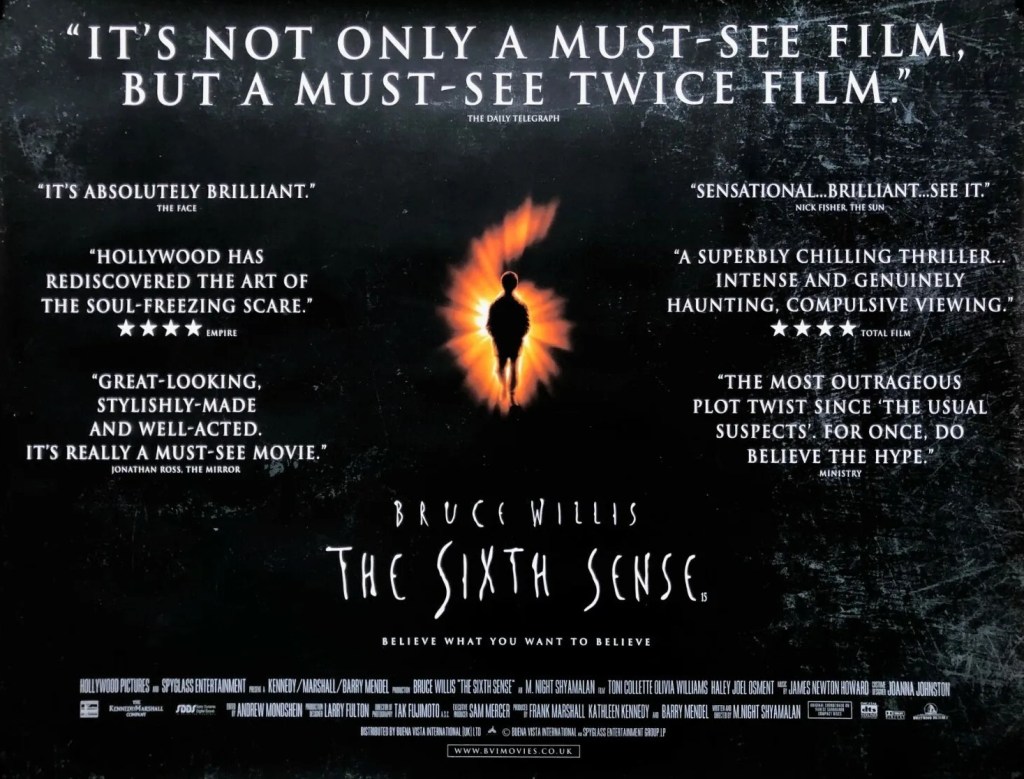
What Shyamalan has done is give the ghost story narrative purpose, two characters who need each other, guilt-ridden psychiatrist Malcolm (Bruce Willis), marriage in trouble, suspecting wife Anna (Olivia Williams) of having an affair, finds himself getting unspoken guidance from the kid he is meant to be giving advice to. Cole is bullied at school, treated as a freak, having to conceal his own torment from everyone, and teachers who should recognize signs of disturbance instead resort to punishment. Kids lock him in a cupboard and single mother Lynn (Toni Collette) is at her wit’s end.
The great screenwriters invent scenes nobody’s ever thought about before. Trying to elicit information from Cole, Malcolms plays a game. If he is correct in an assumption, the child takes one step forward. A few correct answers and he’ll be plonked down in a chair opposite the psychiatrist. But if the answers are wrong, Cole takes a step backward. It’s an incredibly clever conceit, exposition disguised as a game. By the end of it, Cole is back where he started, and the boy’s ostensible savior is revealed as a failure.
These are two tormented souls coming together and for the most part it plays almost with an arthouse sensibility to a kid growing up, making his way in the adult world, except as much as Cole is developing, so is Malcolm, his life foundering, walking around in permanent lament for a world that’s gone wrong, somehow slipped away from his grasp from a time he was physically adored and professionally acclaimed.
It’s the psychiatrist’s burden to occasionally fail. Sometimes the consequences are unendurable even if the client was beyond repair and Malcolm puts his current depression, forgetting his anniversary, for example, down to one terrible failure. Cole isn’t entirely defenceless. He can spot adult weakness, and feeling threatened, humiliates his teacher with with vicious aggression that exposes a childhood disability that appears on the face of it successfully overcome but, in reality, still lurking.
Gradually, Cole grows in confidence, matures, is given the leading part in the school play, accepted, and Malcolm can take pride in his accomplishment. Shyamalan is too clever a screenwriter to have the child identify point blank the adult’s problems. The revelation is a moment of stunning self-clarity.
But I promised not to say any more.
Instead, I’ll talk about Shyamalan’s directorial skill, in particular his use of the fade, a little-used technical device from back in the day. Most directors simply employ the cut. Everything is connected, let’s move on, keep this narrative going. The fade is like the end of a chapter, time to turn a page, a sigh, every section allowed time to breathe, before we move on.
We might also credit Shyamalan with bringing out two superb performances from the leads. He wipes that trademark smirk off Bruce Willis’s face, finds ways of making the screen’s biggest tough guy come off as weak. Haley Joel Osment was a tad older than the character he plays, but still no more than ten, I guess, at the time of filming. To carry off such long speeches with such authenticity would be beyond most child actors, who usually come to the fore in some inconsequential froth, rather than a serious drama, was jaw-dropping. Amazing he didn’t win the Oscar or be given a special one. Because it’s a very special performance and without such singular acting the movie wouldn’t have worked at all.
Shyamalan’s been around longer than Christopher Nolan but with none of the comparable accolade. Apart from an occasional foray into sci-fi, he’s stuck, like Hitchcock, to the thriller genre. He followed The Sixth Sense with, in my opinion, his masterpiece, Unbreakable (2000) and had another big hit with Signs (2002) but thereafter his box office wavered and though consistently churning out a movie every two years ended up at the lower-budget end of Hollywood. His new one Trap, due out later this month, is distributed by a major studio, Warner Bros, so if it succeeds, and it’s getting great buzz, he might be welcomed back into the fold.
I was able to see The Sixth Sense on the big screen again not because someone was attributing retrospective glory to Shyamalan but because a marketing whiz has come up with the great publicity wheeze of tying up a package of pictures from the same year by different studios and chucking them out under the anniversary aegis (25th in case you can’t do the maths) so tapping into nostalgia. As with the current reissue formula, these pictures are restricted to one showing on one day and to my surprise when I saw this, I would reckon the theater was three-quarters full and as much with youngsters as older people.
So while you’ve already missed it on the big screen, I’m sure it’s available on DVD or streaming.
Don’t miss it.
 The Magnificent 60s