Behind the Scenes: Raquel Welch on “Myra Breckenridge” (1970)

In 2012, Raquel Welch was accorded a ten-film tribute at the prestigious Film Society of the Lincoln Center for the Performing Arts in New York and turned up in person to be interviewed on stage prior to various screenings. One of these was Myra Breckenridge (1970). Though interviewer Simon Doonan kicked off proceedings by mistaking her for Ann-Margret (yep). Graceful as our star was, she didn’t storm off the stage.

She admitted she wasn’t first choice for the picture. “I didn’t get a call,” she explained. “I had heard about the movie. I had read the book. The book was absolutely hysterical, so funny, and I thought it was very innovative because it was the first time I had seen somebody like Gore Vidal, who was really a genius, deal with the duality of the nature of both the male and the female. I never saw that before.
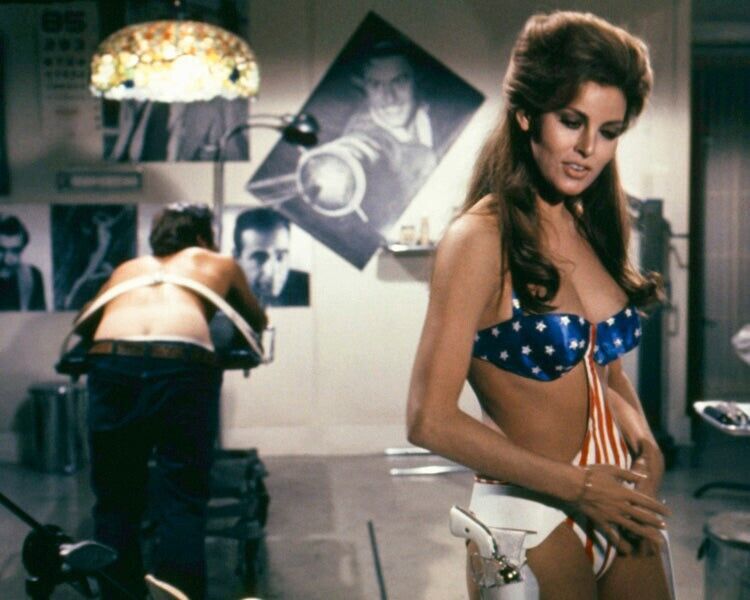
Is that a gun or a are you just pleased to see me?

“I was interested in how they were going to do this movie and then I heard through the trade that Anne Bancroft (after the success of The Graduate, 1969) had turned it down. So I thought, hmmm, I wonder what they’re going for. A little bird told me to call Dick Zanuck (head of 20th Century Fox) so I called Dick, who I was in contract with, and asked what kind of actors they were looking for in this role. I was thinking if a guy was going to change his sex and wanted to be like a movie star kind of girl, don’t you think he might want to look like me? And he said, oh my god, that’s a thought, let me talk to David – that was David Brown (later, producer of Jaws, 1975) and I’m sure Helen Gurley Brown (his wife and editor-in-chief of Cosmopolitan) got in on it too. And then I did get the call and they asked me to come in and talk to them and they gave me the role.

“I had not seen the script, it’s true. As much as I loved doing Myra, I was kind of disappointed in the outcome of the movie because the narrative never did really string together. It was very disjointed and it didn’t really tell the story of Myron the film critic who was enamored of all the very very strong swashbuckling women of the golden age of film from Joan Crawford to Bette Davis and Myrna Loy.

“He wanted really to be one of those superwomen and I think that’s where the superwomen thing started because it was women then who used to go to the movies. They used to bring the guys to the movies. That was the way it went then more than it does now…The dialog was both male and female and I felt like now I’m playing the girl’s part. Rex Reed is playing Myron and there’s really hardly any relationship between the two. They’re not one person so there’s no idea of the duality and nature. One minute she likes girls and the next minute she likes studs and the older men are just to use and abuse.”

Asked about how she developed her character, Raquel replied: “The real thing – I know this is going to sound very shallow – but Theodora Van Runkle (who had swept to national fame by starting a fashion trend with her outfits for Bonnie and Clyde, 1967) did these beautiful period costumes which did emulate all of the great film stars…I felt these clothes kind of evoked this attitude.

“I did want to meet Mae (West). I did go out and research her and find out all about her and it turned out she had never made a color movie before. I asked for an audience. (In her apartment) I noticed all her furniture was white and also noticed all these 25-watt pink bulbs (to keep the room dim).”

Raquel had observed of movie stars, “There’s a screen persona and a real side. Mae didn’t have a real side. She was wearing a long peignoir and lots of eyelashes. This was noon. She didn’t bring the chimps out (she was rumored to have a menagerie of them…and young men, and neither were in evidence).”

(On set) “The other thing that got to me a little bit was that Mae never worked before 5pm. Also she never really moved by herself. (The limousine that had driven her to the studio) also brought her on to the set. I kissed her hand and one false fingernail fell to the floor and then I thought I’m getting a vibe, I think she’s a man. She refused to appear in the same frame as me. At 77 (Mae’s age) all bets are off and you’re not going to be able to doll it up that much.”

While stars being able to veto a director and perhaps refuse to work with certain other stars was still a perk for the highest-paid movie actors, Welch discovered that Mae West had a very distinctive unheard-of perk. She had costume approval. Van Runkle had designed a Garbo-esque black dress that Raquel was looking forward to wearing. But when it came time for that particular scene she discovered it had been “confiscated….nobody got to wear non-color (West was always dressed in white) except Mae.”

“Very early on (I realized) this isn’t Gore’s book. Nobody’s going to undertsand it…they hired Michael Sarne who’s only claim to fame was Joanna (1969), a visual montage kind of thing and that’s what he did to this movie. The fact that it had dialog was secondary. He used to carry round this little rectangular box and he used to say, I’ve got this little box for you, Raquel.

“It was sad fun, I didn’t want to make a movie that didn’t make any sense. I thought we were going to make something that was revolutonary. I did think it was kind of a landmark that said it’s very likely that world culture will change from this point on.”

You can catch this interview and another one discussing The Three Musketeers on Youtube.

Behind the Scenes: Access All Areas at Twentieth Century Fox

No one would have invited journalist John Gregory Dunne to observe the inner workings of Twentieth Century Fox in 1967 had they know how badly the project was going to backfire. The studio was enjoying a commercial peak, The Sound of Music (1965) continuing to set records, the public turning out in droves for the critically-lambasted Valley of the Dolls (1967). Fattening up studio coffers were Von Ryan’s Express (1965), The Blue Max (1966) and spy franchise Our Man Flint (1966) and In Like Flint (1967). By the time Dunne’s book, The Studio, was published however, in 1969, the studio was in financial meltdown.

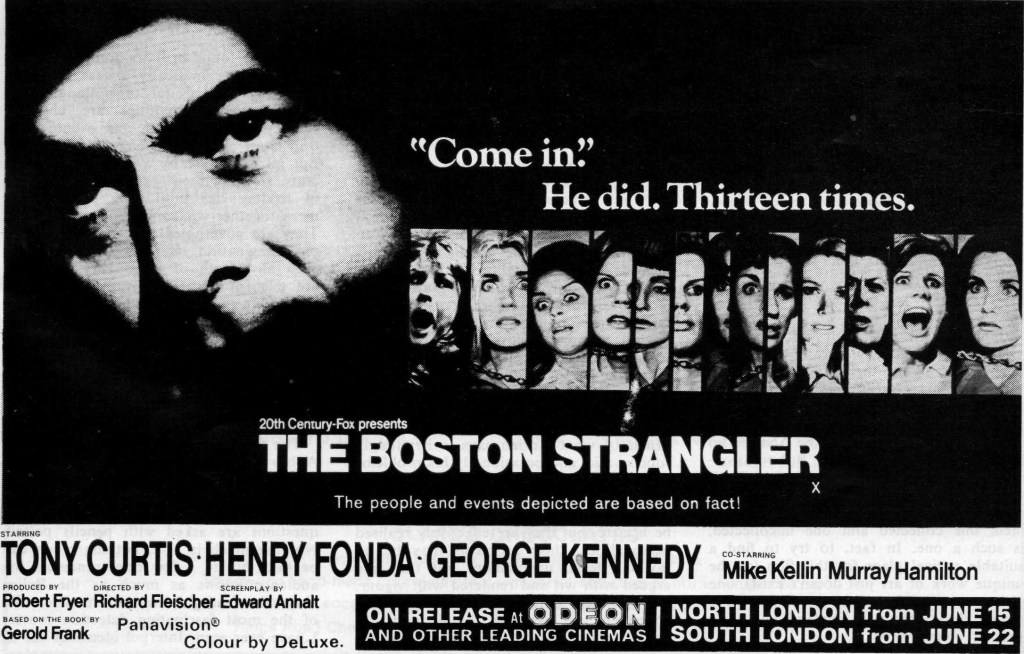
On a hubris high was studio chief Darryl F. Zanuck, who a few years before had saved Fox from bankruptcy. Dunne (later a screenwriter, most notably of A Star Is Born, 1976) had carte blanche to sit in on all sorts of meetings. The studio was going for broke with big-budget musicals, $18 million on Doctor Dolittle starring Rex Harrison (My Fair Lady, 1964) , $12 million for Star! with Julie Andrews (The Sound of Music), both actors considered bankers for their previous work in musicals. There was even $4.5 million allocated to The Boston Strangler which lacked any star commitment.

There were actually two Zanucks. Father Darryl and whizz-kid son Richard who was in charge of production and with whom Dunne had most of his dealings. Dunne observed first-hand how the younger Zanuck whittled down director Martin Ritt’s salary from $350,000 to $200,000 by threat of legal action.  

Script problems had pushed back production on The Boston Strangler, a first attempt by English playwright Terence Rattigan (The VIPs, 1963) rejected and the project now in the hands of Edward Anhalt (Becket, 1964). And it lacked a star.

Robert Shaw was one possibility. He was being paid $300,000 for a picture that would never be made, The Nine Tiger Man, to be directed by George Cukor, deemed too expensive at $7.2 million.  Zanuck could save money if Shaw accepted The Boston Strangler as an alternative. He didn’t. Or another, cheaper, project A Severed Head. He didn’t. Instead, Zanuck dumped A Severed Head (released by Columbia in 1971).

Christopher Plummer also walked away without doing any work. When Rex Harrison quit Doctor Dolittle, Plummer (The Sound of Music) signed up as his replacement for $300,000, Harrison said he hadn’t meant to quit. That wasn’t the only issue Harrison caused. He refused to pre-record his numbers and then mouth the lyrics to a playback. The Harrison, more expensive, method was to be recorded live.  As if producer Arthur P. Jacobs (Planet of the Apes, 1968) hadn’t already been through the mill. Alan Jay Lerner (My Fair Lady) was contracted to do the music. But after 15 months: nada. Jacobs turned to Leslie Bricusse. The budget had risen by 50 per cent, from $12 million to $18 million.

It was hoped the 50-plus companies involving in licensing and contributing $12 million in overall marketing spend would bring in the public. Over 300 items would be sold on the back of the picture, resulting in 45,000 displays in retail stores.  This was a picture you couldn’t miss. Expecting a soundtrack bonanza, the initial print run was set at half a million copies – bigger than that for The Sound of Music. Jacobs was perturbed to learn he would have to pay for window space – retailers paid with free copies.

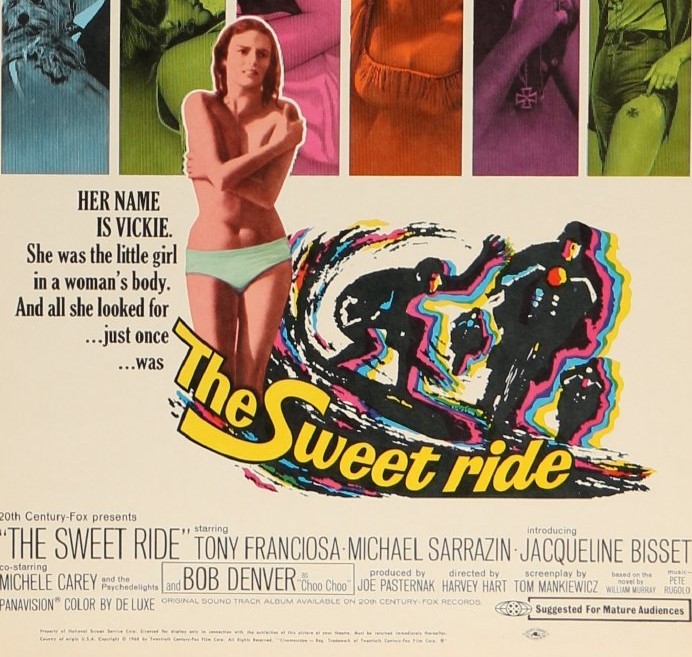
Legendary producer Joe Pasternak was making his 100th movie The Sweet Ride. One of his concerns was that Jacqueline Bisset’s bikini didn’t look tight enough. “It looked baggy in the rushes,” complained Pasternak. Bisset countered, “It fits when it’s dry. It just got a terrible pounding when I was in the water.” She mentions the scene where it got such a pounding in fact that the sea whipped the top off. She reckons that crossing her arms to protect her modesty prevented her tugging the pants on tighter. Once that picture was finished so was Pasternak – he never made another picture.

Another legendary producer Pandro S. Berman was trying to interest English directors John Schlesinger or Lindsay Anderson in Justine (directed by George Cukor in 1969) and on that basis wanted to hire a writer Laurence Marcus (Petulia, 1968) to rewrite the existing Ivan Moffat script in order to entice them. Zanuck’s take: he expected a director to make script changes but couldn’t see the point of altering a script to suit a director you didn’t know would be interested. Nonetheless, Marcus got signed.

All the time agents and directors were pitching movies. Agent Phil Gersh pushed a comedy version of Candy – screenplay by English writing duo Keith Waterhouse and Willis Hall (it ends up minus the Englishmen at Cinerama Releasing). Veteran director Henry Koster’s idea for a musical was nixed. As was the original trailer for Tony Rome, Zanuck hating the voice-over.

On Deadfall (1968), the Michael Caine heist movie directed by Bryan Forbes, actress Giovanni Ralli was having trouble with her English and her contract prevented her being dubbed. It would mean the actress having to lip-synch in post-production. The solution – “tell her she’s got 500 loops and when she hears that maybe she’ll get discouraged and let someone else dub her.” The studio had come up with 14 alternative titles to The Magus (1968) including Seduced by Fate and The Goddess and the Demon.

Fred Zinnemann was priming a $10 million western about Custer. He thought he might save $3 million by shooting in Mexico. The picture was to have no big stars. The only actor who could pull it off was John Wayne and he hated Custer. So Zinnemann planned to go with big names in cameo roles and Toshiro Mifune as Crazy Horse. That picture, too, would be dumped.

Also in the wings, Hello, Dolly! which would get made and Tom Swift, which would be canned despite advance work on building his aeroship, which would not. Nor would another Berman project John Brown’s Body.  

Apart from insights into the way movies are made, marketed and released, Dunne’s book captures the extraordinary Hollywood mix – cynicism and greed coupled with fervor and bone-headed optimism.

Discover WordPress

A daily selection of the best content published on WordPress, collected for you by humans who love to read.

The Atavist Magazine

by Brian Hannan

WordPress.com News

The latest news on WordPress.com and the WordPress community.