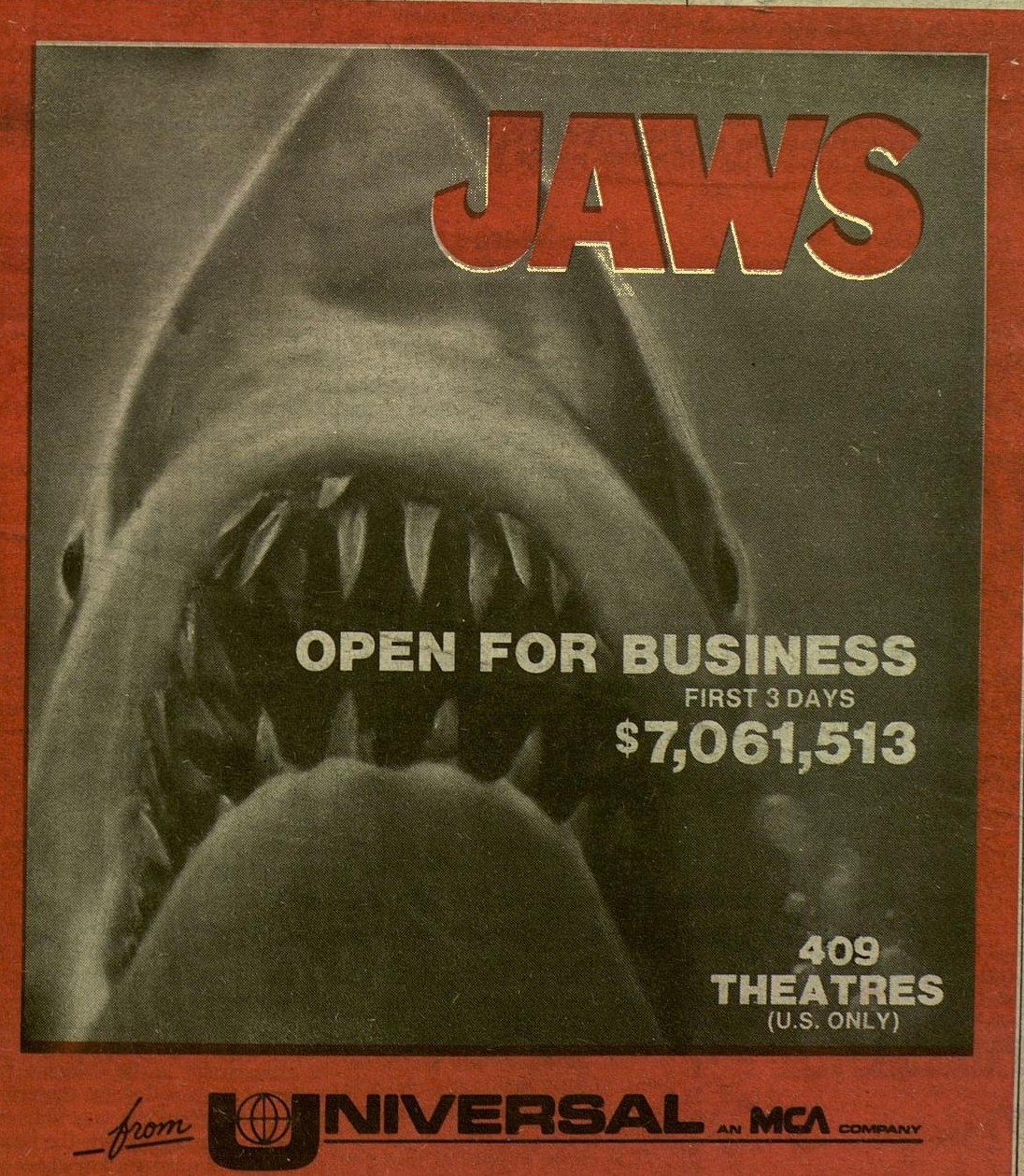
Behind the Scenes: The “Jaws” Juggernaut

Given the surprising success of the reissue of Jaws this weekend – it came in second at the U.S. ticket wickets ahead of such new films as The Roses and Caught Stealing – I thought you might like a second look (or a first one) at exactly how Universal created box office history. And it was not the way you would expect. It did not follow the template set out by previous juggernauts.

Naturally, the hoopla surrounding the 50th anniversary of Jaws concentrates on the budget overruns, director Steven Spielberg’s problems and the mechanical shark, and no one gives a hoot about the most important aspect of the picture – the box office. Sure, it’s always mentioned in passing, because otherwise the movie would have had little impact on pop culture, the driving force of the water cooler effect when so many people see the same movie at the same time it drives word-of-mouth into the stellar regions.

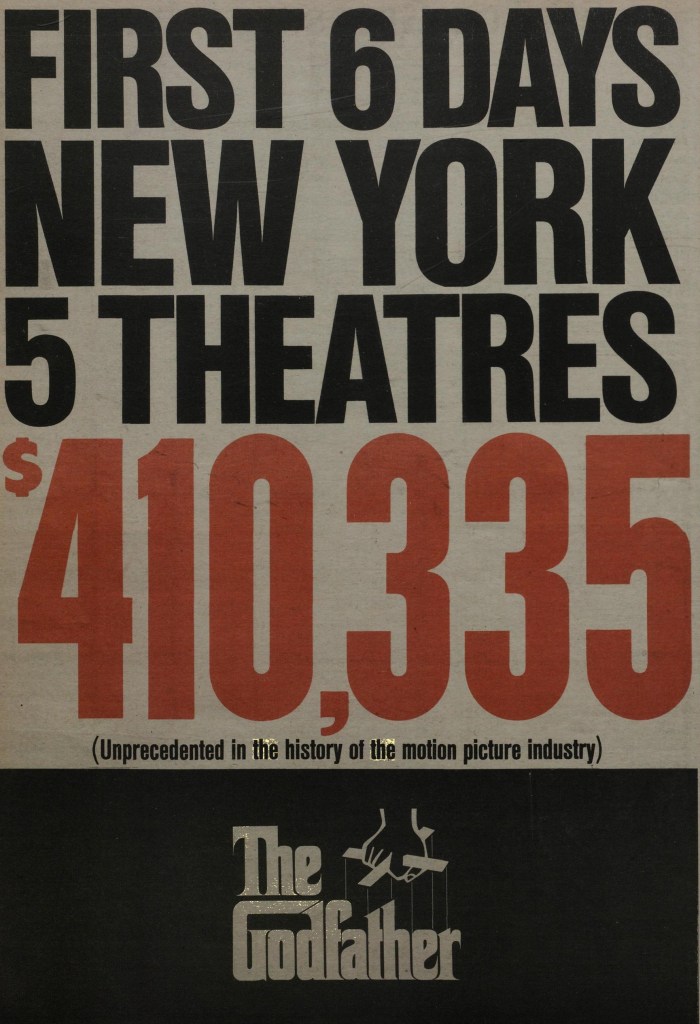
What is little known is how Jaws changed the release system forever. Even The Godfather (1972), its predecessor in topping the box office firmament, while spreading the goodies amongst nabes and the showcase houses did not ignore first run. In fact, for The Godfather Paramount used five New York first run houses – the 1025-seat Orpheum, 1175-seat State I, 1174-seat State II, 599-seat Cine and 588-seat Tower East – to create a pre-emptive strike. This quintet screened the movie exclusively for the first week, permitting the studio to trumpet the record-breaking results.
The other 350-odd cinemas had to wait a further week to get their hands on the gangster saga.

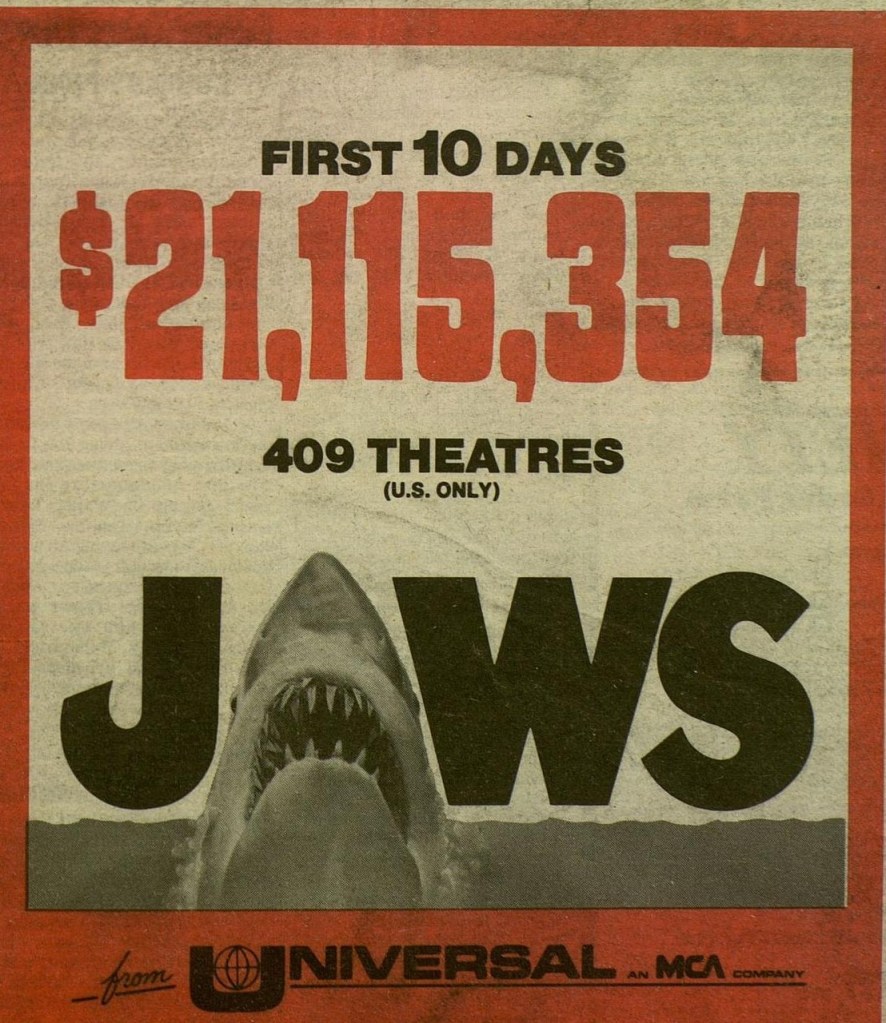
For Jaws, on the other hand, Universal completely froze out New York first run. Not a single first run house was given access to the picture on its initial release on this weekend 50 years ago.

Instead, in New York, Universal went down the showcase route and clocked up just over $1 million in the first three days at 46 cinemas. Prior to Jaws, the only pictures that would open first in showcase in New York and ignore that city’s vibrant first run were those that first run would most likely have declined to show.

With Jaws, across the country Universal was as ruthless in squeezing out first run if it could make a better deal in the nabes and drive-ins. So while Jaws set house records at all the first run houses that were deemed up to standard, it also creamed the nabes and drive ins. Significantly, not all the first run houses chosen would have been the first choice of most studios for a major picture. You wouldn’t have expected this behemoth to end up at the 925-seat Gopher in Minneapolis where it took in $47,000. Similarly, the 900-seat Charles in Boston ($55,000 take) would not have been your first choice (and it’s worth noting that it was only in this city that the movie did not top the week, beaten into second place by Woody Allen’s Love and Death at the 525-seat Cheri Three).
By and large, Universal picked off those first run cinemas that were so delighted to be asked they agreed to the tough terms – a 90/10 split in the studio’s favor and a 12-week run.

Other first run destinations included the 800-seat Cooper in Denver ($53,000 for openers), the 1670-seat Coliseum in San Francisco ($68,000), the 900-seat Southgate I and 550-seat Town Center II in Portland ($55,000 total), the 1836-seat Gateway in Pittsburgh ($70,000) and the 1287-seat Midland in Kansas City ($55,000). In these cities, the premiere outing was restricted to first run.

But while in Chicago the 1126-seat United Artists hauled in $116,000 in the opener, Universal played it canny by screening it simultaneously at four other nabes which brought in another $260,000. It was the same in Cleveland where the 455-seat Severance II was the only first run house among the five cinemas that hoovered up a total of $84,000. The first run 500-seat Goldman in Philadelphia was the only first run location among the total of 15 cinemas that knocked up $312,000.

Elsewhere, echoing the New York approach, first run cinemas were frozen out in Detroit, Buffalo and San Francisco. In Detroit seven nabes gobbled up $350,000, in Buffalo a deuce of nabes snatched $50,000, in San Francisco a trio set about $75,000.

We’ve all seen movies driven to opening weekend box office heights on the back of heavy advertising or hyperbole only to take a dive in the second week. And the fact that Universal was not making an “event” out of its movie by restricting it to first run meant that the sophomore weekend could easily have brought disaster.

Instead, receipts at virtually all the cinemas either beat the first week or fell only fractionally below. The opening weekend appeared to set the tone, every successive day better than the previous one.

Universal immediately set its sights on taking down The Godfather and began posting weekly advertisements in the trade papers hyping its performance at the box office. But in nudging first run out of the equation, it triggered the slow decline of first run houses.

Tomorrow, you can catch on my article that sunk many of the other myths surrounding Jaws, “Behind the Scenes: Exploding The Myth of Jaws.”

SOURCE: Variety.

New York Showcase: 1969 Box Office Race

In the days before computerised box office figures and the internet permitting easy access, fans of the sport had to make do with the weekly tallies in the “New York Showcase” section run every week in Variety. The “Showcase” was an early version of the wide release but instead of the 3,000-4,000 cinemas involved today in an opening week launch, movies would hit the Big Apple in 23-60 theaters. No matter the low theater count, it was still considered the most accurate prediction of how a movie would fare nationwide.

Some films opened straight into the showcase format, others ran day-and-date with a glossy opening on Broadway or a prestigious arthouse, and for a few this was the first step in general release after a roadshow run.

The same rules applied as today. A movie was retained for a further week only if the picture hit the target. Long runs were rare, two weeks the standard. As we shall see, some were movies making their 1969 debut while others were going wide after opening the previous year, the delay accounted for by holdover success in first run or Oscar recognition.

Just over 200 theaters took part in the showcase splurge, divided into five main strands generally through circuit or distributor affiliation plus one that brought together suburban arthouses. Not all the streams were in full-time operation, some weeks saw four new releases others six. Movies could count on losing theaters after the first week.

And, as with now, while overall receipts were the main factor, the per-theater gross could also offer up some indication of future performance.

The best single week’s take in 1969 was achieved by Dustin Hoffman comedy The Graduate which took $760,000 from 43 houses (per-theater average: $17, 674) followed very closely by Ali McGraw debut Goodbye, Columbus  with $757,000 from 44 ($17, 204 per theatre). Steve McQueen thrill-ride Bullitt nabbed $684,000 from 45 ($15,200). In fact all three pictures placed twice in the single-week top ten.

Others flying high, at least for one week, were: Whatever Happened to Aunt Alice ($540,000 from 48), True Grit ($531,000 from 49), Joanne Woodward in Rachel, Rachel ($522,000 from 42), psychedelic outing The Trip ($520,000 from 49), sexploitationer Fanny Hill ($506,000  from 42), The Boston Strangler ($481,000 from 38) and I Am Curious Yellow ($480,000 from 40).

By contrast, at the other end of the heap, Marlon Brando in Night of the Following Day could only manage $125,000 from 31, The Assassination Bureau scraped up $82,000 from 22, Elliott Gould in Ingmar Bergman’s The Touch hit $48,000 from 26 while Michael Caine performed abysmally, Play Dirty knocking up just $91,000 from 24, The Magus $80,000 from 20, The Battle of Britain tumbling stratospherically from $366,000 from 32 one week to $101,000 from 27 the next.

But the showcase system also breathed life into arthouse hits attempting to break out into a wider marketplace. John Cassavettes’ Faces rocked up $469,000 in three weeks, Luis Bunuel’s Belle de Jour $329,000 over the same period, Brian De Palma’s Greetings $263,000 in a fortnight while one week of Robert Downer Snr.’s Putney Swope registered $205,000.

Reissues were also prime fodder to stoke up a distribution system creaking at the seams due to lack of new product. Gone with the Wind (1939) was the plum, $658,000 in three weeks. Disney’s Swiss Family Robinson (1960) chopped down  $418,000 in two and Clint Eastwood pair A Fistful of Dollars/For a Few Dollars More – both released Stateside in 1967 – $279,000 in a fortnight. More usually, reissues lasted just a week, filling a gap in the annual program.

Even so, they could pull in some decent numbers: Peter Pan (1953) grossing $300,000, Sidney Poitier double bill Guess Who’s Coming to Dinner (1967)/To Sir, With Love (1967) $272,000, perennial favorite The Sound of Music $230,000, Rosemary’s Baby (1968)/The Odd Couple (1968) $215,000, James Bond dualer Goldfinger (1964)/Dr No (1962) $162,000, another Eastwood pair The Good, The Bad and the Ugly (1967)/Hang ‘Em High (1968) $155,000 and a lengthy coupling of Planet of the Apes (1968)/ Those Magnificent Men in their Flying Machines (1965) $115,000.

The overall winner in the annual New York Showcase stakes was The Graduate which over a five-week run grossed $2.24 million. Bullitt was the runner-up with $1.99 million over six weeks, though the last sally was in a double bill with Bonnie and Clyde. Goodbye, Columbus came third with $1.95 million over four weeks. Romeo and Juliet lasted a record eight weeks to pocket  $1.69 million. Fifth was Swedish sensation I Am Curious Yellow on $1.28 million after five weeks.

After playing first run for the best part of six months Rachel, Rachel hit the showcases following an Oscar nomination for Joanne Woodward, bringing in $1.08 million over three weeks. Another anomaly was I Love You, Alice B. Toklas, such a flop the previous year it was ranked 78th in the annual box office race, but now emerging as a showcase front-runner with $1.03 million over five weeks.

Eighth spot went to The Boston Strangler ($932,000 in three weeks) followed by Charly – Oscar win for Cliff Robertson – on $910,000 for six weeks. Butch Cassidy and the Sundance Kid was tenth with $900,000 in two weeks – the western had launched at the tail end of the year and did so well it ran for another five weeks in 1970 to capture an extra $1.5 million.

Filling out the top twenty were, in order, Easy Rider, Ice Station Zebra, The Night They Raided Minsky’s, The Wild Bunch, Popi, On Her Majesty’s Secret Service, True Grit, Oliver!, Whatever Happened to Aunt Alice and Fanny Hill.

In general terms, New Yorkers response to showcase releases was mirrored throughout the country.  The majority of the high-flying films mentioned ending up in the annual box office top 20. But there were some anomalies. Rachel, Rachel had finished the previous year in 37th place in the annual chart, hardly suggesting it was prime candidate for an exceptional showcase run. The Night They Raided Minsky’s came only 32nd in the 1969 chart. Whatever Happened to Aunt Alice did not earn enough around the country to qualify for inclusion on the annual chart. And, frankly, I’m mystified as to why I Love You, Alice B. Toklas did so well.

By contrast Paul Newman racing picture Winning performed so indifferently in the New York showcase that for the final two weeks of its three-week run it was bolstered by John Wayne oil adventure The Hellfighters, yet it ran out 16th for the year. Three in the Attic (18th in 1969) and Support Your Local Sheriff (20th) failed to match expectations in New York.

Discover WordPress

A daily selection of the best content published on WordPress, collected for you by humans who love to read.

The Atavist Magazine

by Brian Hannan

WordPress.com News

The latest news on WordPress.com and the WordPress community.