The advertising gurus earned their corn on this one because it must have come as a shock for all concerned, studio and audiences alike, to discover that star Charles Bronson (Farewell Friend, Adieu L’Ami, 1968) was engaged in a rapid reversal of his screen persona, an experiment that ended with the poorly received From Noon Till Three (1976). Sold as an action picture, this struggles to fit into the genre, what with most of the elements of rescue misfiring or D.O.A.
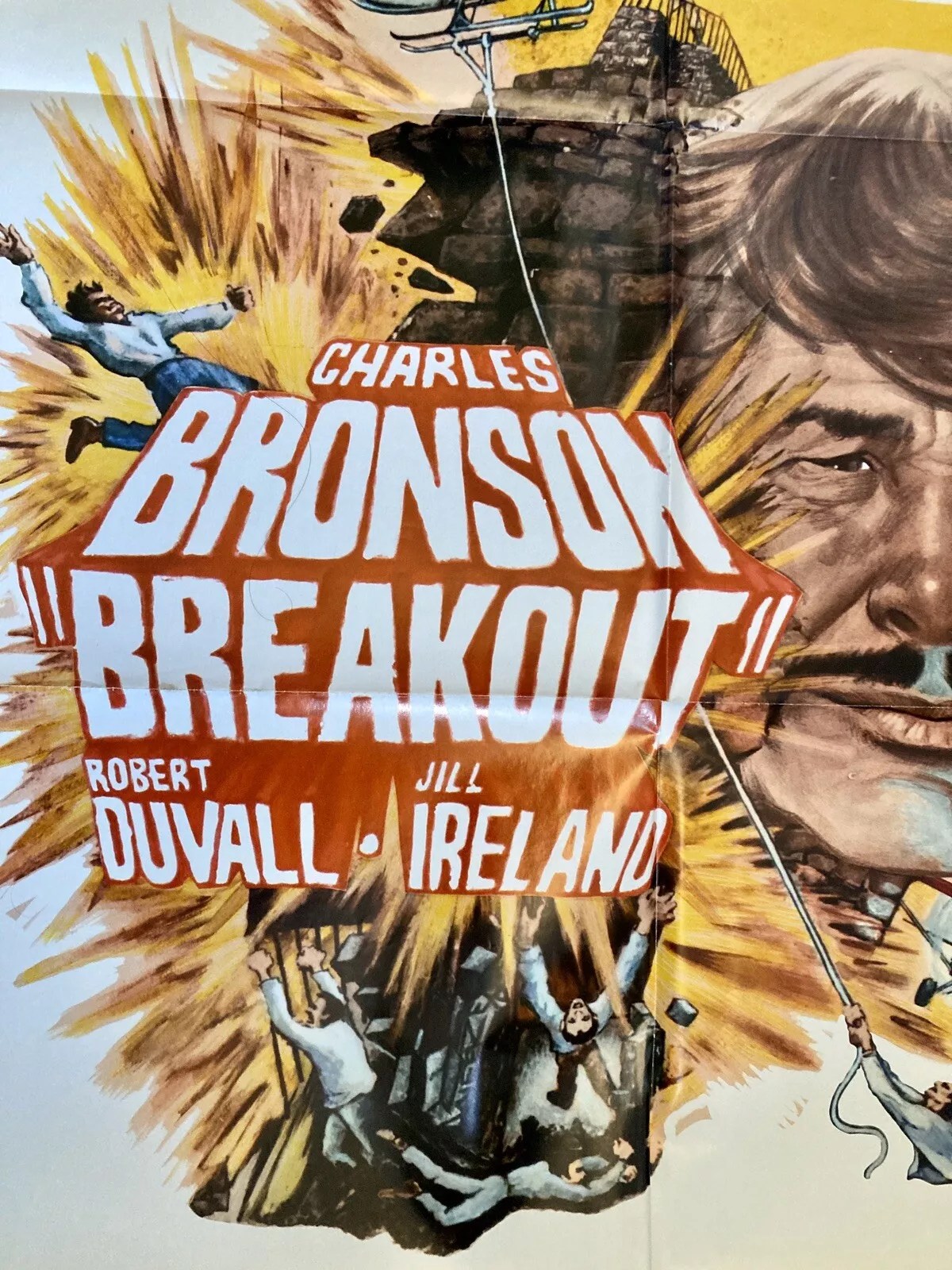
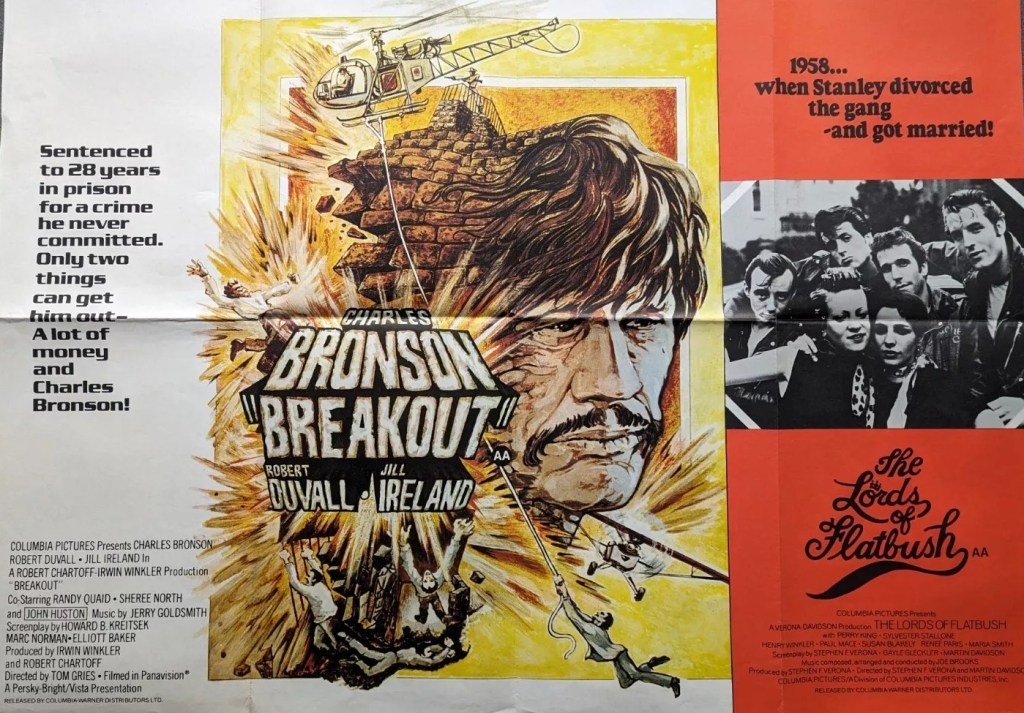
The poster people were so stuck for ways of selling the picture they resorted to using an image of an explosion in a manner that indicated it was key to the actual breakout when in fact it was related to a random incident. The highlight of the picture, the breakout itself, despite the best efforts to generate tension though the application of a 10-second escape window, is as mundane as all get-out, a helicopter basically loitering in a prison courtyard until the prisoner to be rescued saunters out.

Not only does the movie jettison the Bronson tradition of uncompromising tough guy but it sets up constant screen partner Jill Ireland in a more interesting role than normal while skirting a Casablanca-style romance.
The story itself gets off to a mighty confusing start. Nefarious businessman Harris Wagner (John Huston) arranges, for reasons that are unclear, for grandson Jay (Robert Duvall) to be incarcerated in a Mexican prison. Your first double take as an audience is the purported age gap. Huston was, in reality, was just past 70 years of age while Duvall was 44 – and never a chance of that actor playing younger – so you are left wondering how in heck did they contrive to be grandfather and grandson.
Putting that to one side, the first 15-20 minutes of a lean 96 exclude Bronson altogether while director Tom Gries (Will Penny, 1968) builds up the tale of failed rescue attempts by Jay’s wife Ann (Jill Ireland) and the sadistic nature of prison overlord J.V. (Emilio Fernandez) who has a penchant for burying prisoners alive or taking bribes to let them escape before promptly reneging on the deal. Eventually, for reasons unexplained, Ann turns to bush pilot Nick (Charles Bronson) who runs a seat-of-the-pants operation with the kind of plane that looks like it’s held together with string.
He’s not your usual monosyllabic grump, but an overconfident wide boy, the bulk of whose schemes fail to work. A modern audience is going to turn up its nose in any case at one plan that involves faking a rape to create a distraction for the prison guards rather than going down the simpler route of Raquel Welch in 100 Rifles (1969) and Marianna Hill in El Condor (1970) of giving the lascivious guards something to ogle.
And another proposal only works because it’s handed a get-out-of-jail-free card when the guards who make a point of groping every female visitor, in theory to check for contraband or concealed weapons, avoid doing so with Nick’s sidekick Hawkins (Randy Quaid) when he dresses up as a woman.
There’s not enough time for any genuine romance to develop between Nick and Ann, a notion that’s undercut in any case by the fact that she’s trying to rescue her beloved husband, but that does allow for more friction than was normal in their pictures. Takes her a long time, understandably, to trust this untrustworthy fella, what with his schemes that rarely work.
For tension we are almost entirely reliant on the bad guys, J.V. indulging in bits of sadism, someone on the inside always knowing of the plans ahead of time, or of Jay being so debilitated by his stay in prison that he seems too out of it to keep his appointment with freedom. There is a quite barmy assumption that should a stray helicopter land in a prison courtyard that none of the other inmates will think to hitch a lift out.
There is some good value here in the Bronson/Ireland partnership trying to shake off what they saw as the shackles of their joint screen persona, or perhaps wanting to re-validate Ireland’s place in the team after Bronson did exceptionally well in her absence in Death Wish (1974). But the story’s an odd one, a kind of discount-store escape, with Bronson essaying the kind of character usually left to such supporting acts as Warren Oates or George Kennedy.
But there’s just not enough that’s new here – the unfairly underrated From Noon Till Three showed how to ring in the changes – to justify Bronson’s inclusion although the Bronson/Ireland dynamic does undergo interesting change. Robert Duvall (The Rain People, 1969) is also acting against type, devoid of the bluster that was his calling card. Randy Quaid (The Last Detail, 1974) has a quirky part.
Tom Gries did well enough in Bronson’s eyes that he was selected for the follow-up Breakheart Pass. Too many hands on the screenplay tiller – Marc Norman (Shakespeare in Love, 1998), Elliott Baker (A Fine Madness, 1966) and Howard B. Kreitsek (The Illustrated Man, 1969) adapting the book by Warren Hinckle, William Turner and Eliot Asinof – suggested nobody really knew how to make this work. And they were right.
Interesting shift in the Bronson persona but a misnomer on the action front.

 The Magnificent 60s
Here you go:
“Columbia Pictures purchased the film rights to Eliot Asinof, Warren Hinckle, and William Turner’s 1973 book The 10-Second Jailbreak: The Helicopter Escape of Joel David Kaplan for $140,000, as announced in the 23 Apr 1973 and 24 May 1975 issues Publishers Weekly, respectively. A 14 May 1973 Publishers Weekly news item noted that Irwin Winkler and Robert Chartoff were planning to produce the film adaptation.
On 22 Aug 1973, HR reported that Michael Ritchie had been hired to direct. However, Ritchie was replaced the following year by Tom Gries, as announced in a 3 May 1974 HR news item. At that time, Charles Bronson had already been cast as “Nick Colton” and production was scheduled to begin late Jun 1974 in Spain and Los Angeles, CA. Although a 5 Jun 1974 Var brief stated that filming was set to start 1 Jul 1974 in either Badajoz or Puerto de Santa Maria, Spain, a 27 Jun 1974 HR news item noted that the production was delayed to begin a week later, on 8 Jul 1974. However, the 22 Jul 1974 DV reported that principal photography would commence that day near Lancaster, CA. The production moved to locations in France and Spain mid-Sep 1974, as stated in the 13 Sep 1974 Var. A week after filming began, a 30 Jul 1974 DV brief, which announced the casting of John Huston as “Harris Wagner,” noted that Ron Buck was the film’s executive producer, but Buck is not credited onscreen. Breakout remained on Var production charts through 30 Oct 1974 with Buck listed as executive producer. A 28 May 1975 Var brief reported a $1 million budget.
As noted in a 7 Oct 1974 Box news item, Gries publically declared the film a depiction of real events and characters, and his contention was reported in various news sources before the production was complete. In response, Chartoff-Winkler Productions and Columbia issued a formal statement that “clarified” the director’s claim, maintaining that the climactic prison escape scene was based on an actual incident, but the screenplay was entirely fictional. This appeal was met with antagonism from Bantam Books, which had purchased paperback rights to The 10-Second Jailbreak: The Helicopter Escape of Joel David Kaplan for $25,000 with the intention of issuing a “tie-in edition” of the book to coincide with the film’s release, as stated in the 24 Mar 1975 Publishers Weekly article. The producers further distanced the project from the Asinof-Hinckle-Turner book by refusing Bantam permission “to carry the picture’s title or cover copy naming its stars” and the publisher subsequently decided to resell the paperback rights. Publishers Weekly noted that the studio’s attempts to disassociate the film from the book were unconvincing, particularly because a condensed version of The 10-Second Jailbreak had been published in Playboy magazine with the same title as the movie, “Breakout.” Publishers Weekly speculated that Columbia’s insistence about the film’s fictionalization was due, in part, to Joel David Kaplan’s familial relationship with business magnate J. M. Kaplan, whose philanthropic “Kaplan Fund” was identified as a “CIA conduit” during a Congressional investigation of covert U.S. funding to Latin America. The 10-Second Jailbreak alluded to CIA involvement with Joel David Kaplan’s 1971 escape from the Mexican penitentiary, Santa Martha Acatitla, where Kaplan had been detained for nine years after he was convicted of murdering his business partner. J. M. Kaplan refused to comment on Publishers Weekly’s claim that he demanded an advance screening of Breakout.
Despite the controversy, the picture was released with onscreen “suggested by” credit to The 10-Second Jailbreak and its authors in a $1.25 million marketing “saturation” campaign, as noted in a 19 May 1975 Box article. Columbia planned to open the film at approximately 1,400 screens nationwide on 21 May 1975 with notably “stringent terms for exhibitors,” according to the 19 May 1975 DV, including an unusual “two-week payment demand” and a requirement for nightly reporting. The article stated that Columbia was spending an “unprecedented” $3.6 million on television advertisements, but the studio expected to recoup $20 million in the first two weeks of the film’s opening. One week after the national release, the 28 May 1975 DV reported grosses of over $8.2 million at 1,320 theaters.
The picture received generally negative reviews. The filmmakers’ obscure references to the CIA confused several critics, including Arthur Knight, who stated in his 29 Apr 1975 HR review that “somewhere between the concept and the screening room, someone seems to have added the notion of involving the CIA in the plot machinery… like a timely afterthought,” and A. H. Weiler, who commented in the 22 May 1975 NYT that the film’s vague “hints” to the CIA were never developed.”
LikeLiked by 1 person
Thanks for that. Much appreciated.
LikeLike