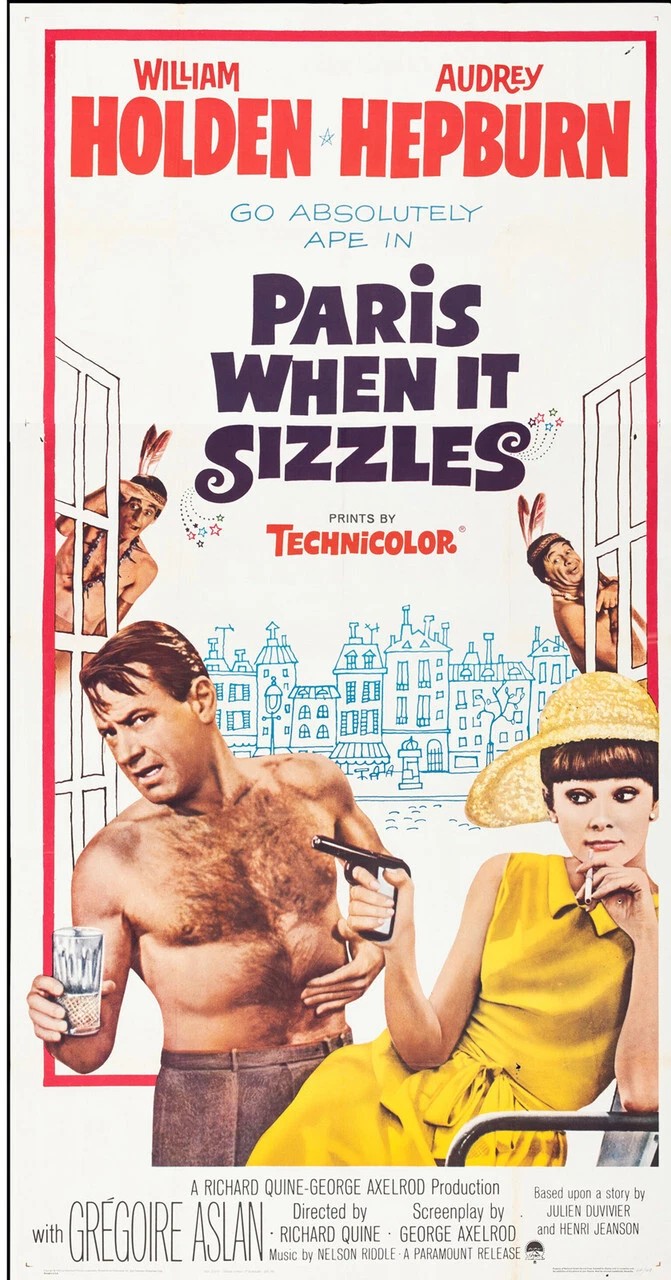
One of the main aims of the Pressbook/Marketing Manual ws to provide cinema managers with material for local journalists, which might result in the movie getting a mention outside the entertainment pages. Mostly, these consisted of bizarre snippets that you might imagine editors would instantly reject, notions that an actor had previously had an arcane profession, or something quite random such as that Audrey Hepburn demanding Dressing Room No 55 in a studio. However, marketeers on this picture struck gold.
Having made three pictures in Paris, Audrey Hepburn offered useful tips for prospective travellers. She named five offbeat haunts. “One is a tiny shop near the Madeleine where old and proud workmen are busy all day on all kinds of things from miniature Eiffel Towers to chessmen,” she advised. “Another is a flower stall on the Ile de Cite where an old grandmother whose three sons died in World War I looks after what she has brought from her own garden to sell.
“Another is an ancient Left Bank restaurant, the Procope, which dates from 1686 but few persons except students know about. Robespierre, Danton, Napoleon, Victor Hugo, Balzac, Verlaine and many other famous persons ate there regularly.”
Another favorite is a “small grove” in the Bois du Boulogne near where the Duke and Duchess of Windsor lived. “The combination of the sun filtering through the elms, spruces and chestnut trees against the loveliest beds of blooms with a little waterfall on one side makes an exquisite ‘real life’ painting.” Her final recommendation was the Little Trianon, favored by Marie Antoinette, at Versailles.
On the fashion front we discover that Hubert de Givenchy worked for six months on designing her clothes for the picture. A hundred sketches “were discarded” before the final selection was whittled down to eight dresses.
Having acted the part of a secretary, Hepburn also felt qualified to pass on tips to those occupying such a position. Don’t ask about your boss’s personal life, she emphasised. Also, make sure you wear the kind of make-up he likes, don’t dress better than the rest of the staff and be prepared to give up your coffee break to pound your typewriter.
Not to be outdone, and possibly encouraged by working alongside a fashion icon, William Holden let rip on male fashion. “Who says that a man has to wear a coat in a fashionable restaurant?” he rages. “And this business of the extra-heavy coat lapel. That’s got to go along with those stupid folded-handkerchief pockets. Also, I can’t understand why men have that extra bottom button on their coat, you know, the one they never button.”
He rails against trouser cuffs and objects to the fashion that “dictates” he has to wear cuff links inside his jacket sleeve.” He and director Richard Quine once fashioned their own suits during the filming of The World of Suzie Wong (1960).
Quine was discounted as having any publicity value in the 10-page A3 Pressbook, but screenwriter George Axelrod was deemed worthy of an article about the “wacky” concept. He argues, “Pictures today must be unconventional. Stories that old-time editors might tell you are the safest may lead to disaster.”
Unasked, he also sprung to the defence of the principals, claiming “They are never late, are spark plugs of enthusiasm and ask to spend extra time rehearsing.” This would have come as something of a surprise to studio executives enduring Holden’s alcoholism – at one point during filming he had to go and dry out.
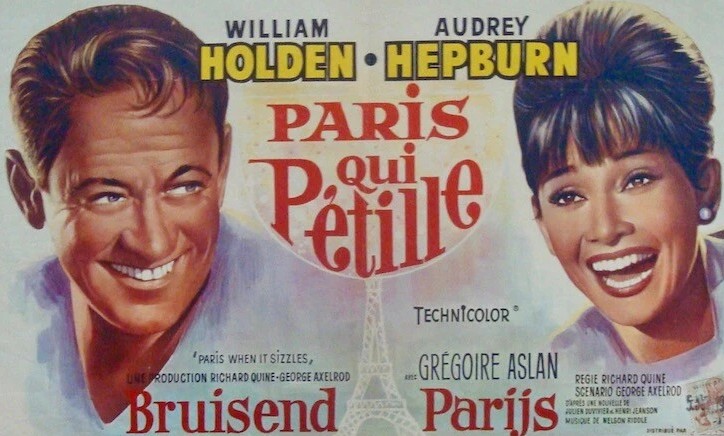
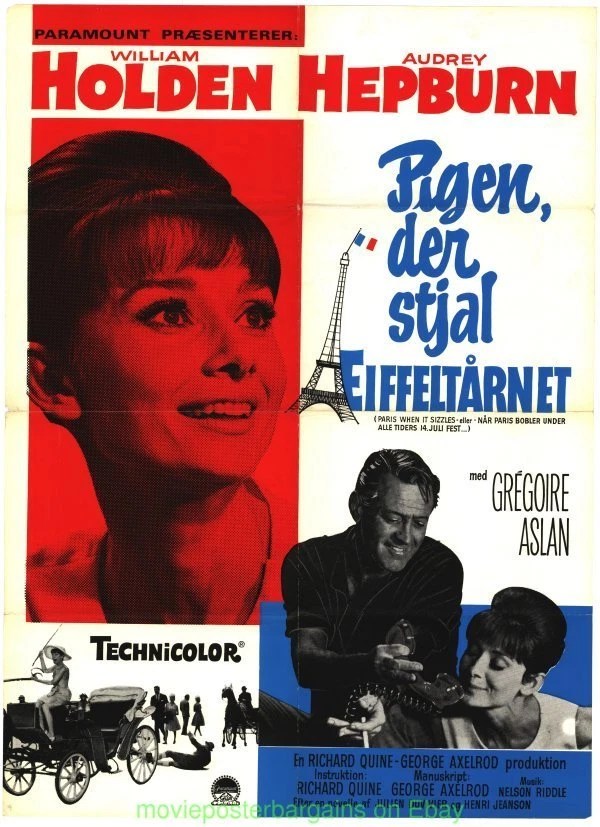
Perhaps believing that the names of the stars would automatically sell the picture, the advertising team stinted on poster variety, relying on two simple designs and taglines.
Otherwise there was a wealth of marketing ideas, the pick of which was a “gigantic national contest” to win an escorted tour of Europe, including a trip to Paris (natch!) run by Gateway Holidays.
As well as record retailers stocking Nelson Riddle’s soundtrack and bookshops selling a novelization of the script – both of which could offer vital window displays, there was also a tie-in with Givenchy. The fashionista’s dresses weren’t being turned into a line, which the vast majority of the audience couldn’t afford in any case. Instead, Givenchy had created a special perfume for Hepburn called “L’Interdit Perfume.” Its launch was accompanied by half-page ads in the likes of Vogue, the New Yorker and Women’s Wear Daily, each carrying mention of the movie.

 The Magnificent 60s