The big buzzword in movie marketing back in the day was “pre-sold.” The reason Hollywood pumped so much money into buying up the rights to bestsellers and Broadway hits was the notion that they came with a built-in audience, either of readers of theater-goers, and without any substantive proof made the connection that anyone who had read the book or seen the play or musical would be only too desperate to see what a movie maker made of the piece. In the 1960s, as I pointed out in a previous article, Hollywood had discovered the paperback tie-in, which marketing hacks perceived as free advertising, since those book covers would go on display in over a 100,000 book outlets across the country.
Even so, it comes as something of a surprise to see how dependent the marketeers writing the 16-page A3 Pressbook/Marketing Manual were on drawing cinema managers’ attention to the fact that Sweet Bird of Youth had originated on the stage. The three main articles in the Pressbook either went with “repeats role” or made mention in the headline of its origins. Admittedly, it had been a hit on Broadway, and with Paul Newman attached, ran for over a year – its poor performance on tour was naturally omitted. The opening article sensibly went to promoting Tennessee Williams. This was deemed “one of his greatest hits” and moviegoers would certainly be aware of his name thanks to Cat on a Hot Tin Roof (1958) and Suddenly, Last Summer (1959), both big hits.
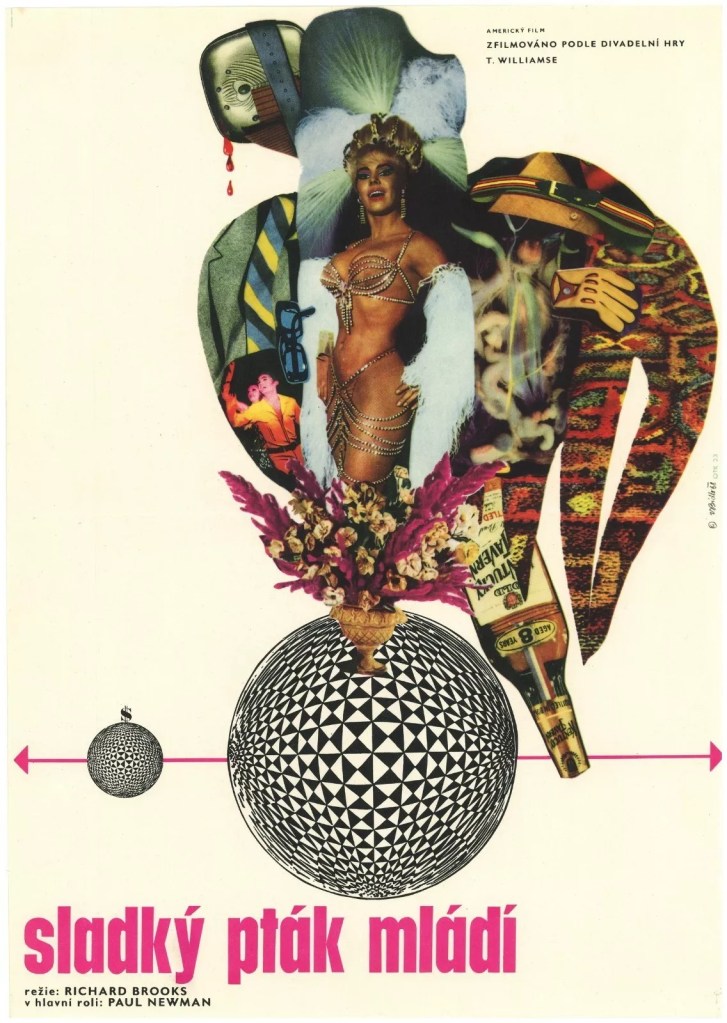
However, given that Geraldine Page was the female lead and Oscar-nominated the previous year for Summer and Smoke, it seems odd that more column inches are devoted to third female lead Madeleine Sherwood with second female lead Shirley Knight overlooked except for a couple of postage-stamp-sized photos.
The “distinguished cast” notion was pushed much in the same way as trailers these days will promote anyone with the slightest brush with the Academy Awards.
“People have wondered why I had to work so hard to repeat a role I had done for more than a year in New York,” said Newman. “My only answer is that during the entire Broadway run of the play, Geraldine Page and I worked and rehearsed every day as if we were preparing for first night.” Despite his box office success he nurtured other ambitions. “ I want to be behind the camera. I’ve got my sights on directing. But I’ll start only when I think I know enough.”
The marketeers fell in line with the notion now being touted in Hollywood that, despite leaving Geraldine Page out in the cold for seven years after she starred opposite John Wayne in Hondo (1954), was “a major talent to be reckoned with by fans and critics alike.”
Commented Page, “I played Sweet Bird and Summer and Smoke on stage for long so that I felt I knew the heroines Alexandra Del Lago (Sweet Bird of Youth) and Alma Winemuller (Summer and Smoke) as well as if they had been sisters of mine. This long-lived familiarity with a part might make some actresses feel cluttered but but it was a great comfort to me…You can work with them forever and never get bored…the longer you get to know them the more you become fascinated with them.”
And what was it, exactly, that was so fascinating about Madeleine Sherwood? It was the fact that she was a method actress, as though this was still big news after being known for over a decade. She explained that “emotional memory” as proposed by Lee Strasberg, method acting’s most famous proponent, was the key to her acting.
Pressbooks always tax the ingenuity of the marketeers who have to dream up snippets which might interest a local newspaper editor. Here we learn that virtually all the cast were blue-eyed, “associated with genius” according to the Pressbook team. For the scenes in which Newman drove a car – on a sound stage no less – he drove 600 miles without hitting a real road. We learned that Newman once wore a beard in a stage show in his early years and that Page once played an old crone also on stage. Also that Page was a dab hand a wearing a negligee, having spent time in her “lean years” working as a model in a negligee factory on Seventh Avenue.
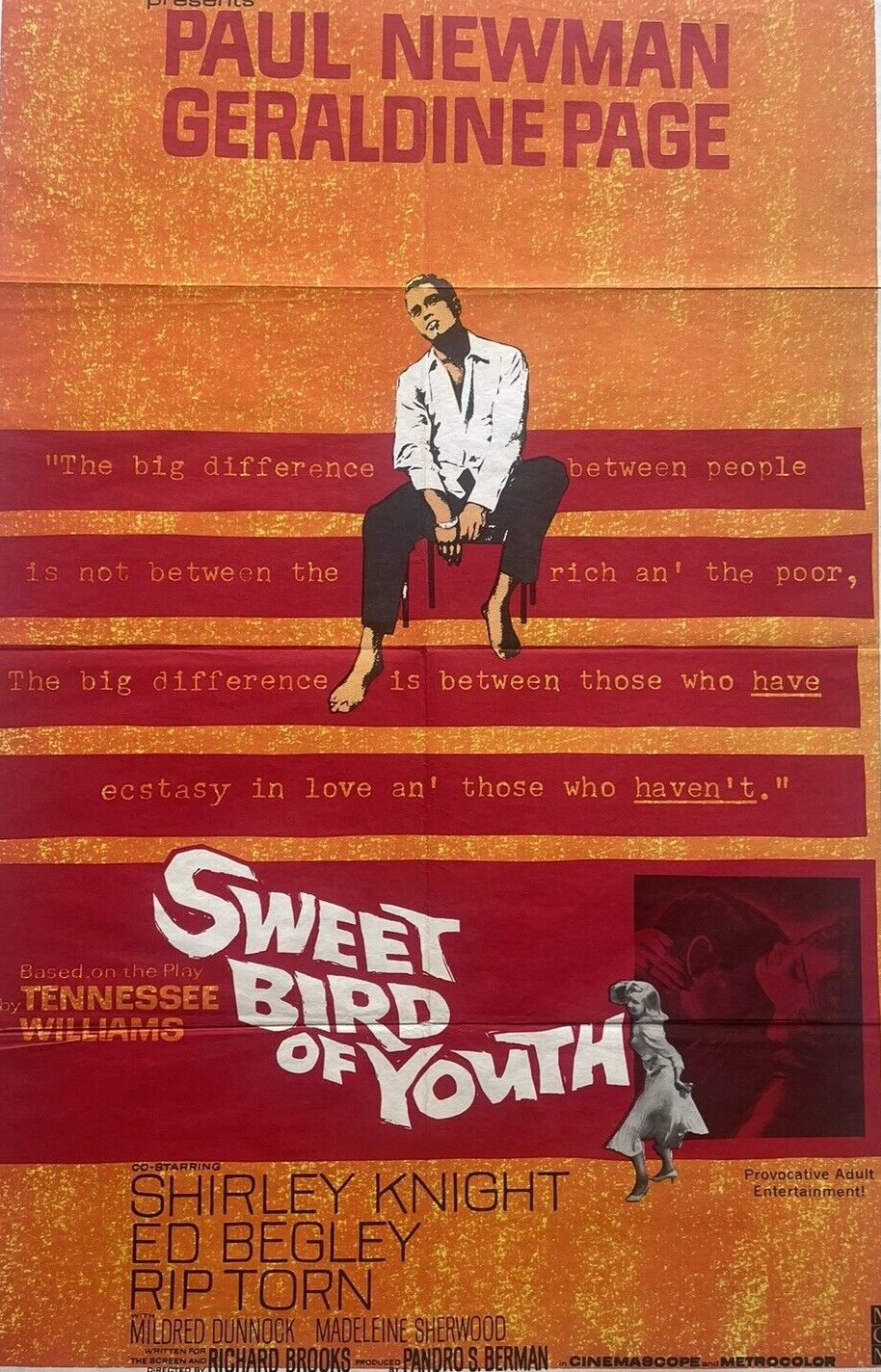
It would appear that there was a difference of opinion when it came right down to it about which advert – there were four to choose from – would lead the advertising pack. The Pressbook led with the tagline – “the big difference between people is not between the rich an’ the poor. The Big difference is between those who have ecstasy in love and those who haven’t.” Instead the team responsible for the posters went with the shorter, “He used love like most men use money.”
That tagline originated from a longer one, that more or less told the story of the movie. “Here he is right up on top of the gaudy world he swore he’d conquer. He’s got a movie contract in his pocket, a fish-tailed convertible in the hotel garage and a dame in his room payin’ for the drinks. He’s Chance Wayne who used love like most men use money!”
The speedboat that makes a brief appearance was central to the marketing campaign. Theater owners were urged to arrange tie-ins with local distributors of not just boats but boat engines. This was on the back of the Dumphy Boat Co of Oshkosh, Wisconsin, providing a $10,000 luxury speed boat for the shoot and because the Scott Racing Team supplied the $200,000 engine that powered it. Claims that the movie contained one of the greatest-ever telephone calls ever committed to celluloid provided the marketeers with an excuse to suggest a tie-in with a local telephone company.
Some ideas were more random. Because Newman wore a watch and Page a fur, tie-ins were suggested with those manufacturers. For no particular reason, except that she used them in her ordinary life, Shirley Knight was associated with cosmetics, perfumes and sportswear
A bit more imaginative was the idea of running a one-act play competition with a local dramatic group. A “Tennessee Williams Week” could be promoted through local libraries. A paperback version of the play had been published by the New American Library.
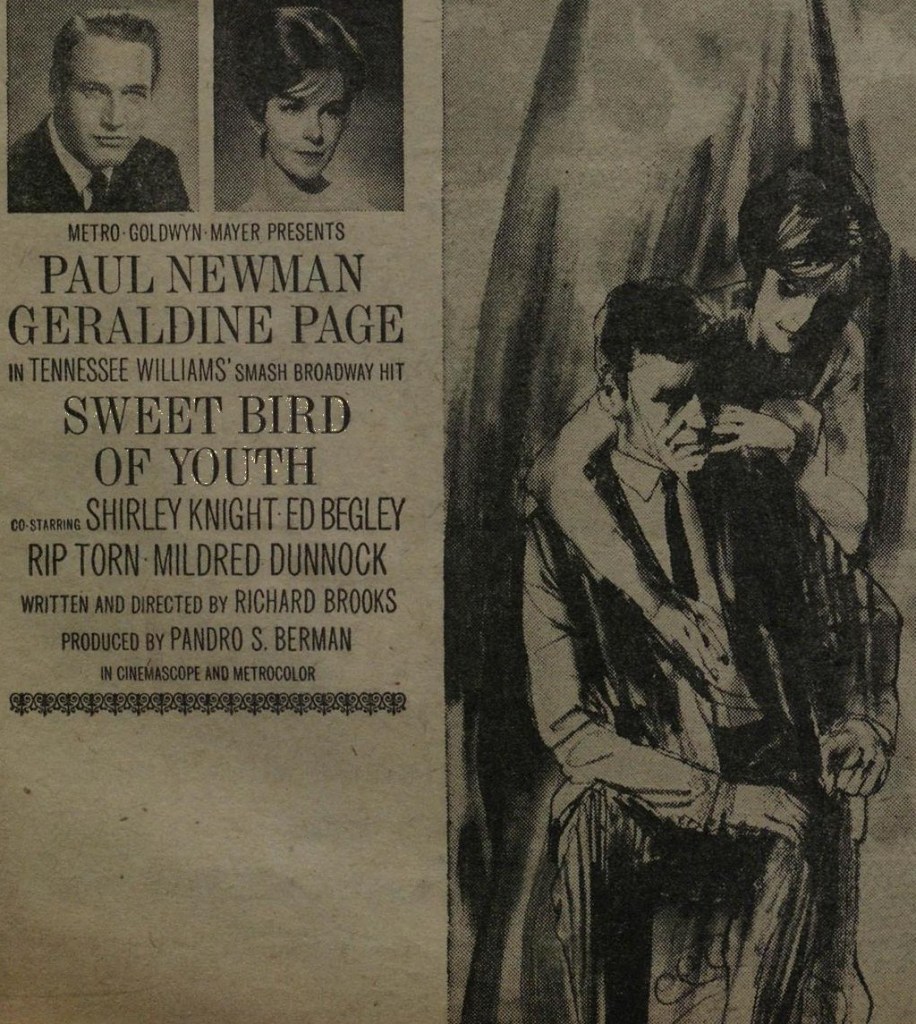
Actually, the biggest element of the Pressbook was the advertising. Twelve pages out of the sixteen were devoted to adverts in various shapes and sizes, that variety important because in those days cinema owners simply cut out the advert they required and passed it on to a newspaper to make up the advert to run there.

 The Magnificent 60s