
It’s easy to forget that the main purpose of the Pressbook/Marketing Manual is simply to provide a cinema manager which a range of advertisements in various sizes that they can cut out and take along to their local newspaper to be reproduced, plus a synopsis of the picture, list of the cast, billing credits and that other essential – running time. Most Pressbooks were not upscale A3 or even A2, printed in color, with fold-outs, and running to 20-plus pages with extensive cast bios, journalistic snippets and promotional ideas.
They were produced long before the movies went into release, sent out weeks or even months in advance, as a studio promotional tool, to lure cinema managers into booking the picture. Big studios employed marketing teams or farmed the job out to PR specialists before there was a finished film to view – and even that might be considered too time-consuming a task.
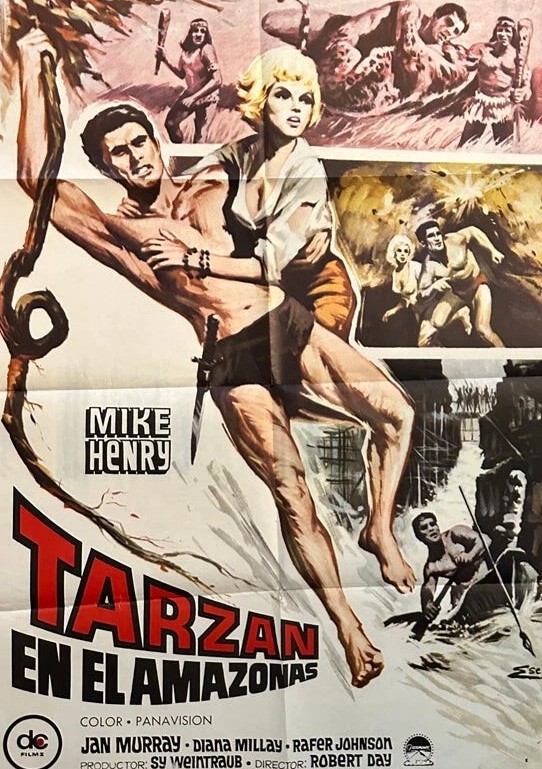
So there was a fair chance marketeers were working from a synopsis. And no guarantee they would even have the time to read that. For a picture like Tarzan and the Great River, there were obvious default promotional ideas – tie-ups with travel agencies, or camera stores for people to submit photos of their travels, or lobby gimmicks.
But it’s not going to help your chances if you – as the cinema manager – haven’t read the synopsis either and plan your promotional agenda on the information available in the “Exploitation Tips” section of this particular Pressbook.
Out of seven such ideas, three assume the movie is set in Africa rather than South America. So camera stores, whose managers wouldn’t have seen the synopsis either and were relying on the cinema manager’s advice, might end up asking customers to submit photos “suggesting African scenes.” Similarly, travel agencies would be instructed to “take advantage of the African background” to organise a window display “with African tour backgrounds.” You would be ordering in safari outfits for the ushers to wear or find African motifs to decorate the lobby.
Outside of these blatant errors, the advertising agency had done a good job of trying to reposition Tarzan’s public image. He was now “America’s Number One Hero” in possibly an attempt to challenge James Bond.
To interest editors, the marketers compiled a list of other athletes turned actors. Current Tarzan Mike Henry had been a “bruising line-backer” with the Los Angeles Rams and the Pittsburgh Steels. The villain of Tarzan and the Great River is played by decathlon champion Rafer Johnson. John Wayne and Jim Brown had also been pro footballers.
Babe Ruth put in a screen appearance, playing himself, in Pride of the Yankees (1942) starring Gary Cooper. Mickey Mantle and Roger Maris played themselves and for a full-length feature in Safe at Home (1962). Former Rams star Elroy Hirsch also played himself, but this more than a cameo, as he was the star of his biopic Crazylegs, All-American (1953). Subsequently, he starred in the non-sports offerings Unchained (1955) and Zero Hour (1957)
With not much to interest the newspapers in Mike Henry beyond beefcake photos, the marketeers majored on producer Sy Weintraub, who had begun his career in television syndication, and was credited with originating the concept of the “Late Show.” As president of Motion Pictures for Television, he ushered in the gold rush of buying up old movies for small screens. He also owned a TV and radio station, but he sold up all these interests to finance the purchase of the rights to Tarzan in 1958.
Tarzan had been around for so long on the silver screen that one of the more interesting promotional ideas was to offer a free ticket to anyone who could recall seeing the first Tarzan Elmo Lincoln back in 1918..
The advertising taglines emphasized danger: “barehanded combat with a wild jaguar,” “vicious man-eating piranhas,” “blazing volcano”, “savage tribes,” and “risking his life to save his woman.” It was rather a bold claim that the picture offered “more heart-stopping adventure than anything on the screen now.”
While the Pressbook was A3 in size, it was limited to just six pages. There were only two advertisements rather than the half-dozen-plus that were common. Having said that, the character must already have been imprinted on the public mind so possibly there was little point trying to say more.

 The Magnificent 60s