
“Showmanship” isn’t a word likely to crop up in critical appraisals of David Lean’s magnificent Russian romance. Few people in any audience would have an idea of its meaning. But when you see Doctor Zhivago given the full roadshow treatment with overture and entr’acte and in a theater where curtains come into play and a good chunk of the audience comprises industry professionals – projectionists, exhibitors and the like – it takes on a certain significance.
Generally speaking, “showmanship” related to the efforts of the exhibitor to sell a picture to a local audience in an enterprising manner. It’s not about posters or adverts. It’s about, in this instance, tying up a fashion show with a department store or having a sleigh sitting outside the cinema on opening night or running a competition where the prize is Russian fur.
But there was another element to showmanship and that was what was under consideration for the 70mm screening at the Bradford Widescreen Festival. You’re probably unaware that studios were incredibly dictatorial when it came to the presentation aspects of roadshows. Not only were musical cues expected to be rigidly adhered to, but projectionists were supposed to open the curtains at a specific point and progressively dim the lights at other pre-set moments.
The opening of the second half of this picture was considered a highlight – if not the highlight of all roadshows – of the movie. For when the movie recommences, we are in a tunnel and stay there until the train emerges at the other side. If such a thing exists it’s a roadshow coup de theatre, a director who’s not just taken immense pains over the most infinite of details but worked out to the last second where the first half of the movie should end and, more importantly here, how the second half should begin.
So the couple of hundred in the audience were watching to see if the projectionist would cock it up. Luckily, he didn’t. I was expecting the audience to burst into applause, but they didn’t do that either.
I hadn’t seen this picture in well over a quarter of century, once the director’s reputation, outside of Lawrence of Arabia (1962), had declined in the face of a critical onslaught that declared him the wrong kind of auteur, the one who wastes his power on frivolities. As far as the auteur theory went, it wasn’t a good idea for a director to drift outside set lines.

And this was one who’d moved from movies featuring a flawed hero struck down by circumstance as with Bridge on the River Kwai (1957) and Lawrence of Arabia, to one who’s major flaw was falling in love. What’s more, in Doctor Zhivago and its critically reviled successor Ryan’s Daughter (1970) he was focusing far more on women than ever before.
Lean was the type of director who visually went all-in. You want jungle, you’ll get masses of it in Bridge on the River Kwai, acres of sand dunes in Lawrence of Arabia, ice-covered panorama in Doctor Zhivago and the pounding Atlantic Ocean in Ryan’s Daughter.
And, boy, especially in 70mm, does it work here. The whiteness of the land is as implacable as the situation our hero finds himself in.
I was surprised how cleverly constructed the film was in terms of the romance. Zhivago (Omar Sharif) and Lara (Julie Christie) are kept apart for substantial periods of screen time. Even when they do fall in love, working side by side in medical tents during the First World War, you don’t see it, or at least not that moment so beloved of the romanticists.
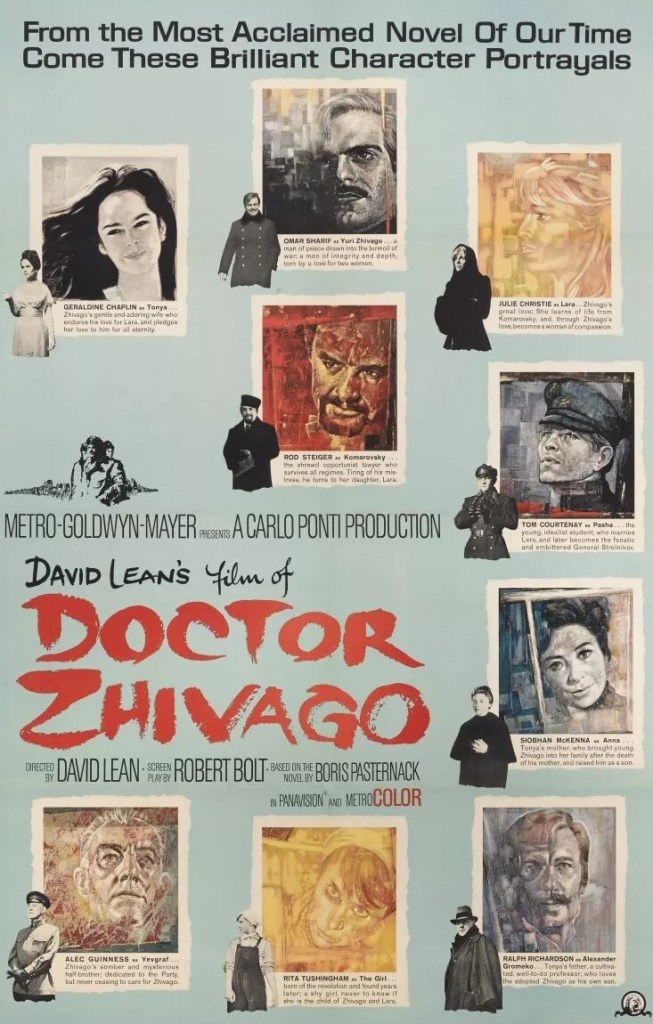
In fact, it would have been better if he had disdained her, given she was the mistress of loathsome businessman Komarovsky (Rod Steiger) and attempted murderess and wife of vicious Bolshevik leader Pasha (Tom Courtenay) to boot. In any case, he’s in love with Tonya (Geraldine Chaplin).
That Zhivago is tossed here and there by the consequences of the Russian Revolution serves the movie’s purpose of keeping him even further apart from Lara. For good measure, his half-brother, the secret policeman Yevgraf (Alec Guiness) turns up from time to time to keep the narrative on track.
Zhivago moves from rich society to a somewhat rebellious proletariat and finally settles down as a poet in an icebound wilderness. But, except for a couple of sequences, David Lean avoids the sweeping action of Lawrence of Arabia, and in fact the most notable scene, the charge of the horsemen down the streets of Moscow, is dealt with discreetly, its impact most viewed through the eyes of the watching Zhivago.
Lean took an enormous risk in imposing two virtual unknowns on MGM for the leads. Theoretically, Sharif was a star but had done nothing to bolster his marquee credentials following Lawrence of Arabia, ending up in a series of duds that did not envisage him as the Egyptian equivalent of the Latin lover. It took Lean to see the power in those brown eyes. And to put his faith in Julie Christie, who had even less in her locker (she made Darling, 1965, after this).
There is very dependable work all round, Rod Steiger (The Pawnbroker, 1964) overplaying, Alec Guinness (Lawrence of Arabia) underplaying, Tom Courtenay (A Dandy in Aspic, 1968) doing both.
But the movie belongs to the principals and to Lean and on seeing again after all these years and with the benefit of 70mm, it now sits very close to the peak of the director’s achievements. Screenplay by Robert Bolt (Lawrence of Arabia) and memorable score from Maurice Jarre (Lawrence of Arabia).
Not just sumptuous, but tough, hard-edged, and doesn’t let the audience a moment to breath.

 The Magnificent 60s
I think this is a great movie; she was terrible at ironing, nobody liked his poetry, but when they met, it was murder! Bolt’s screenplay and Christie really make it for me.
LikeLiked by 1 person
That was the tagline I responded to.
LikeLiked by 1 person
It’s remarkable how much this film’s stature has fallen over the last few decades. It had regular theatrical rereleases into the early seventies and was an event whenever it ran on network television. Even its VHS release in the eighties was heavily promoted. I’d almost speculate that the stigma around “Ryan’s Daughter” stained its reputation but maybe it’s just the public’s every shifting whims. Whatever the reason the film is due for rediscovery. All it needs is one cute girl raving about it on TikTok …
Anyway, I envy you for the experience. Someone needs to mount an international 70mm festival to remind people what a big deal movies once were.
LikeLiked by 1 person
Apologies for the late reply. I’ve been on holiday. I can post reviews in advance so it looks like I’m not on holiday. But then when I don’t respond to comments I’m caught out. I’m with you on reviving it. There are two other 70mm festivals – one in Germany and one in Sweden. But we could still do with more or a curated space that shows them all once a year.
LikeLike