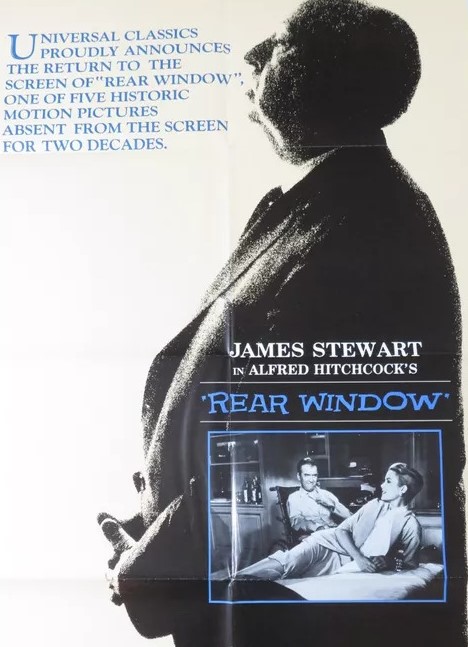
There was a contract makeweight that studios occasionally ceded, something they viewed as a form of vanity from their opposite number across the negotiating table. That was to be given the copyright to your own films seven years after initial release. Studios didn’t believe the concession was worth much than a few dollars to add to a star or director’s pension, otherwise they wouldn’t have allowed it in the first place. In the 1950s, with remarkably few exceptions, a film was done and dusted on initial release. Should there be any more juice remaining, that would be mopped up by a judicious reissue before the seven-year deadline was up.
Once the studio system collapsed in the late 1940s and long-term contracts became devoid, studios battled each other to win over stars and directors with a proven track record. In his negotiations, Alfred Hitchcock asked for, and received, the copyright for five of the pictures that would later prove to be the ones that formed the cornerstone of his revived critical reputation.
In 1981, restoration, thanks to Abel Gance’s Napoleon (1927), had become big business. But optimism only lasted as long as it took for Warner Brothers to lose a sizeable sum on a restoration of A Star Is Born (1954)
Fortunately, another reissue poster boy was waiting in the wings. Universal, its classic division now headed by Jim Katz, looking for a follow-up to Napoleon, was in the right place at the right time. Legend has it that Hitchcock movies had gone missing from the circuits. While that was the case regarding the Paramount quartet to which he owned or shared copyright – Rear Window (1954), Vertigo (1958), The Man Who Knew Too Much (1956) and The Trouble with Harry (1955) – it was not true of the rest of his portfolio.
Critical acclaim for the director had grown faster in Europe than America, one measure of his standing being The 39 Steps (1935) chosen to close the annual Venice Film Festival in 1968.[i] The 39 Steps received a new lease of life in the U.S. in the 1970s as the result of an unusual stimulus. In 1971 PBS television kicked off the year with a five-month weekly series of classic foreign films, including this Hitchcock. Viewers were soon persuaded that there was nothing like seeing old movies on the big screen and following the broadcast the film was reissued in Washington, Pittsburgh and Dayton, in a double bill with The Lady Vanishes (1938), and on its own in Cleveland. [ii]
While exposure in small-capacity arthouses limited earnings, it burnished Hitchcock’s artistic reputation. Both The Lady Vanishes and The 39 Steps continued to entertain new generations of movie lovers and remained popular on repertory programs, for example, in New York and Boston, while The Lady Vanishes, nearly forty years late, made its debut in Japan along with Foreign Correspondent (1940) and Young and Innocent (1937) aka The Girl Was Young.[iii] Remakes of The 39 Steps (1978) starring Robert Powell, best known for the television mini-series Jesus Of Nazareth, and The Lady Vanishes (1980) with Elliott Gould and Cybill Shepherd only served to remind critics of the vastly superior originals.

After Hitchcock’s death in 1980, Universal bought up the Paramount package and in 1983 reissued four of them plus Warner Brothers’ Rope (1948) with new prints and advertising campaigns. Apart from The Trouble with Harry, none could complain of having been undersold or particularly neglected. But they did fit into the “lost classic” category because they were impossible to see, all withdrawn by Hitchcock from the theatrical market for decades, Rear Window, for example, last seen in 1962.
The films would be released in the following sequence – Rear Window, Vertigo, The Man Who Knew Too Much, The Trouble With Harry and Rope – targeting small-to-medium first run theaters, which could support a lengthier engagement (seven to ten weeks) without feeling the commercial strain, rather than arthouses. Universal was bullish, demanding new film terms. The advertising campaign was uniform, Hitchcock’s name more prominent than any individual star. Drawing on the MGM Fabulous Four and Chaplin retrospectives, theaters were expected to commit to showing the films one after the other, achieving, in effect, a Hitchcock Festival lasting up to twenty or thirty weeks. No director aside from Chaplin had been honored in this fashion. Retrospectives of John Ford, Billy Wilder, Howard Hawks or William Wyler had been confined to arthouses or museums, individual films shown for one performance, not weeks at a time.
“Initially,” explained Jim Katz, “we’ll attract people who saw the films when they (first) came out but we’re counting on them to spread the word to the younger generation.” The studio viewed it as “an example of preservation and restoration that can also make money.” A commercial retrospective focused around one director appealed because Universal had other candidates, namely Preston Sturges and Douglas Sirk, who could benefit from a similar approach. The marketing employed a clever mixture of the artistic and commercial, where possible the individual films launched at film festivals, Rear Window leading the way by re-premiering at the New York Film Festival on September 30, 1983, beginning its New York engagement at four cinemas before rolling out in fifteen cities during October.[iv]
The results were spectacular. Rear Window’s opening week in New York commanded $120,000 (equivalent to $400,000 today) running neck-and-neck with other big-budget films of the day, and taking $150,000 in one cinema in Chicago over four weeks. More importantly, when widened out to non-arthouses the movie held its own, with $130,000 from 27 in New York. By the end of November, the nationwide haul was $2.1 million and by the end of the year $3.8 million. Records were broken in Washington, Vancouver, San Francisco and Portland.
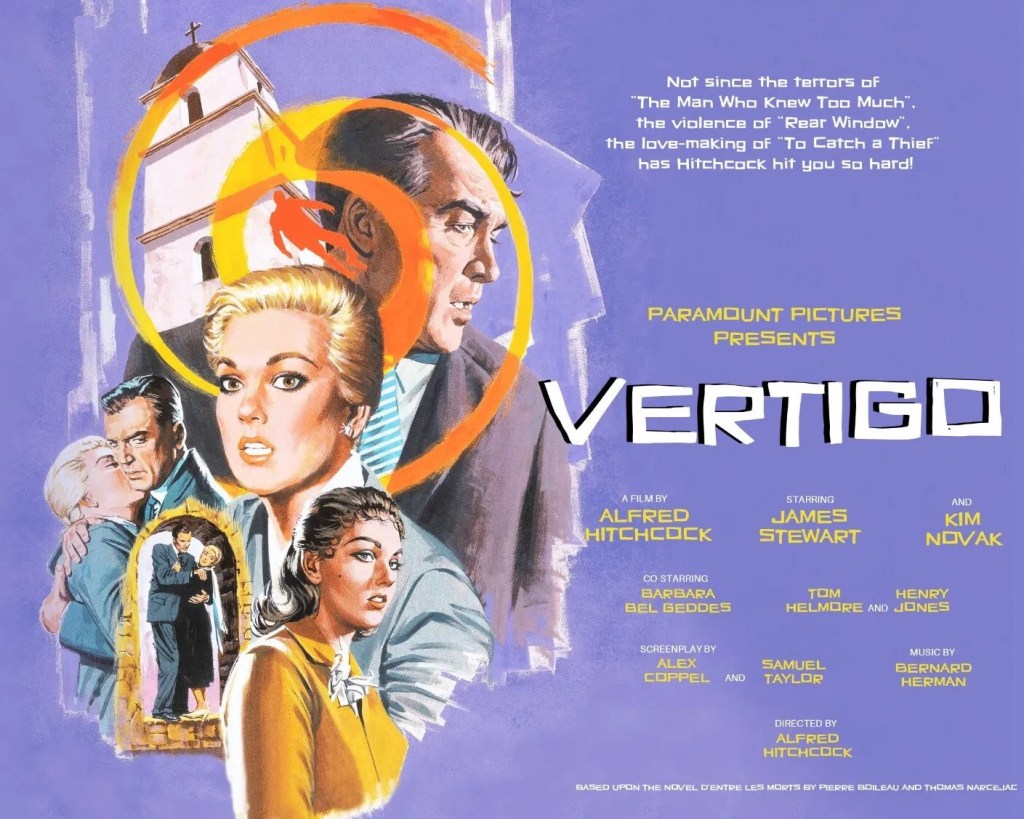
While Rear Window had been a big hit in its day, Vertigo had fallen some way short and there were question marks over whether the James Stewart-Kim Novak combination could match the James Stewart-Grace Kelly. While not hitting Rear Window peaks, Vertigo did better than expected, opening with $91,000 from four cinemas in New York, $50,000 in four cinemas in Los Angeles, $35,000 in San Francisco and $19,000 in Philadelphia. In America, the marketing strategy did not quite work out, the films, especially the last two in the series, better in arthouses than first run, but the Hitchcock Festival concept proved a winner. The next year, the reissues were themselves reissued, a double bill of Rear Window/Vertigo chalking up $14,200 in its first week in New York and Rear Window continuing to play the arthouses well into 1985.[v]
On its U.S. reissue Rear Window earned $4 million in rentals, Vertigo $2.5 million, The Man Who Knew Too Much $1 million, The Trouble With Harry $750,000 and Rope nearly $600,000.[vi] In addition, North By Northwest (1959) entered the equation.[vii] By the time the quintet had played out, for patrons suffering withdrawal symptoms, a Hitchcock Film Festival, all the films crammed into one week, rolled out among arthouses in 1985, whipping up nearly $250,000 in five weeks.[viii]
As important, in terms of legacy and commercial fulfillment, was the impact on ancillary markets. Priced at $59.98, the videocassette of Rear Window was quickly certified gold, meaning sales of fifty thousand copies, adding another $3 million in gross revenue. In due course, the entire quintet appeared on video followed by thirteen other Hitchcocks on a special video promotion.[ix] Screenings of rarer Hitchcocks were welcomed with delight and the precursor to theatrical or video release.[x] The five Hitchcock oldies were the most important reissues of the 1980s because, although an event, they were more accessible to the general filmgoer than the silent classics or Hollywood’s string of hard-done-by quasi-classics. Crucially, commercially they fitted in perfectly to the new dynamic, huge sums in theatrical followed by big ancillary sales. Hitchcock demonstrated that the reissue machine need never run dry if properly oiled and maintained through each new technological cycle or anniversary. In 1996 Vertigo underwent more rigorous restoration and a 70mm version, after its presentation at the New York Film Festival, exhibited astounding commercial appeal – $148,000 from two cinemas in eight days and $800,000 from just eight cinemas in four weeks – and while the reissue was not on the scale of the 1983 revival the grand tally (gross, not rental) was $1.86 million (cueing a further ancillary round) and followed by the restoration of Rear Window which collected another $1.57 million (gross, not rental) in 2000. [xi]
SOURCES: Brian Hannan, Coming Back to a Theater near You, A History of the Hollywood Reissue 1914-2014 (McFarland, 2016) pp425-429.
[i] Brian Hannan, Hitchcock at the Box Office (Glasgow: Baroliant Press, 2104). This formed part of a retrospective of the director’s early films ending with The 39 Steps. Festival director Luigi Chiarini commented: “It seems fitting that young directors and film authors should learn from a great master of cinema.” But the homage was dropped after a festival boycott by U.S. producers. When it ran the next year, the closing film became The Lady Vanishes.
[ii] Hannan, Hitchcock at the Box Office. In 1971 The 39 Steps/The Lady Vanishes took $4,000 at the 150-seat Outer Circle Two ($1.75-$2.75) in Washington; in Cleveland The 39 Steps at the 448-seat World East ($2.50) grossed $3,600 while The Lady Vanishes at stablemate 448-seat World West ($2.50) took $2,100. In 1972, the double bill grossed $2,300 at the 500-seat Guild ($2.50) in Pittsburgh and at the 1,000-seat Cinema East in Dayton, Ohio, clocked up $2,900 and $1,000. In 1973 it was reissued in Paris and also made $3,200 at the 455-seat Severance ($2.50) in Cleveland. Source: “Picture Grosses,” Variety.
[iii] Hannan, Hitchcock at the Box Office. In 1975, The 39 Steps and The Lady Vanishes were shown on a split week programme (i.e. one shown on three days and the other one four) at the 900-seat New Yorker Theater ($2-$3.50) in New York and made $4,200. The following year at Boston’s 150-seat Orson Welles II ($1.50-$3) the films were shown as a double bill for $4,800. (The week before, a double bill of the original The Man Who Knew Too Much and Young and Innocent had taken $4,900.) In Japan, The Lady Vanishes on a double bill with Casablanca notched up $14,500 in Tokyo, the fourth week of $9,000 an improvement on the $8,300 of the third. Source: “Picture Grosses,” Variety.
[iv] “Out of Circulation Hitchcock Pix to Be Released by UI Classics,” Variety, August 29, 1983, 3.
[v] Hannan, Hitchcock at the Box Office.
[vi] “Big Rental Films of 1983,” Variety, January 11, 1984, 11; “Big Rental Films of 1984,” Variety, January 16, 1984, 16.
[vii] Brian Hannan, Darkness Visible: Hitchcock’s Greatest Film, Glasgow: Baroliant Press, 2014). North by Northwest ran for six weeks in a tiny 199-seat theatre in Washington with weekly takings of up to $11,000, as well as Baltimore, Pittsburgh and Cleveland. In Chicago it was on a double bill with Dial M For Murder and in Boston with Fritz Lang’s Fury. Overall, it had added another $800,000 in grosses since its last major reissue in 1966. Source: “Picture Grosses,” Variety.
[viii] Hannan, Darkness Visible. In Boston the Hitchcock Festival took $7,400 in its first week and $10,000 in its second. In Washington second week revenues outgrossed the first, jumping to $18,000 from $13,700. Source: “Picture Grosses,” Variety.
[ix] “Majors Gold and Platinum Titles Led by Warner,” Variety, January 13, 1984, X). Cashing in on the reissues, Universal had sent Psycho out on video.
[x] In Los Angeles a forty-six-film retrospective in Los Angeles saw rare screenings of his first film The Pleasure Garden (1925) as well as the 3D version of Dial M For Murder (1954).
[xi] Hannan, Darkness Visible. North By Northwest (1959) also received the restoration treatment, but was largely ignored by the public.

 The Magnificent 60s
Great piece, you really excavate where no-one else goes. So I remember this well; tv was breathing new leases of life into classic films, the BBC ran regular Hitchcock seasons, and his films were the starting point for many a film-fans journey into the auteur. Shocking to think Rear Window hadn’t been screened since 62; there was quite a kerfuffle about Manchurian Candidate, albeit for different reasons. As you know, I’m finding the BBC genome partularly helpful in pinpointing the moment that films that hadn’t been seen for decades were suddenly revived to audiences of millions on tv. But while I can pinpoint me watching Salem’s Lot on the BBC in Sept 1981, I can only guess at when I saw North by Northwest. Why? Because there’s no comparable genome for ITV…there’s whole areas of film history/popularity which are becoming lost or undocumented, so well done for being on top of this…
LikeLiked by 1 person
Can I direct you to the recently-published book by Sheldon Hall, Armchair Cinema, A History of Feature Films on British Television 1929-1981. Sheldon is a human genome, writing this history moslty based on his extraordinary collection of Radio Times and TV Times. Only downside is the price – £110 in hardback, though a cheaper paperback is promised next year. Might be a copy available for review by someone as distinguished as yourself, I would imagine.
LikeLiked by 1 person
Film-authority, I enjoy your comments. On to the chase in regard to your first viewing of NORTH BY NORTHWEST(filmed 1958, released 1959) on television in the UK. According to UK newspapers of the time, NORTH BY NORTWEST was airing on ITV on Saturday night October 30, 1971. Also, on ITV SOUTHERN on Saturday night September 8, 1973. Again, on ITV on Saturday night January 26, 1974. Earlier the movie was shown on Anglia Television(ATV) on Saturday night April 4, 1970 and again on Thursday night June 11, 1970. Another showing was on Yorkshire Television(YTV) on Thursday night December 31, 1970. Is this any help, or did you first view the movie later on?
Walter S.
LikeLiked by 1 person
Ideal. Thanks.
LikeLike
Brian, I really enjoyed your very fine informative write-up on Alfred Hitchcock’s great 1980’s revival on the big screen and on video. I applaud you in what you’re doing, because you aren’t just writing about the same old same old. This is very interesting movie information, that shouldn’t be forgotten, because it so much a part of movie history. Movies go beyond their initial first week release.
You write that REAR WINDOW(filmed 1953-54, released 1954) was withdrawn from the theatrical market in 1962. Here in the USA the movie was still being shown in walk-in and drive-in theaters in 1965. The USA prime-time network television premiere of the movie was on the NBC SATURDAY NIGHT AT THE MOVIES on October 1, 1966, which is when I first viewed the movie, and I thought it was great and I still do. I also viewed the movie again when it was rerun on April 15, 1967, on the same NBC SATURDAY NIGHT AT THE MOVIES. I viewed it for a third time on April 13, 1971, on THE ABC MONDAY NIGHT MOVIE. Then it disappeared from viewing, unless you were lucky enough to be near a theatrical showing during a Hitchcock retrospective. I don’t think REAR WINDOW was broadcast on television in the UK prior to the 1980’s revival. Am I correct?
Keep doing what you are doing well.
Walter S.
LikeLiked by 1 person
Thanks for that update, Walter. Not sure when rear was shown on British TV.
LikeLike
Brian, here in the USA I finally caught up with REAR WINDOW again on cable TV’s THE MOVIE CHANNEL during the Summer of 1985. According to THE DAILY TELEGRAPH newspaper the movie was showing in the UK on ITV Wednesday night July 23, 1986. Also, according to THE DAILY TELEGRAPH, this was almost 32 years after the movie premiered at the Plaza Cinema in London on October 8, 1954.
Walter S.
LikeLiked by 1 person
Thanks for the update, Walter.
LikeLike