
Giving customers value for money – the impetus behind the original double bill that was standard fare at local neighborhood cinemas for decades – was by the 1970s the least of the worries of exhibitors, their audiences slashed by the onslaught of television, the future in serious jeopardy owning to the financially precarious Hollywood studios. As audiences grew more picky, exhibitors, even with fewer films to hand, went back, in certain instances, to the double bill, hoping that the coupling of two relatively unattractive pictures would succeed where one on its own would not. Usually, for films playing the cinema circuits, it was left to the studios to devise the double bill programs.
So where Love Story (1970), The Godfather (1972), The Sting (1973), Jaws (1975) and Star Wars (1977) need not worry about being teamed with an unlikely partner, there were plenty movies who would have no choice in the matter. I should point that a) this survey only refers to Britain since I have in my possession books covering all weekly releases on the main circuits and b) it’s not touching upon those barmy programs dreamed up by some clever-dick independent cinema manager.
So I’m only looking at those interesting/odd double-A double bills which might leave you wondering why one or even both of the titles was considered so lacking in appeal that it didn’t merit single-billing. Many of these were tough sells even as a double bill. You could start with The Mind of Mr Soames (1970) featuring Terence Stamp awakening from a lifelong coma coupled with William Wyler’s last, disastrous, effort The Liberation of L.B. Jones. (1970). You got to wonder who would be queueing up for the incestuously-hinting Goodbye Gemini (1970) starring Judy Geeson and Mumsy, Nanny, Sonny and Girly (1970) starring nobody and featuring hippies forced into role-playing. Drug drama The People Next Door (1970) headlined by Eli Wallach (hardly a big draw on his own) was linked with C.C. and Company (1970), the movie that tried to make a star out of footballer Joe Namath and nearly wrecked the career of Ann-Margret.
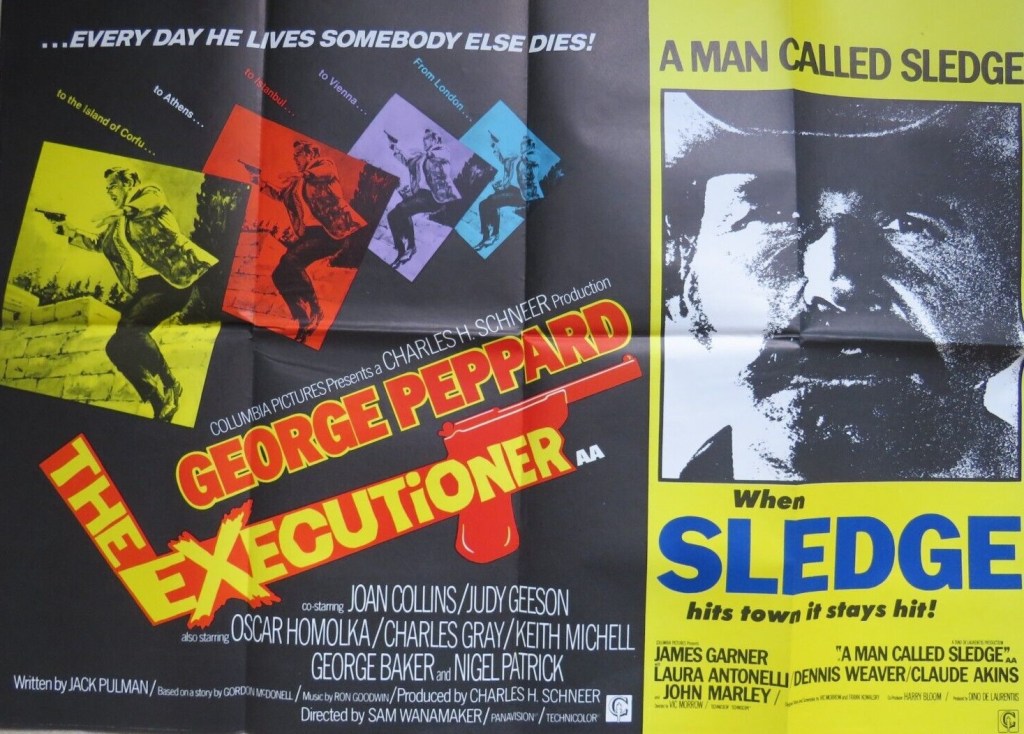
On the other hand some were tailor-made value-for-money packages featuring genuine star wattage. George Peppard in hitman thriller The Executioner (1970) went head to head with James Garner western A Man Called Sledge (1970). Sidney Poitier in They Call Me Mister Tibbs (1970), sequel to the Oscar-winning In the Heat of the Night (1967), went out with Rock Hudson-Sylva Koscina World War Two number Hornets’ Nest (1970). Top British star Hayley Mills fending off Oliver Reed in Take A Girl Like You (1970) hit the sack with Getting Straight (1970) starring Elliott Gould and Candice Bergen. Underrated Hitchcockian thriller Fragment of Fear (1970) with David Hemmings and then-wife Gayle Hunnicutt touched base with romantic drama Loving (1970) with George Segal and Eva Marie Saint. Charles Bronson-Tony Curtis adventure You Can’t Win ‘Em All (1970) stuck it to Gregory Peck and Tuesday Weld in I Walk the Line (1970).
David Janssen in revenge western Macho Callahan was supported by Charles Bronson French thriller Rider on the Rain (1970). Double bill of the decade has to be Raquel Welch as Myra Breckenridge (1970) and the even camper Beyond the Valley of the Dolls (1970), Russ Meyer’s mainstream paean to T&A. Mia Farrow couldn’t escape Blind Terror (1971) as Dyan Cannon headed up a platoon of Doctors’ Wives (1971). Jack Nicholson’s Oscar-nominated turn in Five Easy Pieces (1971) rode shotgun on Samantha Eggar in The Lady in the Car with the Glasses and the Gun (1971). Western Doc (1971) got the drop on World War One aerial spectacular The Red Baron (1971).

The double bill also opened doors for movies that otherwise wouldn’t stand a chance of reaching a wider audience. French crime flick The Samourai (1967) starring Alain and Nathalie Delon supported bloody western A Town Called Bastard (1970) with Robert Shaw and Stella Stevens. Charles Bronson’s Italian-made Violent City (1970) propped up Elliott Gould sex drama I Love My Wife (1970). Milo O’Shea as a sex-mad Irishman Paddy (1970) sought the shade beneath Last Summer (1970). John Mackenzie’s debut One Brief Summer (1971) clicked with demonic The Mephisto Waltz (1971) starring Alan Alda and Jacqueline Bisset. Ray Milland courtroom drama Hostile Witness (1969) found shelter with Lee Van Cleef western Barquero (1970). Walter Matthau-Ingrid Bergman-Goldie Hawn comedy Cactus Flower (1969) took pity on Machine Gun McCain (1969).
You would have thought the horror double bill was sacrosanct. And so it was in large part. Check Twins of Evil (1971)/Hands of the Ripper (1971), Scars of Dracula (1970)/The Horror of Frankenstein (1970), Count Yorga, Vampire (1970)/Cry of the Banshee (1970), and Dr Jekyll and Sister Hyde (1971)/Blood from the Mummy’s Tomb (1971). But strange developments were afoot and someone decided that if the vampire happened to be lesbian it was better for the movie to be paired with a biker picture. Hence, Countess Dracula (1970)/Hell’s Belles (1969) and Lust for a Vampire (1971)/The Born Losers (1967).
SOURCES: Allen Eyles, ABC: The First Name in Entertainment (CTA, 1993) p124-125; Allen Eyles, Odeon Cinemas 2 (CTA, 2005) p214-215.

 The Magnificent 60s
Very interesting article. I’m not familiar at all with film history so all this knowledge is valuable to me. I find it fascinating how double bills have evolved over time. It seemed as if double bills fell out of fashion but last year “Barbenheimer” brought it back in the spotlight. I loved both movies which had a tremendous impact on pop culture. Here’s why: https://huilahimovie.reviews/2023/08/12/barbie-2023-movie-review/
LikeLiked by 1 person
Hope you saw them back to back.
LikeLiked by 1 person
There’s some quite dreary films on that list, so I guess the intention was to prop up movies that weren’t much of a draw on their own…
LikeLiked by 1 person
Also, there was a bit of sneakiness involved. If a star was on a profit share, the studio would claim the revenue should be halved between the two films. Sean Connery took a studio to task over this ploy.
LikeLiked by 1 person
I remember seeing double bills such as
LikeLike
I remember seeing double bills such as The Guns of Navarone/ A coffin from Hong Kong. Dracula/The Mummy (hammer). Bond movies with a Dollar western. Can’t remember which was shown first. Butch Cassidy and the Sundance kid/The Siciilan Clan. Don’t look now/The Wicker Man.
LikeLiked by 1 person
Sometimes what you’d call the main feature was often shown long after initial release as the supporting feature to a newer film.
LikeLike