If ever a career was dashed by public perception and screen persona. By the end of the 1960s Raquel Welch should have been coasting, western 100 Rifles (1969) a big hit, ranked in top dozen female stars by Box Office magazine[i] and named in the Top Ten Female World Film Favourites by Reuters [ii]and beginning to be taken seriously as an actress, lined up for one of the most controversial films of the next decade in Myra Breckenridge (1970).
Sure, she had passed on Butch Cassidy and the Sundance Kid (1969) whose success might have shot her into the box office stratosphere. And she also pulled out of The Dubious Patriots / You Can’t Win ‘Em All (1970) with rising superstar Charles Bronson and Tony Curtis.[iii] Another movie produced by husband Patrick Curtis – “vicious Hollywood love story” Laurie Lee in the Movies, written and directed by Robert Culp [iv]– failed to get funding.

Her final three movies of 1969 – Flare Up, The Magic Christian and unreleased or never-made mystery that was The Boodle (nobody seems to know what happened to that) – did nothing for her career.
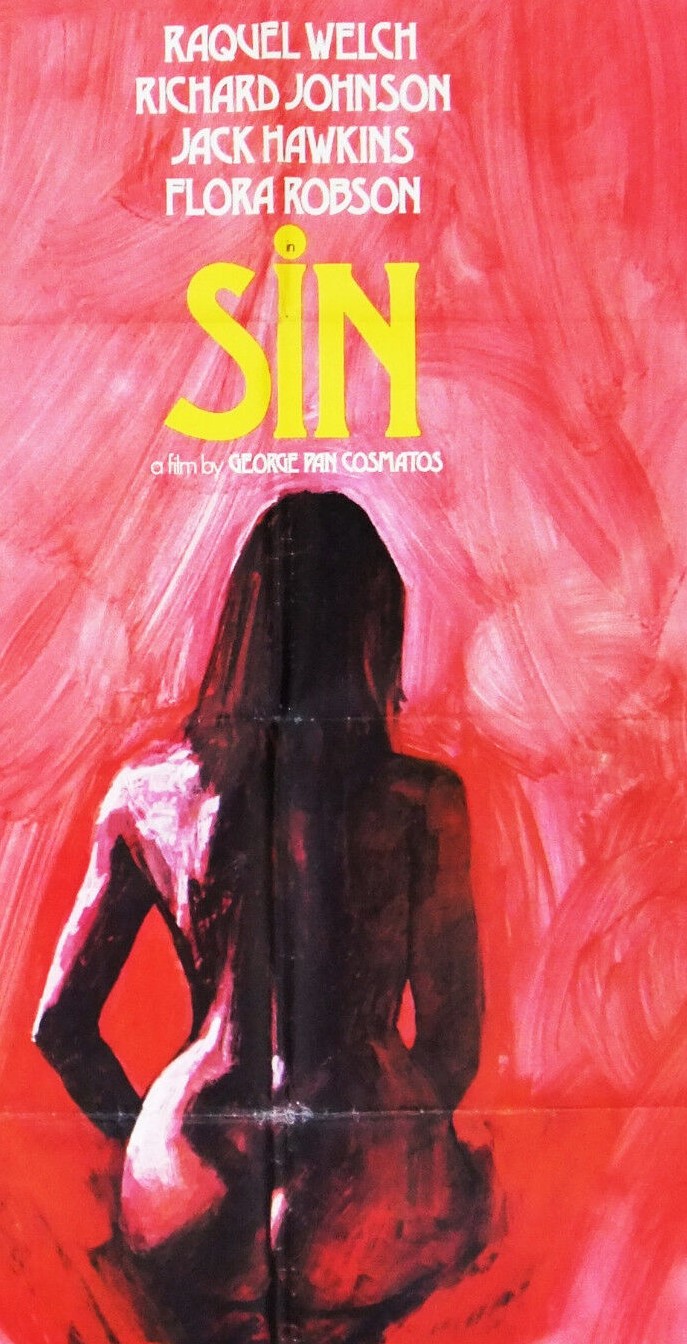
Already the Queen of the Western after Bandolero! (1968) and 100 Rifles, she was set to solidify that position with the $1.4 million Hannie Caulder (1971) and the $2 million Nitro[v] (not made either). Still, she moved into more serious acting with The Beloved (1971) aka Disgrace aka Tilda aka Restless aka Sin (“Let Raquel Show You The Way Of Sin”), a $650,000-budgeted romantic drama filmed in Cyprus by newcomer George Pan Cosmatos and opposite heavyweight actors like Flora Robson and Jack Hawkins, La Welch taking minimum salary in return for 32.5% of the profits.[vi]

Not only was she aiming to knock ‘em dead with Myra Breckenridge and this but she was lined up to play one of Cellini’s mistresses in the Terence Young biopic.[vii] And if she fancied playing up to her sex queen image the role of Tiffany Case in Diamonds Are Forever was hers for the asking.[viii] When an enterprising New York cinema reprised A House Is Not a Home (1965), the posters presented her as the star even though she had only as bit part and still the crowds kept coming.[ix] And when Hammer came to cast The Creatures the World Forgot (1971) it used Welch’s fur bikini image from One Million Years B.C. to launch a talent hunt to become the “screen’s hottest sex symbol.”[x]
And she proved way ahead of her time in setting up, two years before the format would even become a reality, a video cassette business, that would establish her up as a major “influencer” long before the term was even coined by presenting a series of 20-minute programs giving tips about cosmetics and hairdressing. [xi] She had a music publishing business.[xii] And even though her one-hour television special Raquel, reputedly costing $1 million, incited Variety’s critic to complain “can’t sing, can’t dance” it was a phantasmagoria of a production aired by CBS and bought by the BBC for prime time showing.[xiii]

But a fall from grace was imminent. Warner Bros had signed her up as the star of Kansas City Bomber (1972) but when they fell out she took the project to MGM.[xiv] It was her last starring role. When Brian De Palma was in the director’s chair she was announced as top-lining Fuzz (1972)[xv] but when the cop picture appeared she was way down the credits with the derisory “and” prefix. But there should have been a comeback. George Pan Cosmatos had signed her up to star in A Pope Called Joan, “a bawdy and irreverent comedy” possibly in the vein of The Decameron (1971) written by film journalist Robin Bean and certainly not in the serious mode of rival production Pope Joan (1972) starring Liv Ullman.

“As far as I know,” averred producer Patrick Curtis, “these are two different pictures. The other is in a serious vein, ours is a satire with contemporary parallels.”[xvi] But it never appeared. The attachment of Raquel Welch to a project did not guarantee it would get made.

Although there were later flourishes in supporting roles – The Three Musketeers (1974) for example – and the legal minefield of Cannery Row (1982) she became better known as the epitome of how fleeting true movie stardom can be, though few would forget her in a handful of roles such as One Million Years B.C. (1966), Fantastic Voyage (1966), Fathom (1967) and her first two westerns. At least she ended up in the Texas Wax Museum alongside Hollywood stars like Ginger Rogers and Joan Crawford.[xvii]
[i] “All-American Favorites of 1968,” Box Office, April 7, 1969, p19.
[ii] “Reuters Poll,” Variety, February 12, 1969, p2.
[iii] “Columbia Set in Turkey,” Variety, June 4, 1969, p34.
[iv] “Curtwel’s Laurie Lee with Raquel Welch Set,” Variety, June 4, 1969, p4; “Hollywood Report,” Box Office, June 16, 1969, p14.
[v] “Curtwel And Tigon Films Join Oater Trend,” Variety, November 18, 1970, p36; “Hollywood Report,” Box Office, February 15, 1971, p10
[vi] “Raquel in Tilda,” Variety, April 23, 1969, p19. “Hollywood Report,” Box Office, June 16, 1969, p14; “Raquel Welch, Johnson To Co-Star in Disgrace,” Variety, August 5, 1970, p24; “Cosmatos, Aide on Exodus, Gets His Own 650G Beloved Finished,” Variety, December 16, 1970, p18. It was based on the novel by Elizabeth Kata who had written A Patch of Blue.
[vii] “Young To Rein Sun Next April and Preps Cellini Biopic,” Variety, November 19, 1969, p5.
[viii] “Raquel Welch Pends,” Variety, February 10, 1971, p6; “Jill and Jo Ann Top Femmes In Connery’s Next Bond,” Variety, March 17, 1971, p34.
[ix] “Carnal on 80-Site Showcase,” Variety, December 22, 1971, p5.
[x] “Columbia and Carreras in Global Talent Search,” Box Office, Nay 11, 1970, p9.
[xi] “Curtwel and Tigon,” Variety.
[xii] “Raquel Welch Is Also A Music Publisher,” Variety, July 8, 1970, p51.
[xiii] “Betting $1-Mil on Raquel Mex Spec,” Variety, February 11, 1970, p31; Review, Raquel, Variety, April 26, 1970; “BBC TV Buys Raquel,” Variety, June 3, 1970, p39.
[xiv] “Corporate Minds,” Variety, May 26, 1971, p6; “Hollywood Report,” Box Office, June 14, 1971, p10; “Raquel Off WB Derby; May Skate for MGM,” Variety, December 22, 1971, p3;
[xv] “Team Raquel, Brynner for Farren-UA’s Fuzz,” Variety, August 11, 1971, p5.
[xvi]“Pact Raquel for Pope Called Joan,” Variety, March 31, 1971, p28.
[xvii] “Likeness of Raquel Welch Now in Texas Wax Museum,” Box Office, September 25, 1972, p7.

 The Magnificent 60s
Apparently my Dad was a big Raquel fan. He took me to HANNIE CAULDER and KANSAS CITY BOMBER. being 16/17, I much appreciated this. On FUZZ – “Raquel Welch did not like Burt Reynolds because of comments he made while they were filming 100 Rifles (1969) that she considered unsavory. So in this movie, she insisted that she not have any direct scenes with Reynolds. The closest they get is during the interrogation. Even when in the same room, they never had direct eye contact.”
LikeLiked by 2 people
You were lucky to have a dad who admitted to being a Raquel fan. Yes, Reynolds was pretty rude to her on 100 Rifles.
LikeLiked by 1 person
A relatively short career in the film business, but it sounds like she was pretty savvy when it came to business in general. While I haven’t seen everything she has done film-wise, I have liked most of what I’ve seen her in.
LikeLiked by 2 people
I think she did all right in the end. I’m not sure her producing career did so well – that was mostly at the behest of her husband. But she knew how to exploit her marquee appeal and was certainly underrated.
LikeLiked by 2 people
What is that she’s kissing? A courgette?
LikeLike
Something extremely rude.
LikeLiked by 1 person
Too late for my article I discovered she was supposed to be teamed with Lee Marvin in Great Scout and Cathouse Thursday. Imagine!
LikeLiked by 1 person
That’s a nearly-was thought that will take some time to sink in.
LikeLike
I’ve always felt the biggest missed opportunity for Raquel in the 70s was when she signed on to do a big screen version of “Sheena, Queen of the Jungle” which was was supposed to start shooting in 1976 and which never went into production (Universal put the project into limbo and then it passed to new producers who made it ineffectively in 1984 at Columbia with Tanya Roberts). This would have come out at the time of Lynda Carter’s “Wonder Woman” TV series and would have been something Raquel could have effectively capitalized on if she’d been able to play Sheena as the liberated force of nature of the comic books and how 50s TV Sheena Irish McCalla played the role (someone who never needed a man to bail her out; that really would have played perfect in the era of 70s women’s lib).
Raquel mentioned the project in a 1976 NY Daily News interview. It’s clear she didn’t view playing a jungle queen as a step back to doing OMYBC all over again.
“We are living in an age of Ellen Burstyns and Glenda Jacksons,” says Raquel Welch, “Nobody’s strutting their stuff really good on the screen lately. So I’m going to play Sheena, Queen of the Jungle.”
Raquel Welch pours herself some coffee. “Since I’ve got some stuff to strut,” she continues with a grin, “I just figure, what could be better than a girl in loincloth riding tigers and swinging from vines?”
(We’ll overlook the fact there are no tigers in Africa!)
LikeLike
No tigers in Africa? Hollywood begs to differ. Hollywood wasted Welch. She had sufficient acting skills to get past the sex symbol image. But the Cannery Row debacle made Hollywood wary.
LikeLike