
Originality was rarely the key to open the box office door in the 1960s. Though considerably more expensive than original screenplays, books and Broadway musicals were viewed as a better bet, in part because they came with a perceived built-in audience of readers and theatergoers. And the figures prove that, for once, Hollywood got it right.
All except one, the top ten movies for the decade at the box office derived from bestsellers or stage hits. The exception was Guess Who’s Coming to Dinner (1967), an original screenplay by William Rose who received a then-record sum for his efforts. The decade’s out-and-out winner, The Sound of Music (1965) was based on both a book, The Story of the The Trapp Family Singers and a West German film The Trapp Family (1956), as well as the Rodgers and Hammerstein musical.

Though substantially altered for the screen, runner-up The Graduate (1967) was based on the bestseller by Charles Webb. Doctor Zhivago (1965), Gone with the Wind (1939)* and Ben-Hur (1959) ** were based on bestsellers by, respectively, Boris Pasternak, Margaret Mitchell and Lew Wallace. Mary Poppins (1964) which placed sixth for the decade, despite the musical additions of the Sherman Brothers, was based on a series of much-loved children’s books by P.L. Travers, who didn’t much care for the Disneyfication.
Multiple Oscar-winner My Fair Lady (1964) followed The Sound of Music template, based on a 1913 play Pygmalion by George Bernard Shaw, and a subsequent film of the same name a quarter of a century later, before falling into the hands of Broadway team Lerner and Loewe. The biggest box office surprise was that it didn’t beat The Sound of Music at the movie box office because it had trounced it on Broadway, racking up nearly double the performances. The Sound of Music wasn’t even the best performing of the Rodgers and Hammerstein Broadway portfolio, lagging in third place, a long way behind South Pacific and Oklahoma!.
British author Ian Fleming was the single-best argument for buying novels over screenplays. Books could be purchased for relatively small sums, if the well was tapped early on, and thanks for the development of the sequel business, Thunderball (1965) snapped up ninth spot. You might imagine Cleopatra (1963), especially with its emphasis on the racy Elizabeth Taylor-Richard Burton romance, was an original work, but that, too, was based on previous publications of the non-fiction variety.
William Rose’s original screenplay was as instrumental in Guess Who’s Coming to Dinner reaching tenth place as he was in It’s A Mad, Mad, Mad, Mad World (1963) becoming one of only two original screenplays to feature in the next ten movies on the box office chart, that madcap comedy targeting eighteenth. Robert Benton and David Newman’s original screenplay (with a little help from Robert Towne) helped Bonnie and Clyde (1967) after a faltering start to cling on to 13th spot.
You might also imagine James R. Webb delivered an original screenplay for the Cinerama roadshow How the West Was Won (1962) – which finished 12th in the rankings – but while not based on a bestseller it was adapted from an extensive series of non-fiction books on The Old West published by Time-Life.
Of the other films registering in the top 20, five originated as novels, and two were first seen on the stage. The fiction quintet featured another deuce from the pen of Ian Fleming – Goldfinger (1964) and You Only Live Twice (1960). Jacqueline Susann was responsible for the bestseller Valley of the Dolls (1967), E. M. Nathanson for The Dirty Dozen (1967) and E.R. Braithwaite for To Sir, With Love (1967). West Side Story (1961) was another adaptation of a Broadway musical while The Odd Couple (1968) was from prolific playwright Neil Simon.
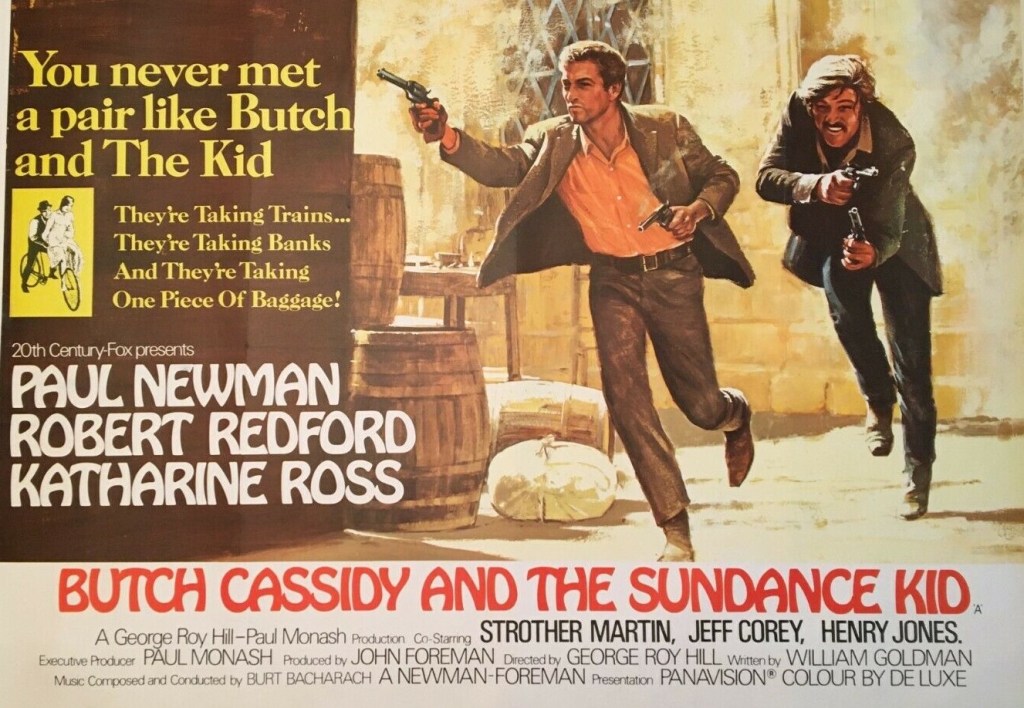
There was similar reliance on proven hits in the next 20 movies. Only two pictures – Those Magnificent Men in their Flying Machines (1965) by Ken Annakin and Jack Davies and Butch Cassidy and the Sundance Kid (1969) – were original screenplays, though Twentieth Century Fox shelled out a record $400,000 to secure the rights to the latter from writer William Goldman.
Even movies like The Love Bug (1968) and Bullitt (1968) were originally novels. The bulk of these next twenty came from publishing, though Funny Girl (1968), Romeo and Juliet (1968), Who’s Afraid of Virginia Woolf (1966) and Thoroughly Modern Millie began on stage, the latter not from Broadway but the British West End.
Of course, not much has changed. Half this year’s Best Picture Oscar candidates are based on published works. Poor Things was based on the book by Scottish novelist Alasdair Gray, Zone of Interest from the novel by Martin Amis, Killers of the Flower Moon by the non-fiction work by David Grann, Oppenheimer on the biography American Prometheus by Kai Bird and Martin J. Sherwin, American Fiction from Percival Everett’s novel Erasure.
*Gone with the Wind was reissued in 1967 as a 70mm roadshow and, coupled with a 35mm wider release the following year, cleaned up at the box office, making more money than it any of its previous four revivals put together.
**Ben-Hur (1959) ran in Nov-Dec 1959 in only a select number of cinemas, collecting, by my calculations no more than $1 million in rentals. Therefore, I deduced that in reality the vast bulk of its box office was taken in the 1960s and therefore in any accounting of that decade’s movie rentals was more fairly to be included then than in the previous decade.
SOURCE: The Magnificent 60s, The 100 Most Popular Films of a Revolutionary Decade by Brian Hannan (McFarland, 2019).


 The Magnificent 60s
How did I not know that Bullitt was a novel? Very educational….
LikeLiked by 1 person
Teacher is my middle name.
LikeLiked by 1 person