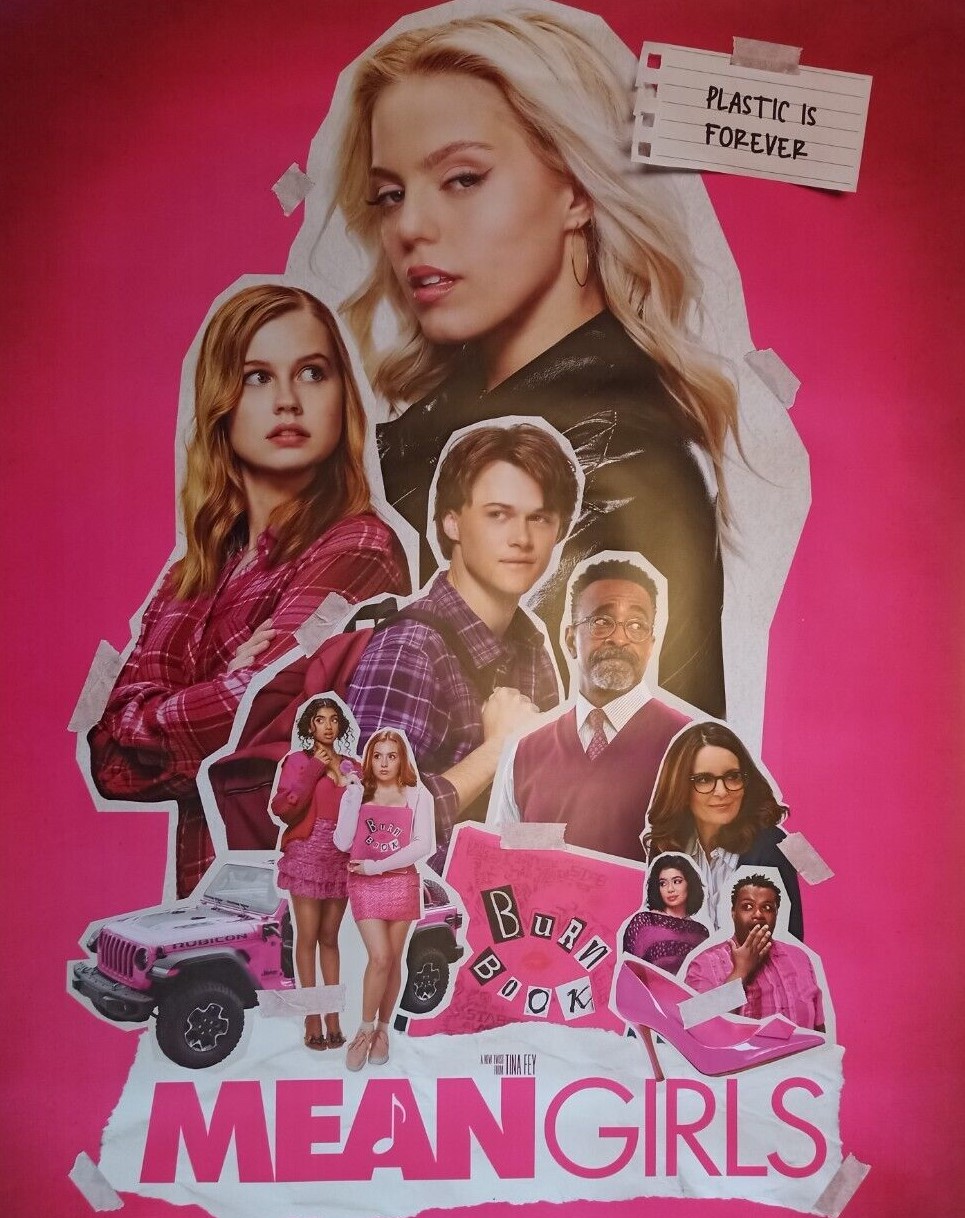
Hollywood has clearly grown leery of the musical after the disastrous public reaction to Steven Spielberg’s much-touted remake of West Side Story (2021). Or of just marketing them. I turned up to see Wonka (2023) not realizing it was pretty much a full-blown musical, because the trailer made little reference to that fact. And the same holds true of Mean Girls. So it’s hardly surprising both received mixed reviews from audiences expecting more straightforward narratives.
Of course, the problem is that musicals in the past came with a substantial in-built audience. No movie was ever made until a musical had ended its Broadway run of four/seven/ten years and hit London’s West End and toured the world and sold millions of copies of the original cast recording so that when the movie finally appeared there was at least the prospect of a decent opening from fans of the stage show. They might gripe at what Hollywood did to their beloved show, but at least they came, and they came back, giving the movie the legendary “legs” if they thought the transformation was good.
I enjoyed Wonka primarily because of the narrative invention and Timothy Chamelet’s terrific performance but the singing and dancing left me cold, the only tune that struck any kind of chord was a leftover from Willie Wonka and the Chocolate Factory (1971). I didn’t come to Mean Girls with trepidation. I had no idea the original had turned into a beloved cult classic and therefore didn’t arrive armed with objections to the various changes.
I only came because there was nothing else. So I double-billed it with a second stab at The Beekeeper (2024) and emerged from the experience wondering why no social media guru had though fit to tag these pictures a la Barbieheimer – Meankeeper has a nice ring to it (can’t be Bee Girls because there already is Invasion of the Bee Girls) – because they made a zingy combination.
What struck me most about Mean Girls was the paradox between outward confidence and inner insecurity. The songs acted as soliloquies or confessions or inner turmoil and occasionally they were employed to help tell the story. As a musical, I thought it was flush with inventiveness, fresh, and contained a number of killer songs. I wasn’t acquainted with any of the cast but most appeared capable of carrying a tune.
But it was the dance numbers that really caught my attention. This was Hollywood throwback. Dancing ensembles appeared out of nowhere, doing incredibly daft routines, using whatever props came to hand, and it proved an insanely infectious success. The characters, of course, are cliches, alpha females and those caught in their thrall or rebelling against their power. It’s hardly original to note that the worst thing that can happen to an alpha female is to get a pimple or put on weight.
In another picture that would have been its downfall. Instead, the actors went overboard with the cliché, tore the face off it, and except for scrambling around at the end trying to find some moralizing conclusion that would satisfy wokeness, the approach worked a treat.
Shorn of the earworm numbers of a hugely successful musical, given I had no idea there would be any singing involved, equally I wasn’t waiting to see what they did with a favorite number, and, unlike Wonka, every time they set the tale to one side and embarked, generally all-out, on a tune, I sat back and lapped it up.
And unlike your standard musical, it was filled with neat twists and ripostes, the screenplay slammed full of zingers, and intelligent ones at that, for example, when the carefully-planned revenge plot backfires and social media goes wild to copy Regina’s (Renee Rapp) mascara-streaked face as the latest must-have look, or when the incapacitated Regina admits to liking her enemy Katie (Angourie Rice) only to admit that’s only probably on account of the medication. The “gossip is bad” notion, on the other hand, feels tacked-on although the close-your-eyes-and-raise-your-hand sequence that nails it is actually well done.
I’m not sure what was changed from the stage show and whether I should be irate or grateful for that, because I really don’t care.
On a footnote, this predilection for every aspiring star to have a crazy name is wearing thin. You can’t possibly remember all the odd combinations or inventions. Presumably, these are intended to attract attention, but when you get so many thrown at you all at once, the mind just freezes into disinterest.
The wife-and-husband team of Samatha Jayne and Arturo Perez Jr, in their debut feature, made a sparkling start to a big-screen career. Tina Fey wrote the sharp screenplay as she did the original 2004 movie, but I don’t know if she wrote the lyrics of Jeff Richmond’s excellent songs.
Go see. Build the Meankeeper legend.

 The Magnificent 60s
This is So Fetch! I’m a paid up member of the Tina Fey fan club, so it was no surprise that this was good. But it’s got the freshness that old musicals had in the 40’s, 50’s and 60’s, and a mix of comedy and music that gels; that’s where fellow Broadway musical The Color Purple is up against it. Mean Girls is meant to be a laugh with a moral attached, and that’s ideal for a short, funny film like this.
LikeLiked by 1 person
It had me from the very start. I’m less keen on Color Purple.
LikeLike
I Think Isabella Pappas would better choice as Cady Heron In Mean Girls (2024 film)
LikeLiked by 1 person
You’d need to fill me in on Pappas.
LikeLike