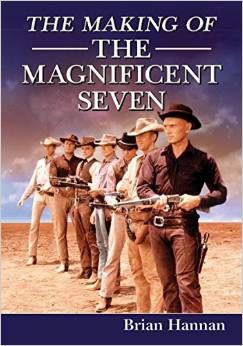
It’s become something of a Xmas tradition that I puff up the books I have written in the hope you will stick them in your (or someone else’s) Xmas stocking. I’ve authored over a dozen publications – from “Behind the Scenes” books (known as “Making of” titles in the publishing business) and compilations of my daily reviews to histories of aspects of the Hollywood business machine, as well as those concentrating on my favorite era (the 1960s in case you can’t guess), and a few relating to my home-town of Paisley in Scotland.
The most popular has been, without doubt, The Making of the Magnificent Seven. Telling the “Behind the Scenes” tale of how one of the most popular westerns ever made wasn’t so initially popular (it flopped in the U.S.). Given the various problems it needed to overcome – loss of three directors, umpteen screenwriters involved, Actor’s Strike. Writer’s Strike, censorship by the Mexican government, the threat of severe editing – it was a wonder it ever saw the light of day.
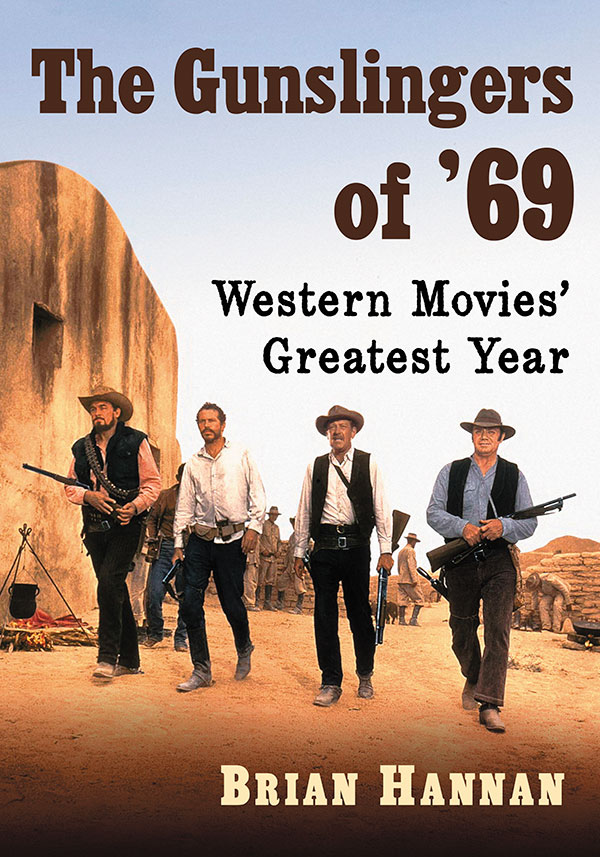
If you’re keen on this line of Hollywood history you might also be interested in a couple of other “Behind the Scenes” volumes – The Making of The Guns of Navarone (Revised Edition) and The Making of Lawrence of Arabia. For that matter, there is ample “behind the scenes” material in two other books: The Magnificent 60s – looking at the top 100 movies of the decade and which could be retitled “how the decade was born” – and The Gunslingers of ’69 which examines the western in a pivotal year that saw the release of The Wild Bunch, True Grit, Once Upon a Time in the West and Butch Cassidy and the Sundance Kid.
I’ve possibly had an unusual writing career in that one idea has usually led to another. While researching The Magnificent Seven, two aspects of that film fascinated me. The first, as mentioned above, is that it was a flop but that it became very successful as a reissue. So that sent me looking at the whole issue of reissue/revival. That took me way back to the Silent Era. And given no one else has written so extensively on the subject I guess I can fairly claim to be the leading expert. The result was my biggest book – 250,000 words including Notes – Coming Back to a Theater Near You, A History of Hollywood Reissues 1914-2014.
The Magnificent Seven was also given an unusual kind of release – what was called a “saturation” release with about 750 prints racing from state to state in a staggered release around the country. Eyebrows were raised because that was the way dodgy films were distributed, exploitation and horror films, whipped out of cinemas before word of mouth could kill them off. Because prints already had another pre-designated destination, The Magnificent Seven, no matter how well it played, could not be retained at any cinema, so word-of-mouth was killed stone dead.
But when I did a bit of digging I discovered that the wide release had been in sporadic use since the Silent Era and I told that story in In Theaters Everywhere: A History of the Hollywood Wide Release 1913-2017.
Oddly enough, doing the research for both those books led me to my most unusual enterprise. When you go so far back in time doing research, and digging through the daily and weekly issues week-by-week of the Hollywood trade papers as was my wont, you tend to turn up other interesting facts. One of these was a report that in 1935 Mae West was the highest-paid actor (male or female).
Like everyone else I had assumed that female stars were underpaid compared to their male counterparts. But in digging deeper I came across another article that showed in the Silent Era that Mary Pickford, at the height of her box office powers, substantially out-earned a Charlie Chaplin at the height of his box office powers.
The result of that was When Women Ruled Hollywood – between 1910 and 1948 the top female stars often out-earned the top male stars – which examines the so-called gender pay divide.
Another movie-related hobby led me to a separate string of books. I have a collection of Pressbooks/Campaign Manuals dating from the 1950s. As well as providing, literally, cinemas with adverts in various sizes for a forthcoming movie, these publications (anything from double-sided A5 to 32-page full-color A3) came up with dozens of publicity wheezes. I got to wondering how many of these clever ideas a cinema manager put into practice. So I went down to the museum in Paisley, where I was living, and starting looking through five years’ worth (1950-1954) of the local newspaper the Paisley Daily Express.
In those days, local newspapers in Britian had adverts on the front page not news stories. And the biggest advert here was a block advert listing what was showing every day at the town’s eight cinemas. I didn’t find any examples at all of cinema managers using the ideas suggested in the Pressbooks but I did, as a matter of course, write down what was showing every day at every cinema. So at the end of the process I had five years’ worth of interesting data.
What to do? What else but turn the material into a book, relating the movie-going patterns of this town, what movies and stars were most popular, distribution patterns, B-movies, serials and reissues. That turned into Paisley at the Pictures 1950 (and there have been two sequels so far).
But since I’m not from Paisley, and as ever, in order to write this book, I started digging backwards into the town’s history of cinemas, I discovered that a horrific disaster had occurred in a cinema in 1929 where over 70 children attending a matinee perished. That became The Glen Cinema Disaster.
As a result of researching The Magnificent 60s book I came across so many interesting movies that didn’t fit into the remit, which was to analyze the 100 most popular films of the decade. In fact, I soon became aware, that thanks to academics, I had quite a distorted view of the 1960s cinema. And that nobody had really done any consistent work on popular rather than Oscar- or arthouse-worthy movies. And also, except for critics writing for monthly magazines, newspapers only allocated few hundred words to cover an entire week’s output. So most movies really only got potted reviews of less than 100 words. So I thought I would dig.
The initial result was this blog. But after receiving so many requests to make the material more easily available for consumption, I have started to turn the reviews and “Behind the Scenes” articles into books. Ambitious though this seems, I’m aiming to put into book form, one way or another, reviews on 1,000 films from the decade – and at the standard length I use for the blog, not reduced into capsule reviews like you get in so many other compendiums.
I’m going to have two types of books, splitting the actual reviews into one series of volumes (I’ve reached Volume Two so far) and the Behind the Scenes into another. Eventually, all will be available on both print and e-book formats.
So everything I’ve written is available on Amazon. I’m assuming the link below will take you to my Amazon page (you might find some items cheaper on Ebay) but if not then just put my name into Amazon and my page should pop up.
Even if you’re disinclined to purchase any books, you could do me a good favor by passing on details of my Blog to other interested parties. Currently, I’m approaching 90,000 views a year and I need 100,000 to be welcomed into the holy grail of Rotten Tomatoes.

 The Magnificent 60s
Well, I’ll keep reading your wonderfully detailed books and your compulsive blog, and look forward to you getting onto the RT platform, where your excellent writing on often obscure films should be welcome.
LikeLiked by 1 person
Thanks for your support.
LikeLiked by 1 person