
Admission: box office analysts like myself rarely get the full picture. Global figures have been available on a regular basis only since the 1990s and commentators these days are only too keen to inform us just how much revenue a movie has to take in before it can break even. Pictures like the latest Fast and Furious, Indiana Jones and Mission Impossible have little chance of turning a profit, it seems, unless they can pile up in excess of $400 million gross.
Back in the day it was a good deal more complicated. Studios were reluctant to reveal just how profitable or unprofitable movies were. But anyone with an inkling of the correlation between cost and rentals could tell that a $17 million movie like Doctor Dolittle (1967) was going to have a hell of a time turning a profit on U.S. rentals of $6.2 million. But throw in overseas rentals of $10.3 million and its position appeared considerably rosier, especially with television revenue still to come.
But rentals minus budget did not provide the full picture. Budget reflected negative cost, the amount it took to make a picture. It didn’t take into account all those elements required to ready it for release – advertising, marketing, Pressbook / Campaign Manual, prints, publicity tour, premiere, distribution, studio overhead and interest on the loan necessary to fund the picture. There was a general rule of thumb – to turn a profit you needed to make twice as much in rentals as the movie cost to make.
But that was really only guesswork, an easily-understood equation conjured up to satisfy over-inquisitive journalists. Since the bulk of the journalists in the 1960s covering the business side of Hollywood were American, very often they deemed a movie a success or failure based on domestic receipts and had little understanding or interest in foreign revenues and how they might influence the outcome. In part this was down to distribution patterns. It might take a couple of years to measure a movie’s overall performance once it had completed its entire foreign tour. And that was too long to wait to make the snap decisions journalists favoured.
In any case, there was little prospect of studios in the 1960s opening their books to anyone other than head office to properly divine a movie’s success.
But it turns out there was an internal measure, at least at Twentieth Century Fox. That studio related global rentals to what it termed “estimated rentals required to break even.” That, in turn, provided a guide to the additional costs incurred by movies once filming had been completed but advertising and prints and so on were still to be paid for.
Taking the decade’s best example, The Sound of Music (1965). Initial cost was set at $8.02 million but once everything else had been taken into account the studio needed to generate total rentals of $29.5 million to break even. That was much higher than the 2-to-1 income-to-budget ratio, and more akin to nearly 4-to-1. Luckily, with a global rentals tally approaching $121.5 million there was more than enough in the kitty to meet those costs.
By comparison, Those Magnificent Men in Their Flying Machines the same year had a negative cost of $6.5 million. Fox estimated it needed to rake in $17.8 million – a ratio of 3-to-1 – to break even. Again, fortunately, global rentals hit $29.9 million so happy faces all round. Valley of the Dolls (1967), budgeted at $4.69 million, required $9.7 million – just over the supposedly classic 2-to-1 cost-to-profit ratio – and again, by chance, there was another $13 million in rentals to make this venture highly lucrative.
But there was nothing left over from either The Bible (1966) or The Sand Pebbles (1966). Global rentals for the former were $25.3 million and the latter $20.6 million, so you might assume such big hitters had a good chance of turning a profit. Originally budgeted at $15 million, The Bible incurred additional costs of $11.9 million and The Sand Pebbles, costing $12.11 million, was assessed as having an overall cost of $21.2 million. The outcome was that both were deemed financial failures, the former losing nearly $1.6 million, the latter $600,000. But on a cost-to-profit ratio, both came in at under the expected 2-to-1 calculation.
Improved overseas revenue was not necessarily the antidote to a flop. Dr Dolittle (1967) theoretically nearly broke even when foreign brought in $10.1 million in addition to domestic’s $6.2 million. On paper the movie cost $17 million. But additional costs of $14 million scuppered any chance of redemption. Although overseas improved on domestic for Audrey Hepburn’s How to Steal a Million (1966) once all the ancillary costs were added in it still lost $1.55 million and Two for the Road $1.7 million.
And what of stinkers like Justine (1969) and Staircase (1969)? You might imagine in light of their woeful box office performances in the U.S. that the studio saved money by cutting back on advertising and prints. However, in addition to the former being budgeted at $7.87 million and the latter at $6.37 million, they were still loaded down with additional expenditure, another $4.9 million for Justine and $4.23 million for Staircase, in both instances way below the 2-to-1 cost-to-ratio format. Justine was written off to the tune of $10 million and Staircase to $8.5 million.
After all the post-production extras were calculated and global rentals taken into account, Marlon Brando-starrer Morituri (1965) lost $6.4 million, James Stewart in The Flight of the Phoenix (1966) $6 million, Omar Sharif as Che! (1969) $5.3 million, Michael Caine-starrers The Magus (1969) $4.5 million and Deadfall (1968) $2.8 million, The Chairman / The Most Dangerous Man in the World (1969) $4.3 million, Hard Contract (1969) $4 million, and Doris Day-starrers Caprice (1967) $2.7 million and Do Not Disturb (1965) $2 million,
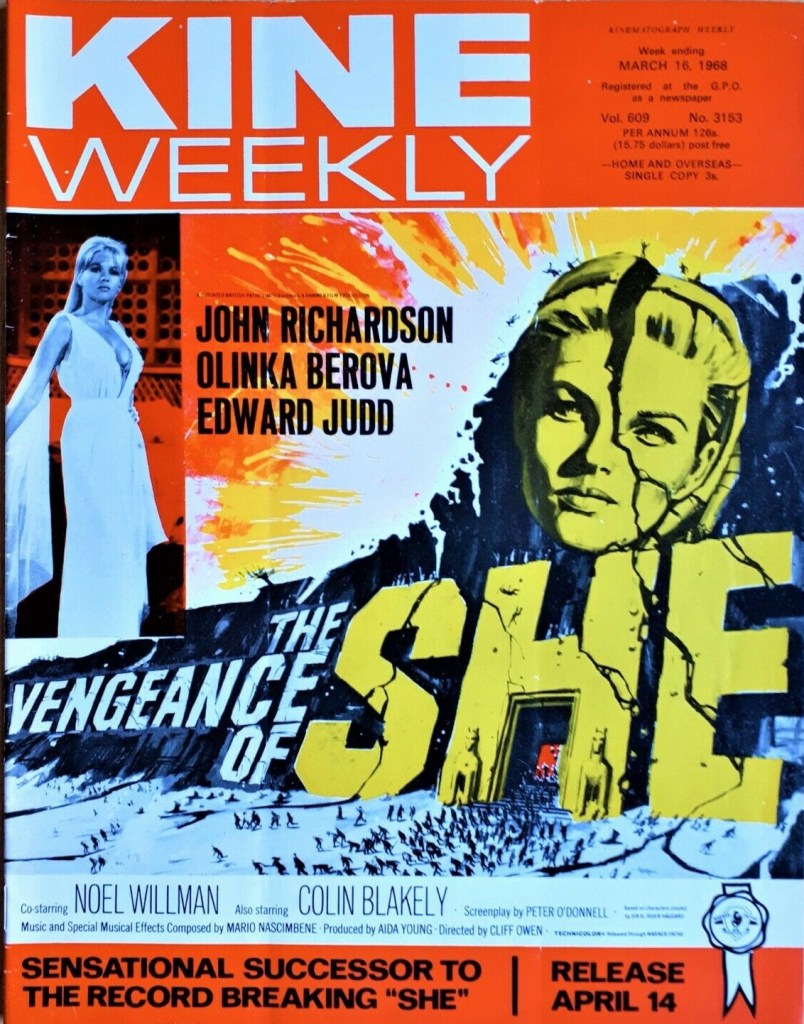
Relatively low cost was no protection against loss. A High Wind in Jamaica (1965) lost $3.7 million, The Visit (1964) $3.5 million, The Flim Flam Man / One Born Every Minute $2.8 million, The Reward (1965) $2.7 million, The Touchables (1969) $2.7 million, Fate Is the Hunter (1964) $2.6 million, Joanna (1969) $1.9 million and Hammer trio The Lost Continent (1968) $900,000, The Viking Queen (1967) $800,000 and The Vengeance of She (1968) $700,000
Even unexpected hit The Blue Max (1966) barely made it into the black. With $16.85 million in global rentals on a budget of $5 million you would have thought there was plenty of fat even with extra post-production costs. Instead, saddled with $9.2 million of additional cost – still below the 2-to-1 projection, it only earned a profit of $2.65 million. The Boston Strangler (1968) cost $4.1 million but with $4.5 million of post-production charges eked out a profit of $2.5 million.
Some pictures were surprisingly profitable. After all costs were met, Zorba the Greek (1965) cleared $6.4 million; Our Man Flint (1966) $5.25 million and In Like Flint (1967) $2.2 million; One Million Years B.C. (1966) $2.17; Dustin Hoffman-Mia Farrow oddball romance John and Mary (1969) $1.8 million; and The Prime of Miss Jean Brodie (1969) $1.2 million;
Despite poor overseas takings Hush, Hush, Sweet Charlotte (1964) registered a profit of just over $1 million; The Nanny (1965) $800,000; Bedazzled (1967) $725,000; Batman (1966) $700,000; the remake of Stagecoach (1966) with Ann-Margret and Alex Cord $650,000; the low-budget British-made Guns at Batasi (1964) $480,000; and Hammer double bills Dracula: Prince of Darkness / Plague of the Zombies (1966) $800,000 and Rasputin: The Mad Monk / The Reptile (1966) $400,00.
On the profit front from a global perspective Frank Sinatra proved not as safe a pair of hands – The Detective (1968) registered $1.4 million profit and Von Ryan’s Express (1965) $1.3 million but Tony Rome (1967) and its sequel Lady in Cement (1969) ended up in the red, losses of $600,000 and $300,000, respectively. It was also touch-and-go for Raquel Welch. As mentioned above One Million Years B.C. brought in $2.17 million and Bedazzled $725,000, respectively. But Bandolero (1968) lost $1.4 million and 100 Rifles $1.3 million with Fantastic Voyage (1966) and Fathom (1967) both down half a million each.
From 1964 to 1969, author Stephen M. Silverman records that Fox releases generated $714 million in global rentals and still, after additional costs, made a $13 million loss. In the Appendix to his book in the section devoted to these figures, Silverman came across a handwritten assessment of the studio’s year-to-year operation. That breaks down the movies into three categories – losers, just above breakeven and adequate profit. Of the 106 movies distributed over those six years, 76 were deemed outright losers, seven just topped breakeven and 23 made adequate or good profits.
Note: my two sources shown below, while presumably accessing the same figures, used them in different ways. Solomon employed only domestic rentals while Silverman took a global rental approach so it was down to me to subtract domestic from global to unravel foreign rentals and subtract global from initial budget to arrive at the post-production costs.. Any mistakes, of course, are mine.
SOURCES: Stephen M. Silverman, The Fox That Got Away, The Last Days of the Zanuck Dynasty at Twentieth Century Fox (Lyle Stuart Inc, 1988) pp323-328; Aubrey Solomon, Twentieth Century Fox, A Corporate and Financial History (The Scarecrow Press, 2002) pp 228-231, 252-256.

 The Magnificent 60s
I applaud your detailed attempt to explain the notorious system of Hollywood accounting that operated in the 1960s and which still seems convoluted today, although many factors have changed. I think you’ve covered nearly everything but perhaps not the thorny problem which is now partly responsible for the current strikes. I refer to the concept of ‘library/catalogue’ titles and both their asset value and the opportunities they offer for future monetisation.
I guess a lot of films simply vanish without trace but many of the titles you mention will have been running on TV channels either as standalone titles or as part of bulk packages and they be still lurking in studio libraries. It’s even more complicated now with streaming. I know your interest is the 1960s but even then studios were remaking properties and re-releasing older films. It’s very difficult to determine if any film ever becomes ‘profitable’ – something that the writers on strike are well aware of.
LikeLike
Apologies for delayed reply, Roy. I was at the Bradford Widescreen Weekend. The bulk of the films released in the 1960s would become profitable due to ancillary revenue. Before streaming, it was believed that cinema release only accounted for about 20 per cent of movie income, the “long tail” of TV/cable/DVD/VHS etc making nearly everything eventually profitable. In the 1960s TV revenue was based on box office. the biggest films still commanded huge amount. But they were sold on leases, just three years usually and then re-sold and re-sold. Foriegn TV rights were less expensive to buy but overall global sales soon mounted up. Films could have been re-sold 20 or 30 times either singly or in packages and libraries themselves re-sold. DVD had layers of sales opportunity – premium price for rental companies, then initial purchase price then going through about four more layers right down to the bargain basement and various packages. But I agree with you, the accounting was formidable and designed to prevent profit participation unless it was a share of gross. But United Artists, for example, did shell out. I’ve some acccounts from various films that prove this, Some Like It Hot, for example.
LikeLike