
While I was aware that Hollywood had faced financial catastrophe at the beginning and end of the 1960s, I wasn’t so familiar with just how hard it proved for the studios to actually make a buck. If hadn’t been for the bounty of The Sound of Music (1965) and to a lesser extent Butch Cassidy and the Sundance Kid (1969), a studio as big as Twentieth Century Fox would have posted an overall loss for the decade.
Sure, audiences were in decline and production stultified but there was a fair chance those obstacles could have been overcome through the combination of roadshow, the reinvigoration of the dormant spy genre via James Bond and his imitators, the onset of more liberal material – i.e. sex and violence – thanks to changes to the Production Code and the decade-end “youthquake.”
From 1960-1969, according to the Aubrey Solomon digest of releases, which was my main source for this article, Twentieth Century Fox invested $434 million in 107 movies at an average cost of $4 million. Overall rentals – the amount returned to studios once cinemas had taken their cut of the gross – amounted to $478 million. A total profit of $44 million for the decade was probably, given the various crises, not a bad return. But once you removed The Sound of Music’s $83 million rentals bonanza from the equation, the result was less convincing.
Break-even might have appeared a good result given the doomsayers predicting complete collapse but it says a lot for the vagaries of the business that only 42 pictures – about 40 per cent of the movies greenlit – generated a profit. You will be familiar with the big loss-makers of course: Cleopatra (1963) $16 million in the red on initial U.S. release (though most of that clawed back from overseas rentals, reissue and television sale), calamitous musical Doctor Dolittle (1967 – only $6 million in domestic rentals) and Star! (1968 – only $4 million).
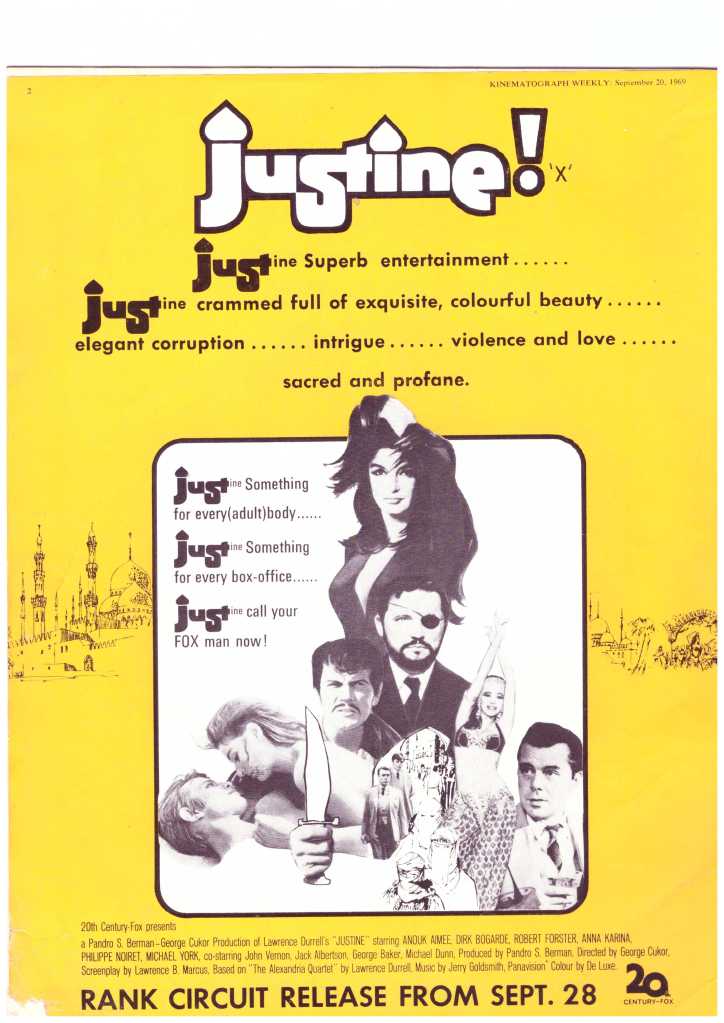
You might wonder what possessed the studio to invest $7.87 million in George Cukor’s Justine (1969). When original director Joseph Strick threw in the towel you might have imagined the studio would do the same given the stars – Dirk Bogarde, Anouk Aimee and Michael York – were hardly standout box office figures. Loss on the U.S. rentals was $5.67 million. Staircase (1969) at least had a stellar cast – Richard Burton fresh from worldwide hit Where Eagles Dare (1968) and Rex Harrison whose Oscar-winning success in My Fair Lady (1964) appeared to grant him box office immunity. But U.S. audiences only returned $1.85 million in rentals from a budget of $6.37 million.

“Two for the Road”
Another star-laden vehicle – the Paris-set caper picture How To Steal a Million (1966) teaming Audrey Hepburn (My Fair Lady) and Peter O’Toole (Becket, 1964) – came unstuck, losing $2.08 million on a budget of $6.48 million. Hepburn was at fault again the following year, losing, oddly enough, exactly the same amount for Two for the Road with Albert Finney (Tom Jones, 1963) directed by Stanley Donen (Charade, 1963) out of a budget of $5.48 million.
Other casualties were: William Holden in The Lion (1962, $3 million loss), biopic Tender Is the Night (1962 – $2.65 million), George C. Scott as The Flim-Flam Man / One Born Every Minute (1967, also $2.65 million), Nine Hours to Rama (1963, $2.61 million), Doris Day spy comedy Caprice (1966, $2.59 million), Gregory Peck in Cold War thriller The Chairman / The Most Dangerous Man in the World (1969, $2.41 million), James Stewart in desert drama The Flight of the Phoenix (1965 – $2.33 million) and James Coburn and Lee Remick in Hard Contract (1969 – $2.32 million).
Even John Wayne stiffed. Civil War western The Undefeated (1969), on a budget of $7.1 million only brought in $4.5 million in rentals. Charlton Heston/Rex Harrison roadshow The Agony and the Ecstasy (1965), on a similar budget, lost more – $3.17 million. Michael Caine/Anthony Quinn drama The Magus (1968) barely brought in $1 million from a $3.77 million budget.
Unexpected winners included Valley of the Dolls (1967 – $15.31 million profit), Planet of the Apes (1968 – $9.2 million), Those Magnificent Men in Their Flying Machines (1965 – $7.5 million), The Boston Strangler (1968 – $3.9 million), Our Man Flint (1966 – $3.87 million) – though only $1.2 million in the black for sequel In Like Flint (1967) – and The Blue Max (1966 – $3.4 million).
Frank Sinatra proved a safe bet. The Detective (1968) turned a profit at the U.S. ticket wickets of just over £2 million and Von Ryan’s Express (1965) just under that figure although Tony Rome (1967) registered a small loss. Raquel Welch just about squeaked home – $1 million profit for Bandolero (1968), $380,000 profit for Fantastic Voyage (1966) balanced out by $420,000 loss for 100 Rifles (1969).
Of course, there was always the possibility that foreign revenues would save the day. And although occasionally the likes of United Artists’ The Magnificent Seven (1960) on initial release had earned considerably more in the overseas market than in the U.S., that was, unfortunately, rarely the case. There was no guarantee that certain genres – comedies, musicals – would travel. Hollywood studios generally received a smaller percentage from movies released abroad while facing increases in distribution costs.
Overseas business was viewed as icing on the cake rather than an essential element of the box office. There was also the problem that foreign cinema owners could check out U.S. box office figures in advance – unlike now there was no instant global release system – and should a movie falter on its U.S. debut would assume they were going to be renting a flop, therefore reduce marketing back-up and renegotiate terms.
SOURCE: Aubrey Solomon, Twentieth Century Fox, A Corporate and Financial History (The Scarecrow Press, 2002) pp 228-231, 252-256.

 The Magnificent 60s