The Trial of the Chicago 7 (2020) ****

Oscars voters will be sharpening their pencils for Aaron Sorkin’s political powerhouse. Comic Sacha Baron Cohen is a revelation as yippie Abbie Hoffman while Yahya Abdul-Matten II as Bobby Seale, Mark Rylance as the defense attorney and Frank Langella as the  judge will surely be in contention. Eddie Redmayne as Tom Hayden (Jane Fonda’s squeeze and later a Congressman) might also be favored. I guess Sorkin’s name will be in the hat but once again his writing and directorial skills clash.

The trial was a repercussion of the riots in Chicago surrounding the Democratic Convention in 1968. At the outset I was baffled and confused by the plethora of personalities and coming to grips with the American legal system but once the courtroom drama got underway I was hooked. The battle between a judge and defendants who refuse to recognize his authority plays out like Perry Mason at warp speed (though with the regulatory old-school last-minute intervention).   

But I would urge you to see this on the big screen because at any one time so many characters litter the frame they will be too compressed on television and in part because the two most stunning scenes have far greater impact when the action is blown up.

As the various civil rights groups descended on Chicago to stage a protest, the police and National Guard expected a riot – and proceeded to start one. A few years later, the government produced trumped-up charges against the various leaders, including Black Panther Bobby Seale who just happened to be in the vicinity. We are well used, unfortunately, to police brutality and here it is no less brutal. The police have also infiltrated the various groups so can provide doctored evidence of intent. But what is most shocking is the way political will subverts the law. Even grizzled legal eagles are astonished by the judge’s antics especially when Bobby Seale is chained and gagged in the courtroom after one too many outbursts. On the other hand, the banter between the accused and the judge, while breaking  protocol, is hilarious; Hoffman and sidekick Jerry Rubin often beating the judge to the punch which a cry of “overruled.”

As a young student at the time I was aghast at television images of the Vietnam War, had seen the Black Panther salute at the 1972 Olympics, and read some Eldridge Cleaver and James Baldwin, but was only vaguely familiar with the personalities behind opposition to the Vietnam War. Here, these personalities are presented mostly in confrontation with the exception of Jerry Rubin, who romances what turns out to be a cop. Wit of both the humorous and intelligent kind are given ample display, sometimes both together. It could have degenerated into a battle between Clever and Cleverer (Hoffman and Hayden, take your pick as to which was which), but that is only part of the wider picture.

While Sorkin’s brilliant script captures the quirks of both the personalities and the legal system, Sorkin the director gets in the way, insisting on incorporating black-and-white newsreel footage and inserting a stand-up comedy routine by Abbie Hoffman. And he definitely pulls his punches regarding Hayden ‘s contribution to the riots.

The best scene is the duel between Redmayne and Rylance in a dummy run for the former taking the witness stand. But the cinematic standout is the ending. Although echoing “Captain, My Captain” in Dead Poets Society (1989) it carries a far deeper meaning, setting on collision course two tenets of American culture, respect  for the court and regard for those who have fallen on field of battle.

My only real carp is why this was a film at all when there is clearly ample material for a television series, a four- or six-parter along the lines of Mrs America (2020). I’ll probably watch this again when it reaches television but I will be surprised if it has the same impact as seeing it at my local cinema, where, by the way, I paid for admission. Either way, don’t miss it. It starts on Netflix Oct 16.

Return of the Seven (1966)***

Given United Artists’ predilection for speedy sequels – the Bond films, the Pink Panthers, the Beatles movies – Return of the Seven took an age to get out of the blocks. Production was in part held up because of abortive plans to make a Broadway musical with Brynner reprising his leading role. At one point it look edas if the sequel would again pair Brynner and McQueen. And at another point it was set as a 1965 shoot with first Larry Cohen (creator of the Branded television series) and then Walter Grauman (633 Squadron, 1964) in the director’s chair.

Production finally got underway in February 1966 in Spain with Burt Kennedy (The Rounders, 1965) in command. But where the budgets for the Bond films increased with every outing, this was on a reduced budget compared to the original. The film was less of a sequel than a remake (even to the extent of re-using Bernstein’s score). The three survivors recruit four others to save a village from a ruthless Mexican rancher. Brynner returned with Robert Fuller from television’s Laramie filling McQueen’s shoes and Spanish actor Julian Mateos making his Hollywood debut standing in for Buchholz.

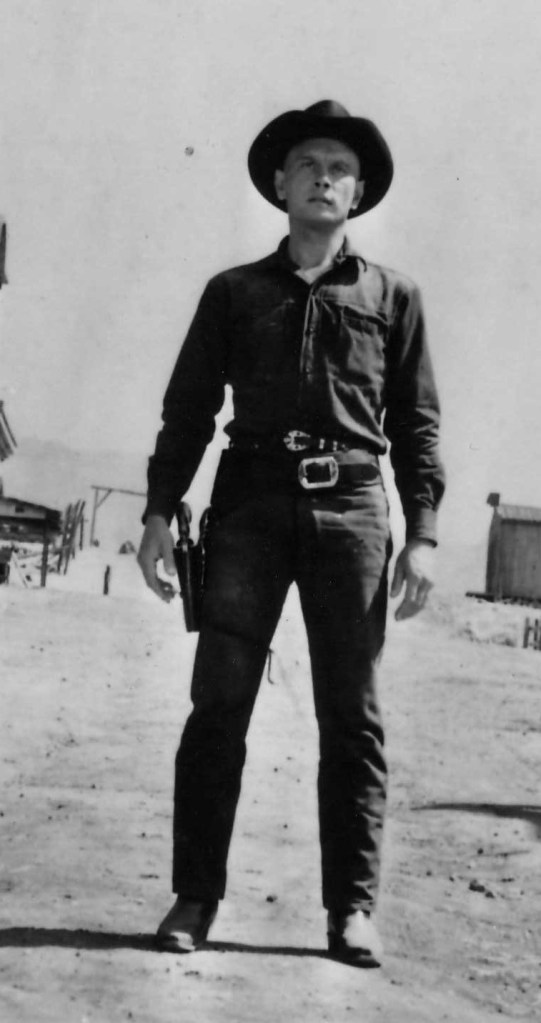
Lone gun – Brynner was the only member of the original cast who returned for the sequel.

A decent attempt was made to recapture the magic of the original by casting unknowns who could have a shot at stardom. Jordan Christopher was the pick of the wannabees. Although he had only The Fat Spy (1966) under his belt, he would go on to star alongside Hollywood veteran Jennifer Jones in offbeat drama Angel, Angel Down We Go (1969). While Christopher had the looks Warren Oates (The Shooting, 1966) was half a decade away from top billing although already his off-beat screen charisma brought an unpredictability to the characters he played. Making up the numbers were Claude Akins from television’s Rawhide and veteran Portuguese actor Virgilio Texiera, the former filling the gap left by the broody Charles Bronson, the latter as suave as Robert Vaughn. Perhaps as intriguing for western aficionados was Fernando Rey and Emilio Hernandez who would both become famous screen bad guys, Rey as the drugs kingpin in The French Connection (1971) and Hernandez as Mapache in Sam Peckinpah’s The Wild Bunch (1969).

Certainly, if cast was anything to go by, the ingredients were there and Kennedy would go on to a distinguished career in the genre (The War Wagon, 1967, Support Your Local Sheriff, 1969). But where The Magnificent Seven was a trend-setter, the sequel had nothing new to say. The market in mercenaries had been taken over by The Professionals (1966) and the western revival had been reshaped by movies as varied as Shenandoah (1965), Major Dundee (1965) and Nevada Smith (1966) – the “Dollars” films not released in America until 1967. Part of the problem, of course, was that critics who had buried the original had revised their opinions and were now gunning for something that might trample on that august legend.

But it’s far from suffering from, as Variety maintained, a cliche-ridden script and limp direction. The scenes with the villagers, herded away like slaves, are far grimmer than before and there are some interesting nods to the original. Where Brynner and McQueen rode shotgun on a hearse, here Fuller (the McQueen) character is asked if he will pay for a funeral. While none of the introductions can match The Magnificent Seven, this is altogether a more down-and-dirty world, a country of ruins and cockfighting. The quality of the recruits is lower, Brynner trawling the prison. Honor is in short supply, too. But in chopping pretty much half an hour off the running time, it moves along a fair clip.

Brynner is the standout and the sight of the man in black reaching for his gun still commands the screen. Neither has he lost this humanity and the sense of loss at having left the village is apparent. And while Emilio Hernandez cannot match the panache of Eli Wallach, you cannot help but admire his misplaced sense of honor. The battle scenes are well handled without reaching Sturges’ peak. Had the other actors stepped up to the plate, or if Kennedy had been accorded a bigger budget, it might have been a different story. However, most sequels suffer if all you do is compare them to the original. If you come at this without much reference to its predecessor it still stands up as a good Saturday afternoon matinee.

Return of the Seven is available as a stand-alone DVD but for little more than that cost you might as well get the whole set. Note: here it is called The Return of the Magnificent Seven.

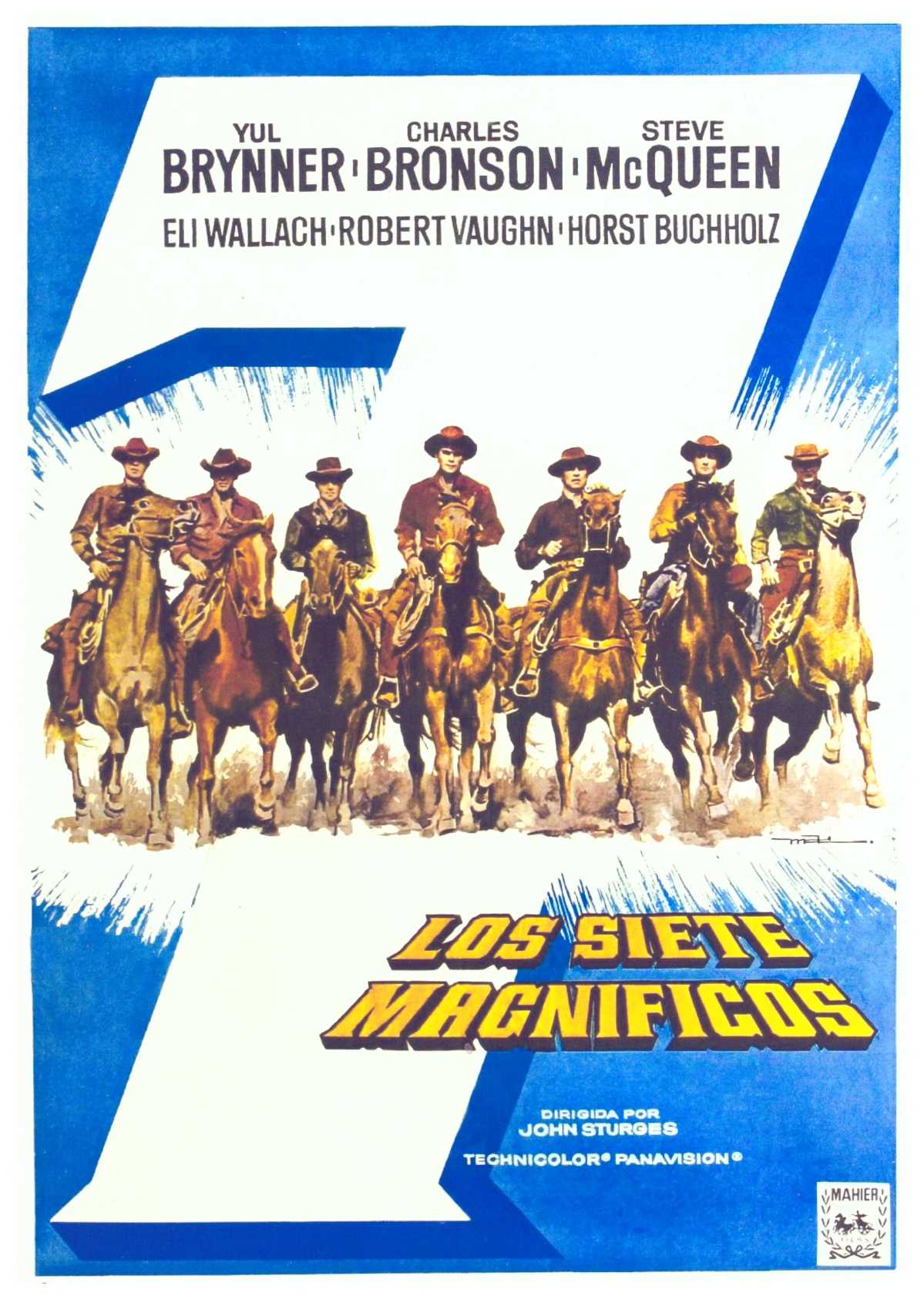
Pressbook – Selling The Magnificent Seven (1960)

Employing the marketing tools provided by the Pressbook were the main methods a cinema had of selling a movie to the public. In the case of The Magnificent Seven, the Pressbook comprised twelve A3 pages. As well as a range of advertisements, this contained plot summary, press releases, lobby cards, stills and material that could be marketed to television (a one-minute highlights spot and two 20-second ads) and radio (a double-sided record including jingle and interviews with Yul Brynner and Steve McQueen).

While the posters on display outside a theater would be in color, those for use as advertisements in a local newspaper would be in black-and-white. Different typefaces and letter shading were used to ensure advertisements were as arresting when seen in black-and-white as well as color. Unlike today when one image and tagline is used to sell a movie, in the 1960s a studio would produce several different posters/advertisements with a variety of taglines.

This Pressbook came with a bundle of promotional ideas, many revolving around the film’s titular number. Cinema owners were encouraged to develop tie-ups with local retailers that might include the gimmick of a seven-day, seven-hour or seven-cent sale or one that ran from 7am to 7pm. Or in conjunction with the local law enforcement agency, come up with “The Magnificent Seven rules for Safety” or, with travel agencies, a “Magnificent Seven-day Holiday,” Mexico the obvious location. Radio station disc jockeys might come up with the seven best tunes and play the rousing Elmer Bernstein theme music. Stores were encouraged to put up displays of the record sleeves. There was even potential for a fashion link with department stores after adverts had appeared in Esquire and Gentleman’s Quarterly of Eli Wallach modeling menswear.

Publicists did not let the facts get in the way of a good story. Horst Buchholz apparently spoke seven languages. According to the Pressbook it was John Sturges who taught the actors how to draw. The Pressbook also gave the misleading impression that it was Brynner who was in love with the female lead Rosenda Monteros. Another article commented on the difficulties Brynner had on rolling a cigarette one-handed – even though he smoked cigars throughout.

The main tagline was: “They were seven…and they fought like seven hundred.” And there were endless variations of this. Sometimes “they fought like seven hundred” was sufficient. Other times this idea was expanded: “seven notches above the ordinary,” and “the matchless seven.” On occasion, there was tagline that summed up the entire picture: “the renegades among them came for gold…the firebrands came just to taste the excitement…and all seven came to wipe away the past.” In this same advert, each of the gunfighters was defined – Brynner “the leader,” McQueen “the deadly one,” Buchholz “the young one,” Bronson “the strong one,” Vaughn “the vengeful one,” Dexter, “the greedy one,” and Coburn “the rugged one.”

Some exhibitors came up with their own taglines and cut-and-paste images to create their own adverts. In San Bernardino audiences were wooed by “Savage hordes of kill-crazed bandits (hungry for women, gold and blood lust) against the flaming guns of the Seven.” Elsewhere, moviegoers were expected to respond to “a message picture handsomely mounted.” Among the self-made posters was one with women in a provocative pose, something that did not occur in the picture.

Wall St Journal on “The Making of The Magnificent Seven”

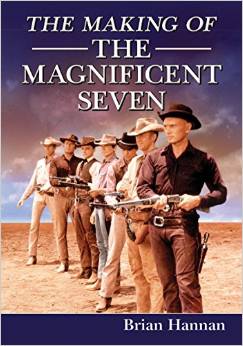
In 2015 I published my first major book about the movies – The Making of The Magnificent Seven – and I was lucky enough to receive a review in the Wall St Journal. So I thought I would reprint it below since this month marks the 60th anniversary of the film opening. In recognition of the anniversary the publishers have made substantial price reductions for the print and Kindle version – the latter being less than half the original cover price.

Wall St Journal

These Guns for Hire

Heroism, the film subversively suggests, can sometimes lie in settling down to domestic life.

By 

DAVID A. PRICE

Oct. 2, 2015 4:14 p.m. ET

1 COMMENTS

‘The Magnificent Seven,” when it appeared in theaters in 1960, would have seemed an unlikely addition to the canon of classic films. Its initial release was a flop at the box office, and the reviews were mixed. Even today, film writers commonly place it in the second tier of westerns, beneath “The Searchers,” “High Noon” and a few others.

All guns blazing – The Magnificent Seven launch an empire – three sequels, a remake and a television series.

But if it’s only a runner-up among critics, the story of tough but emotionally vulnerable gunmen coming to the aid of a poor Mexican village is within the top ranks of another canon—what might be called the people’s canon. The film’s popularity grew over time, both in America and abroad. It earned more at the box office in its second four years than in its first three; when the BBC showed it on British television for the first time in 1974, it drew an estimated 40% of the population. “If not the most critically-admired western of all time,” Brian Hannan notes in his account of the making of the film, “The Magnificent Seven can certainly lay claim to being the most loved.”

The film was a pioneering attempt by an American studio to remake a foreign feature. Its source was Akira Kurosawa’s 1954 film “Seven Samurai,” which the actor Yul Brynner had learned about from his friend Anthony Quinn. Brynner bought the rights with the intention of directing rather than starring.

In the volatile development process that followed, the film ended up not in the hands of Brynner but in those of John Sturges, who had started his directing career making short films for the Army in World War II. The Vladivostok-born Brynner would play the lead gunman. He would be joined by, among others, television actors Steve McQueen, Charles Bronson,James Coburn and Robert Vaughn, for whom the film would be their big break.

The composer of the film’s music, Elmer Bernstein, was the director’s third choice, possibly his fourth. But Bernstein’s hiring proved a stroke of luck: His stirring symphonic score, now practically synonymous with the Old West, would be the film’s unseen co-star.

The screenplay by William Roberts and Walter Newman—the latter took his name off the film over a dispute about credits—was broadly similar to that of Kurosawa’s original. In both films, a farm village impoverished by the raids of a bandit gang sends a few men off in search of deliverance. The men meet a master fighter who agrees to help and enlists a fighting force. When the recruits arrive at the village to drive the gang away, both the bandits and the farmers themselves prove to be more formidable obstacles to the gunmen than expected.

Yet Roberts and Newman seemingly defied the laws of physics, reducing the 31/2 hours of Kurosawa’s film to two hours while making “The Magnificent Seven” richer in both incident and characterization. The supporting gunmen have distinct, vividly drawn personalities and motives. In “The Magnificent Seven,” the chief bandit—who is all but faceless in “Seven Samurai”—has an ignoble nobility that makes him almost sympathetic. Indeed, hardly any of the characters in the film are ciphers, not even the dunce who refuses to let Coburn’s gunman and knife-thrower walk away from a duel. One of the useful contributions of Mr. Hannan’s account is to show in detail just how the writers—with, among other things, efficient storytelling devices and shrewd shifts in emphasis—accomplished what they did.

“The Magnificent Seven” is also, to a surprising extent, a film of ideas. Although its precise period is never specified, it ties the gunmen’s limited work prospects to a force that will never stop bearing down on them—the encroachment of civilization. Also notable is the film’s subversion of its own foundations with its suggestion that heroism can lie in settling down to domestic life. For several of the gunmen, the possibility exerts an attraction that they let slip in unguarded moments. The question is whether, as Mr. Hannan puts it, “they have come too far down the road to change.”

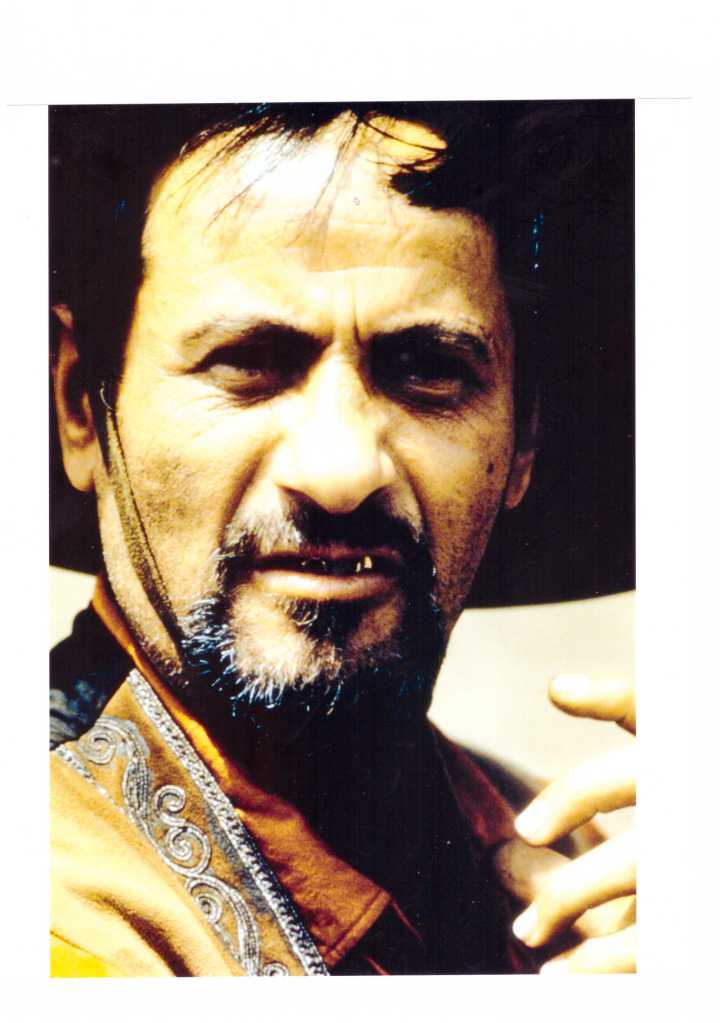
Bandit lead Eli Wallach.

The filmmakers, Mr. Hannan tells us, had an unwanted collaborator in the Mexican government. Perturbed by Hollywood’s earlier unfavorable portrayals of the country, the Mexican film bureau demanded and got significant sway over the script as a condition of shooting the film in Mexico. Among the bureau’s requirements was that Mexicans would not go in search of American fighters, an implication of Mexican inferiority. (Modern academic commentary on the film has suggested that the filmmakers set “The Magnificent Seven” in Mexico as a positive metaphor for U.S. intervention overseas during the Cold War; the more mundane truth is that Brynner had decided not to work in the U.S. for tax reasons.)

As Mr. Hannan recounts, screenwriter Roberts found a clever solution to Mexico’s demand: The farmers would go not to find mercenaries, American or otherwise, but to buy guns with which to defend themselves. While looking for guns in a border town, they would encounter Brynner’s character, who would introduce the idea of hiring men, telling them that “nowadays” gunmen are “cheaper than guns.” The shift gave Roberts an unexpected chance to strike the film’s thematic note of societal change and the gunmen’s struggles with it.

Mr. Hannan’s research for “The Making of the Magnificent Seven” is impressive. Although he apparently spoke to only one of the principals (most are dead), he makes the most of archival material. If anything, he sometimes goes over the line from authoritative to exhaustive. But on the whole, it’s a story well told.

As it happens, Hollywood is remaking the movie with Denzel Washington and Chris Prattamong its stars. In an ideal world, the remake, like the original, would be a film that parents can watch with their teen and preteen children—while also seeing them absorb lessons deeper than the “believe in yourself” of today’s standard fare. But as “The Magnificent Seven” tells us, it’s not an ideal world.

—Mr. Price is the author of “The Pixar Touch: The Making of a Company.”

The Magnificent Seven (1960) *****

For an action-packed western, The Magnificent Seven begins with a piece of such subtlety that you probably won’t notice it. The credits appear over what looks like a tableau – mountains in the background, ricks of corn in the foreground. After a minute-and-a-half, the tableau comes to life, a tiny figure walking out from behind a corn stack and a few seconds later tiny horsemen – the Mexican bandits about to terrorise the village – enter  from the opposite side of the frame. This is a far more subtle picture than generally given credit for. Although the protagonists often verbalize their intentions, it is the visual that gives away hidden emotions. Charles Bronson hands a child a whistle, Steve McQueen looks wistfully at women doing laundry by a stream, Robert Vaughn braces his back against a wall to avoid combat, young villager Rosenda Monteros displays her true feelings for Horst Buchholz by soundlessly dumping food on his plate.

It is a violent film that questions the nature of violence. Whether being a gunman is fulfilling or detrimental. It is a film about standing up or giving in. Those new to bearing arms take the optimistic view, the villagers at first exhilarated by being able to tackle the invaders before falling prey to age-old fears, the young Mexican played by Buchholz idolizing the gunfighters. But the gunfighters themselves are a disillusioned bunch. Their calling has brought them neither wealth, roots nor satisfaction. When we first encounter Yul Brynner and Steve McQueen, they are drifters, and impoverished at that. Charles Bronson chops logs to pay for his breakfast, Robert Vaughn is on the run without the wherewithal to pay for his room. Brad Dexter is the stereotypical cowboy, looking for one last big score. Only James Coburn appears self-contained. All are so poor they are willing to take on a job lasting six weeks for a paltry twenty bucks.

They might have a code of honour – but then again they might not. Mexican bandit chief Eli Wallach sees them as no different to himself. The villagers fear them as much as the bandits, to the extent of hiding away their women.  Of the seven, Brynner and Coburn are the only two willing to stick to the letter of their contract. The climax of the film might appear to be the battle royal at the end, but, in fact, the emotional highpoint has taken place some time earlier when the hyped-up Buchholz is brought down to earth by the gunfighters’ tally of their achievements – no wives, no children, no homes. The village, a nothing place in the middle of nowhere, has become more than a job, it has turned into a fantasy, a place where Bronson is adopted by children, where Buchholz is seduced into the life he abhors, and where the gunmen will give up their own food to the starving villagers.

The picture is surprisingly full of twists and turns.  The bandit leader is far more affable – a benevolent dictator – than such a role normally demands. And he is pretty savvy, so that at points the movie becomes a game of cat-and-mouse. The villagers go from despising the gunmen to hailing them as heroes to betraying them. The seven trap the bandits only to be trapped in turn.

And it is all held together with terrific verve. The tracking camera had never before been used with such skill in a western. There are two brilliantly choreographed knock-‘em-dead battles, added to which are several outstanding sequences. The 20-minutes recruitment section contains three such scenes. Confronted by an act of racism, Brynner and McQueen team up to drive a hearse taking a dead Native American to a graveyard, their sole reward a few swigs of whisky. Then there is the initial dismissal of the callow Buchholz who cannot draw his gun before Brynner has clapped his hands. And there is the knife-throwing expertise of  James Coburn.

While the hiring of the others – Harry (Brad Dexter), Bernardo (Charles Bronson) and Lee (Robert Vaughn) – is more prosaic, time is taken to establish their characters. Most movies do not waste time introducing secondary characters, but in taking all the time in the world Sturges gives the audience investment in these men. Courtesy of their actions, Chris, Vin and Britt have nothing to prove to the moviegoer, Harry is set up as the greedy one. Young Chico is most likely to get his head blown off. But that still leaves mystery about the shifty Lee and the inscrutable Bernardo.

Although roughly sticking to the source material, Akira Kurosawa’s Seven Samurai (1954), The Magnificent Seven lacked its epic running time of three-and-half-hours. Cutting the film back to a trimmer two hours created a western with its own rules.  Yul Brynner dressed all in black, chomping on a cigar, barking orders, strode around as if he owned the place. But at the same time displayed the world weariness of his profession.  McQueen brought a new kind of persona to the screen. Coburn’s screen charisma was in its early stages but his easy lope and self-assurance stood out. Bronson demonstrated a taciturnity that could have spelled the end of a career never mind the start of one. Buchholz and Robert Vaughn had the hardest parts. The former had to bridge the gap between immaturity and responsibility and to shoulder the picture’s sole romance. The latter was on the edge of a nervous breakdown.

The Magnificent Seven was the link between the classic westerns of John Ford and Howard Hawks and the more violent offspring of Sergio Leone and Sam Peckinpah. In previous westerns, cowboys raced to rescue for love, revenge or out of a sense of duty, never for anything as shabby as money. But this was a more realistic example of the genre and a study of the type of man who ends up as a mercenary. Civilization has  driven mavericks down to the border. The past has caught up with them.  Perhaps all the future holds is the prospect of one last stand.

At the time few recognized the terrific job director John Sturges had done in marrying action with the psychological and the philosophical. The only Oscar nod was for Elmer Bernstein’s bracing score. Sturges had become something of a western specialist. Six of his last ten films had been westerns. These included modern western Bad Day at Black Rock (1955) with Spencer Tracy, Gunfight at the O.K. Corral (1957) with Burt Lancaster and Kirk Douglas and Last Train from Gun Hill (1959) with Douglas again. But this was without doubt his masterpiece. He moved the camera with aplomb, he allowed time for characters to develop, he built up the tension, and he handled the three big action scenes with the skill of a proven battle master. Although the stand-offs against the Mexicans tend to hog the action praise, the hearse sequence deserves equal attention. For a start it is hell of a slow. The horse is going, understandably, at a funereal pace. And the hearse is headed uphill so we have no idea what lies ahead. In terms of structure and execution it is beautifully handled.

This month marks the 60th anniversary of the release of the film. It is supposed to be available on Amazon Prime. But if not there are no shortage of DVD options. You might also like to know that I wrote a book about the making of the film which is available on Kindle and Amazon.

Five Golden Dragons (1967) ***

Producer Harry Alan Towers, himself something of a legend, had put together a quite superb cast – rising Eurostar Klaus Kinski (A Bullet for the General, 1967), Hollywood veterans Robert Cummings (Dial M for Murder, 1954), George Raft (Scarface, 1932), Dan Duryea (Black Bart, 1948) and Brian Donlevy (The Great McGinty, 1940) plus British horrormeister Christopher Lee and Rupert Davies (television’s Maigret). Throw in Margaret Lee (Secret Agent, Super Dragon, 1966) and Austrians Maria Perschy (Kiss, Kiss, Kill, Kill, 1966) and  Maria Rohm (Venus in Furs, 1969).

And all in aid of an enjoyable thriller set in Hong Kong that dances between genuine danger and spoof. I mean, what can you make of a chase involving rickshaws? Or a race over bobbing houseboats parked in a harbor? There’s a Shakespeare-quoting cop (Davies) whose sidekick often out-quotes him. And there’s British-born Margaret Lee, a cult figure in Italian circles, belting out the title song and just for the hell of it Japanese actress Yukari Ito in a cameo as a nightclub singer.

A newly arrived businessman is chucked off the top of a building by an associate of Kinski  but not before leaving a note that falls into the hands of the police. The note says, “Five Golden Dragons” and is addressed to Cummings’ character. No reason is ever given for Cummings involvement. No matter. He is soon involved via another route after falling for two beautiful sisters, one of whom (Perschy) turns up dead but also not before springing a bit more of the plot which is that the titular dragons are the heads of an evil syndicate that is meeting for the first time in Hong Kong.

In a nod at the spy genre, there are secret chambers opened by secret levers. There are double-crosses, chases, confrontations, and lots of sunglass removal. Apart from breaks here and there for a song or two, director Jeremy Summers (Ferry Across the Mersey, 1964) keeps the whole enterprise zipping along, even if he is stuck with Cummings. In truth, Cummings is a bit of a liability, acting-wise. While the rest of the cast takes the film seriously, he acts as if he’s a Bob Hope throwback, cracking wisecracks when confronted with danger or beautiful women, or, in fact, most of the time, which would be fine if he wasn’t a couple of decades too old (he was 57) to carry off the part of a playboy and if the jokes were funny. 

Towers (under the pseudonym Peter Welbeck responsible for the screenplay, loosely based on an Edgar Wallace story) was a maverick but prolific British producer who would graduate to the likes of Call of the Wild (1972) with Charlton Heston but at this point was churning out exotic thrillers (The Face of Fu Manchu, 1965) and mysteries (Ten Little Indians, 1965) and had a good eye for what made a movie tick. This one ticks along quite nicely never mind the bonus of a sinister George Raft and the likes of Margaret Lee and Maria Rohm (Towers’ wife).

Some Like it Hot (1959) *****

I caught this at my local arthouse a few days ago and it made me realise that big screen pristine prints have a way of making a movie pop and reminding you that movies were not meant for the constrictions of a DVD screen. It’s a trope to say everything is bigger on the big screen, but a classic like this is practically bursting at the seams, Jack Lemmon fizzes with energy, and you cannot take your eyes off Marilyn Monroe, nor any part of her, given her skin-tight (and Oscar-winning) outfits that must have given the censor conniptions.

Not surprisingly, there’s a lot more detail to notice, but what is revelatory is how detailed that detail sometimes is. There’s a tiny scene at the beginning of George Raft as gangster Spats closing a steel folding concertina door and you can see he is actually trying to make it close not pretending to do so. Attention to detail is what makes this picture sing. And there’s nothing more carefully constructed than the story. Sure, you can easily come up with some kind of mumbo-jumbo to make two guys cross-dress. But how to make it believable rather than pantomime? Easy enough to make them look like women and sound like women – but how to make them emotionally convincing? And to shift the story away from the obvious – fear of being found out.

Monroe earned over $800,000. The film cost $2.8 million and although worldwide the film took in nearly $13 million it only brought in $616,000 profit after profit percentages, producer fees, distribution costs and marketing.

Maybe you’re not familiar with the story so here’s the nutshell – two musicians having witnessed the St Valentine’s Day Massacre in 1929 dress up as women and hide out in an all-female band headed for Miami. There, Tony Curtis falls for Marilyn Monroe while Jack Lemmon finds himself/herself an object of lust from millionaire Joe E. Brown. Inevitably, they are rumbled, and they have to make the decision to keep on running or stay put.

The musicians hide out in an all-female band because if they try and hide anywhere else they will be easily caught. The female personalities they adopt are totally at odds with their male characteristics. Curtis, the womanising chancer, willing to risk everything on a horse, turns into a soft-spoken rather snooty woman lending a sympathetic ear to loser-in-love Monroe. And while admittedly this is originally for ulterior motives, it initiates a complete character change. Being a woman liberates Lemmon from his over-cautious male nature and he/she has a blast.  Feminists turn away now, but Lemmon get so into his new identity that he appreciates being wooed and spoiled and shrieks with pure joy at the prospect of getting married. Curtis, meanwhile, has a third identity to play to fulfil Monroe’s fantasy of falling for a harmless intellectual be-spectacled playboy complete with Cary Grant mannerisms.

The movie was filmed in black-and-white because the make-up on Curtis and Lemmon looked awful in color.

And there are two versions of Monroe on show, the sexy showgirl and the sweet and tender lass. This is the final twist. In every Monroe movie under the sun she is the object of desire. Here, she is the one who has to make the running. In the end, everyone has to give up their fantasies and settle for reality – except for Joe E. Brown who does not care if he is marrying a man, “nobody’s perfect,” he snaps in one of the greatest last lines. So it’s a master class in character development.

But it’s also as funny as hell. And that’s without going down the route of easy laughs. The script – developed over a year by director Billy Wilder (Double Indemnity, 1944) and co-conspirator I.A.L. Diamond –  is a cracker and visual gags abound. There’s plenty of humour from the gender switch – Monroe cosying up to Ms Lemmon, Lemmon having his/her ass pinched, an over-confident bellboy making a pitch for Ms Curtis. And while Raft’s henchmen are straight from Stereotype Central, director Billy Wilder pays homage to the gangster greats – the idea for a minor character with a penchant for flipping coins lifted form a trick Raft himself used in Scarface (1931), the gangland supremo is Little Bonaparte instead of Little Caesar (1931), and Raft comes close to apeing Cagney in Public Enemy (1931) when he is tempted to squash a grapefruit into a confederate’s face..

You want exuberance, here it is in spades. Lemmon has turned the volume up to eleven, Joe E. Brown is continually on twelve, Monroe belts out a couple of great songs and if there was any limit on sexiness she breaks those barriers. And yet it is counterbalanced by Curtis’s myopic millionaire and the little-girl-lost Monroe. The kissing scene between Curtis and Monroe is so finely nuanced that you cannot help but be swept up in its innocence.

Curtis, who had just emerged from the Universal beefcake cocoon to gain more peer acceptance after his Oscar-nominated turn in The Defiant Ones (1958), did not quite gain the credit he deserved for his triple role, but Lemmon, who was Oscar-nominated, saw his career take off while Monroe, with a percentage of the gross, made a killing.

Of course, even such a genius as Wilder didn’t get everything right first time out. The original cast was meant to be Jerry Lewis, Frank Sinatra and Mitzi Gaynor. Go figure!

Catch it on the big screen: OCT 2-4 Gilson Cafe & Cinema, Winsted, CT, USA; OCT 6 Broadway Center, Salt Lake City, USA; OCT 13 Odeon St Michel, Paris, France; OCT 20 Folkbiografen, Hovmantorp, Sweden; OCT 22-NOV 18 LAB111, Amsterdam, Netherlands; OCT 25-OCT 27 CGV Apgujeong, Seoul, South Korea; and NOV 13 Astor Film Lounge, Koln, Germany. Contact distributor Park Circus on info@parkcircus.com for details of further showings.

If you’re not lucky enough to live in any of these cities, your best bet is DVD.

Discover WordPress

A daily selection of the best content published on WordPress, collected for you by humans who love to read.

The Atavist Magazine

by Brian Hannan

WordPress.com News

The latest news on WordPress.com and the WordPress community.